
Honda Motocompo
This tiny motorcycle folded its handlebars and footrests into a suitcase-like body so a Honda City could carry a second kind of adventure in its luggage bay.
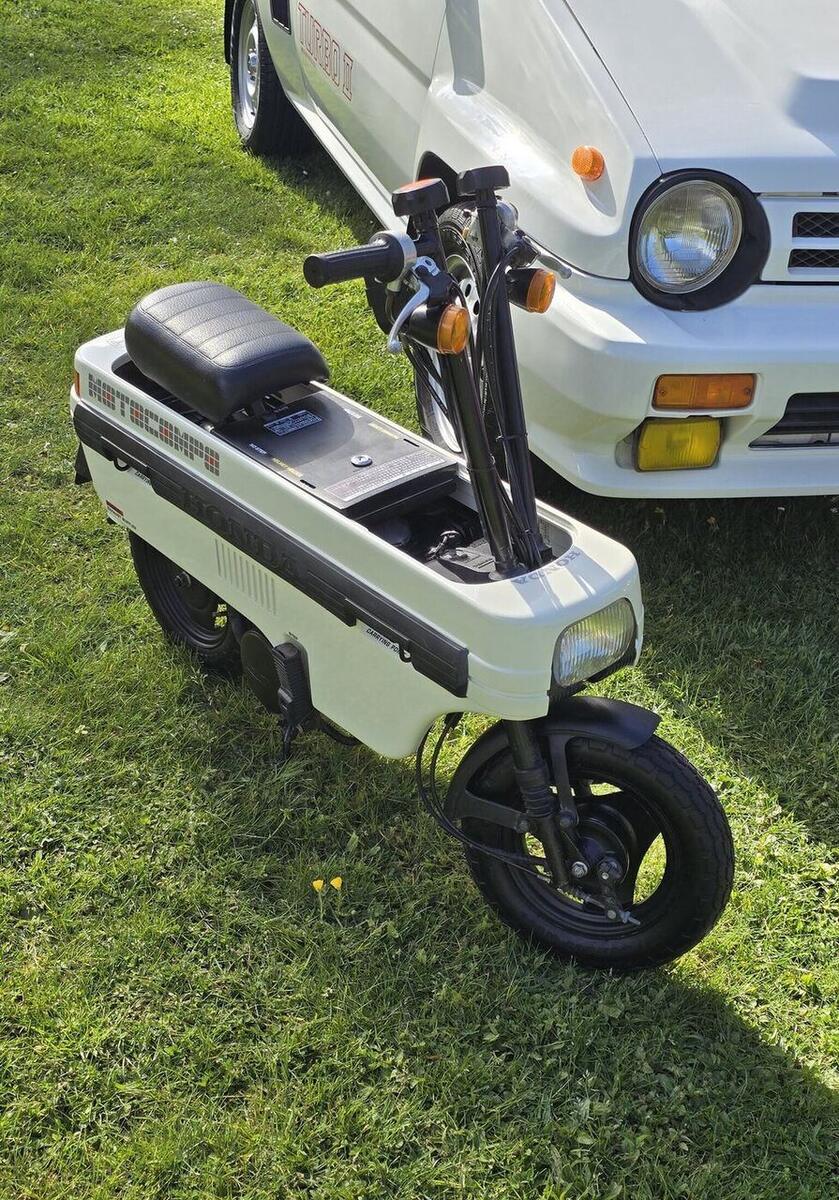
1981 Honda Motocompo cover · Calreyn88 · CC BY-SA 4.0
What did this one sell for?
Make a guess, then reveal one identity-matched completed auction result. It is a comparison point, not a price promise.
Reveal the auction result
Based on a completed sale at Iconic Motorbike Auctions, an estimated value for this vehicle is $3,750.
Why this sale: Exact 1981 Japanese-market Honda Motocompo AB12, VIN AB121050160, imported from Japan and described by the auction as appearing stock; not a later-year Motocompo, modified clone or electric Motocompacto. True mileage was unknown and the scooter was sold on a bill of sale only. Before sale it received a replacement battery, spark plugs, air filter, seat and 2024-dated tires; the fuel tank was flushed, light tank rust and an inoperative speedometer were disclosed, and a quarter-mile test ride was completed.
Auction total: $3,500 winning bid plus $250 buyer fee. Taxes, registration, title work and transport are excluded. One auction result is a reference, not an appraisal; condition, history, options, location and market timing can change value. Accepted as the newest exact-year completed primary auction result found in this bounded review. The condition, replacement parts, non-working speedometer, bill-of-sale status and buyer-fee-inclusive total materially limit comparison; this is one sale result, not an appraisal or globally latest-sale claim.
More than a set of wheels.
Honda developed the City car and Motocompo together, calling the little AB12 a new category of 'trunk bike.' Both went on sale in Japan on November 11, 1981. The motorcycle was only 1.185 meters long and weighed 42 kg dry, yet carried a street-going 49 cc two-stroke engine. Leak-control systems for fuel, oil and the battery helped it travel safely inside the City, whose luggage area included anchor nuts for an optional securing belt.
Look a little closer.
Honda planned to sell 10,000 Motocompos every month—more than the City's own 8,000-unit monthly target in the same launch release.
Photos show an example of the model or generation. The pictured vehicle’s year, equipment, or modifications can differ from the specification described here.
A car and motorcycle designed as one package
This was more than a small bike that happened to fit a car. Honda's release described the City and Motocompo as the world's first simultaneous four-wheel/two-wheel development. The City's luggage bay gained anchor nuts, while the bike gained folding controls and leak prevention. Together they proposed driving out of town, parking, and continuing on two wheels.
Source: Honda · 1981 City and Motocompo launch release ↗The folded shape was serious engineering
Folding handlebars and footrests made the sides tidy, but carrying a gasoline motorcycle also required systems that resisted leaks from the 2.2-liter fuel tank, one-liter oil supply and battery. Honda's museum preserves the mechanical basics too: a backbone frame, telescopic fork and unit-swing rear suspension around the 49 cc engine.
Source: Honda Collection Hall · Motocompo record ↗Where these facts come from
- Honda · 1981 City and Motocompo launch release
- Honda Collection Hall · Motocompo record
- Honda Global · City development story
- Honda Global · 1980s trajectory of challenges
Selected facts checked for this edition. Some source pages link to broader model families. Last reviewed October 1, 2026.