
Jaguar XJ220 production car
The production XJ220 traded its concept car's V12 and four-wheel drive for a compact racing-derived twin-turbo V6—and became faster.
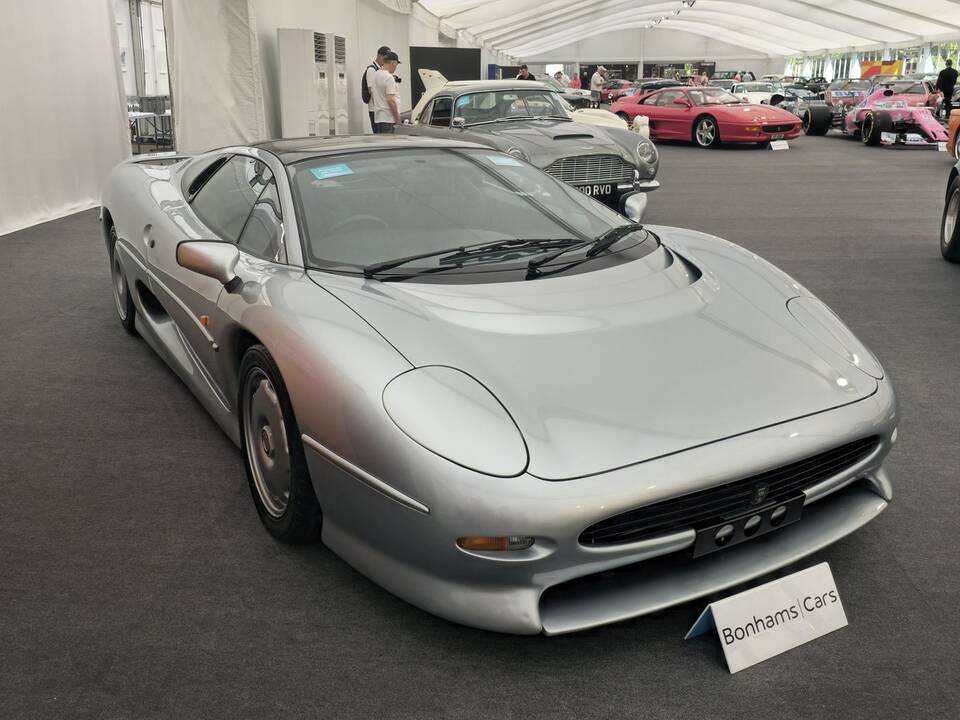
Jaguar XJ220 SAJJEAEX7AX220894 1992.jpg · Calreyn88 · CC0
Research pending
A matching completed auction sale has not been verified for this exact year, body, trim, engine, transmission and market.
Joyride shows this gap instead of substituting an asking price, unsold bid or mismatched special vehicle.
More than a set of wheels.
Chief engineer Jim Randle's volunteer 'Saturday Club' created the first XJ220 as a technology demonstrator, revealed in Birmingham in October 1988 with a V12, four-wheel drive and scissor doors. Demand prompted a production study and a JaguarSport programme with Tom Walkinshaw Racing. The 1992 road car was shorter, lighter and mechanically different: a 3.5-litre twin-turbo V6 sat behind the cabin and drove only the rear wheels. Hand-built at Bloxham, it reached about 213 mph and briefly held the production-car speed crown.
Look a little closer.
Jim Randle joked that the first central tub was designed with CAD: Cardboard Aided Design.
Photos show an example of the model or generation. The pictured vehicle’s year, equipment, or modifications can differ from the specification described here.
The concept and the production car are different machines
The 1988 concept used a 6.2-litre naturally aspirated V12, a 31:69 front/rear four-wheel-drive system and scissor doors. The 1992 production car used a 3.5-litre twin-turbo V6, rear-wheel drive and conventional doors. Both share Keith Helfet's visual idea and the XJ220 name, but specifications from one cannot be used to describe the other.
Source: Jaguar Media · 25 years of the XJ220 ↗A smaller engine helped the whole car
The compact V6 let JaguarSport shorten the wheelbase and remove the heavy four-wheel-drive system. The production shell used bonded aluminium honeycomb, while double-wishbone suspension and large AP Racing brakes were derived from competition practice. Turbocharging restored—and exceeded—the desired power without returning to the concept's larger, heavier drivetrain.
Source: Jaguar · 1992 XJ220 Press Information ↗Where these facts come from
- Jaguar Daimler Heritage Trust · 1992 XJ220
- Jaguar Media · Marking 20 years since the XJ220
- Jaguar Media · 25 years of the XJ220
- Jaguar · 1992 XJ220 Press Information
- Jaguar Daimler Heritage Trust · XJ220 development history
Selected facts checked for this edition. Some source pages link to broader model families. Last reviewed October 1, 2026.