
Volkswagen Phaeton W12
Volkswagen's 2002 flagship packed twelve cylinders into a short W shape, then paired them with all-wheel drive and air suspension. It looked restrained outside but was built almost by hand in Dresden.
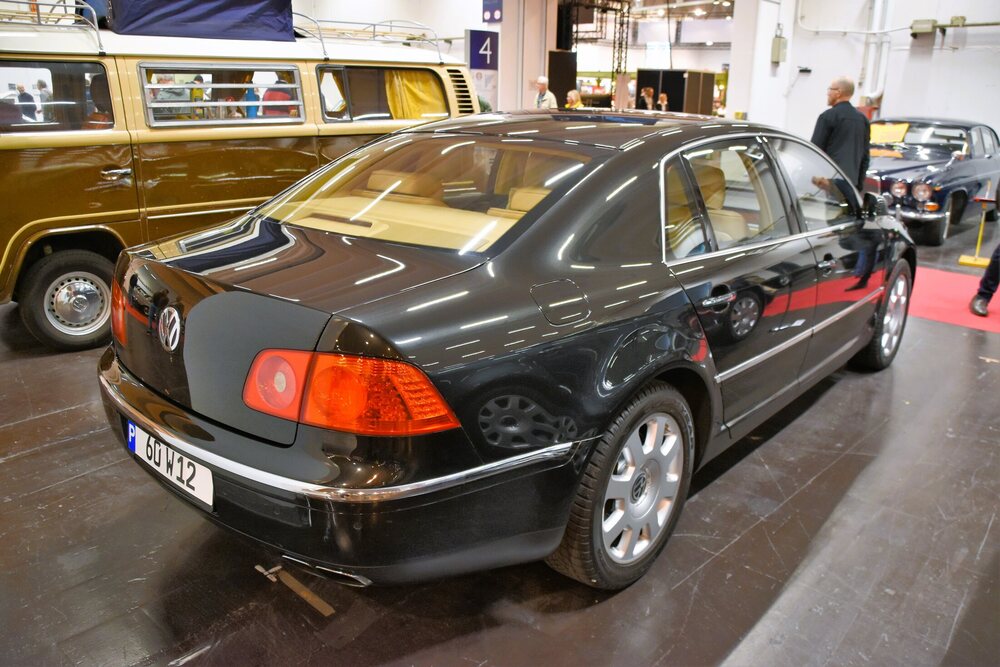
2002 Volkswagen Phaeton W12 cover · Charles from Port Chester, New York · CC BY 2.0
Research pending
A matching completed auction sale has not been verified for this exact year, body, trim, engine, transmission and market.
Joyride shows this gap instead of substituting an asking price, unsold bid or mismatched special vehicle.
More than a set of wheels.
The Phaeton was Volkswagen's move into the highest luxury-car class. Assembly began at the new Transparent Factory in Dresden, where workers completed cars in bright halls over wood floors. The launch W12 used two narrow-angle six-cylinder layouts joined into one compact twelve-cylinder engine, allowing a shorter package than a conventional V12. This profile is the original 420-PS, standard-wheelbase German W12—not the 450-PS update introduced in 2005 and not the 120-mm-longer chauffeur version.
Look a little closer.
Volkswagen says the Phaeton launched with more than 100 patents, even though its exterior was deliberately quiet and conservative.
Photos show an example of the model or generation. The pictured vehicle’s year, equipment, or modifications can differ from the specification described here.
The short twelve-cylinder idea
The W12 was built by combining two narrow-angle V6 arrangements into a W. That made the 5,998 cc engine unusually compact for twelve cylinders. The launch tune produced 309 kW (420 PS) and 550 N·m; the later 331-kW/450-PS version belongs to a different production period and is deliberately excluded here.
Source: Volkswagen Newsroom — Phaeton engine versions ↗Comfort was structural
The Phaeton's calm ride did not come only from soft seats. Volkswagen combined standard pneumatic suspension with adaptive damping and a highly torsionally rigid body, then reduced mass at the ends with aluminium for the bonnet, doors and boot lid. Those choices helped the large saloon glide without feeling loose or creaky.
Source: Volkswagen Newsroom — 20 years of the Phaeton ↗A factory meant to be seen
Volkswagen did not hide Phaeton assembly in an ordinary industrial shell. Dresden's Gläserne Manufaktur, or Transparent Factory, used glass walls, light-filled halls and wood flooring while employees completed much of the car by hand. The building turned manufacturing itself into part of the flagship's story.
Source: Volkswagen Newsroom — Phaeton (2002–2016) ↗Where these facts come from
- Volkswagen Newsroom — Phaeton vehicle data
- Volkswagen Newsroom — Phaeton engine versions
- Volkswagen Newsroom — 20 years of the Phaeton
- Volkswagen Newsroom — Phaeton (2002–2016)
Selected facts checked for this edition. Some source pages link to broader model families. Last reviewed October 1, 2026.