
Ducati 750 GT
Ducati’s first road-going twin placed two cylinders in an L shape and opened a new chapter beyond the company’s smaller single-cylinder machines.
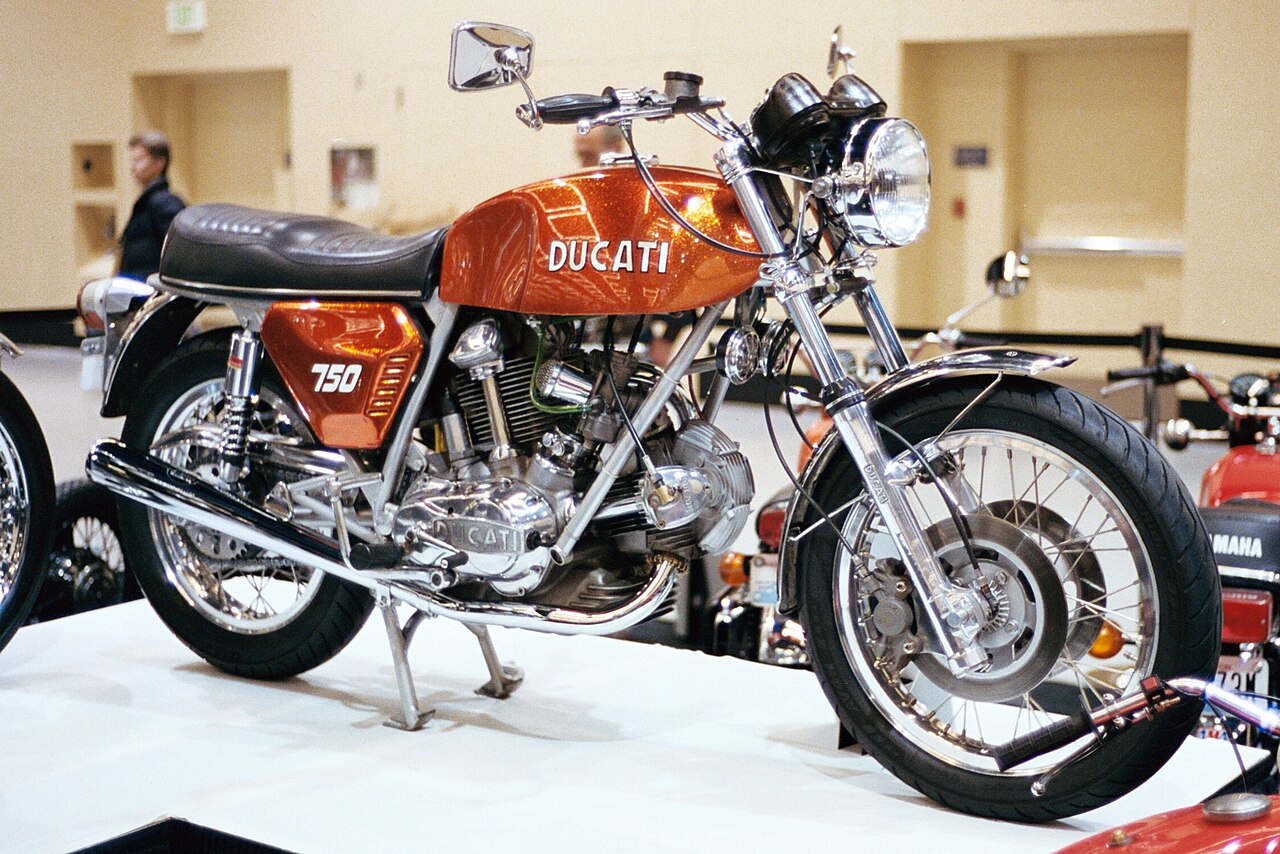
1972 Ducati GT 750 right.JPG · Dennis Bratland · CC BY-SA 3.0
Research pending
A matching completed auction sale has not been verified for this exact year, body, trim, engine, transmission and market.
Joyride shows this gap instead of substituting an asking price, unsold bid or mismatched special vehicle.
More than a set of wheels.
The 750 GT entered production in 1971 as large, powerful motorcycles were reshaping the European market. Fabio Taglioni designed its new twin-cylinder engine. Ducati then developed a distinct racing derivative for Imola in 1972; that success helped establish the road-based racing identity that would become central to the brand.
Look a little closer.
The original production GT was started with a kick pedal, even though its engine displaced nearly three-quarters of a litre.
Photos show an example of the model or generation. The pictured vehicle’s year, equipment, or modifications can differ from the specification described here.
The front brake changed during development
Taglioni’s early 1970 sketches considered a large front drum brake. By production, the GT used a single front disc. A disc brake grips a flat rotating plate to slow the wheel, whereas a drum brake acts inside a circular housing. The change shows that this new road machine was being developed as a complete package, beyond the choice of engine.
Source: Ducati Heritage USA · 750 GT development ↗A road bike becomes the basis for an Imola winner
The 1972 Imola racer descended from the 750 GT but added desmodromic timing and competition preparation. Paul Smart won, with Bruno Spaggiari second. That relationship matters: the GT supplied the starting point for the project, while the race machine had its own specification. A GT profile therefore should not acquire the racer’s higher output or special valve system.
Source: Ducati Heritage · 750 Imola Desmo ↗Where these facts come from
Selected facts checked for this edition. Some source pages link to broader model families. Last reviewed 2026-10-02.