
Honda CX500 Turbo
Honda wrapped a computer, fuel injection and a tiny high-boost turbo around a water-cooled V-twin to build a rolling 1982 technology laboratory.
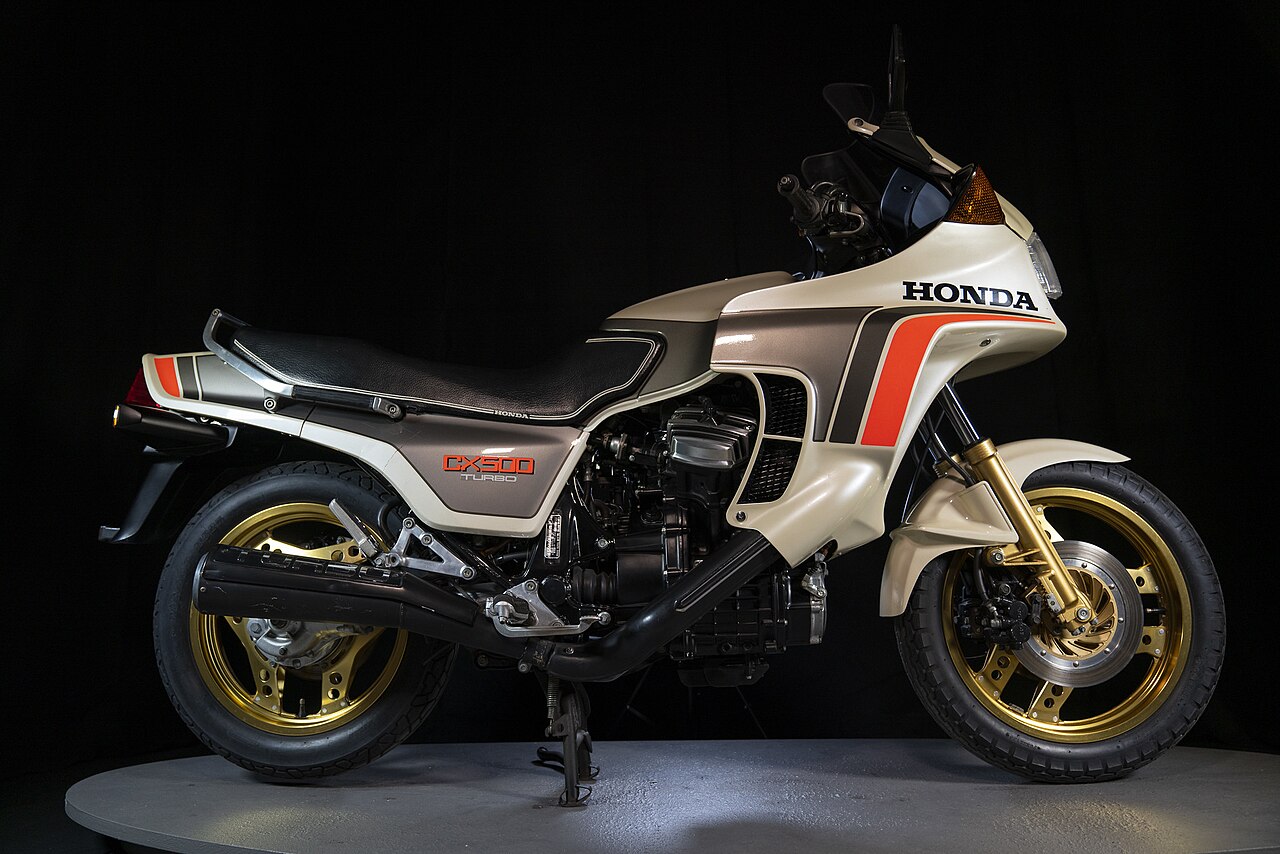
1981-1982 Honda CX 500 Turbo.jpg · Zweiradmuseum Neckarsulm · CC BY-SA 4.0
What did this one sell for?
Make a guess, then reveal one identity-matched completed auction result. It is a comparison point, not a price promise.
Reveal the auction result
Based on a completed sale at Bring a Trailer, an estimated value for this vehicle is $5,000.
Why this sale: Exact 1982 Japanese-built export Honda CX500 Turbo/CX500TC road motorcycle, VIN JH2PC0303CM002685, with turbocharged 496 cc V-twin, electronic fuel injection, five-speed transmission and enclosed shaft drive; not a naturally aspirated CX500, a Japanese domestic GL/CX derivative or a 1983 CX650 Turbo. 29k miles shown. The selling dealer reported cleaning the fuel system and replacing the battery; the auction discussion represented that it started easily, rode well and had functioning systems. Seat blemishes and older Metzeler tires were disclosed.
Winning bid; Bring a Trailer's 10% motorcycle buyer service fee in effect for the listing, taxes, dealer charges (listed as $0) and transport are excluded. One auction result is a reference, not an appraisal; condition, history, options, location and market timing can change value. Accepted over an August 2024 Iconic result whose bike would only run on starting fluid and was suspected to need a fuel pump. This later completed sale is identity-exact and running, though tire age and seat condition remain caveats.
More than a set of wheels.
Honda announced the CX500 Turbo in 1981 as an export-only model, then sold it for the 1982 model year. It became Honda's first fuel-injected production motorcycle and one of the first factory turbo motorcycles. Engineers strengthened the familiar CX500 V-twin, lowered its compression, added a small IHI turbocharger and let an electronic control system meter fuel as boost changed. The result was a comfortable, complex sport-tourer whose acceleration arrived dramatically above about 4,000 rpm. Honda replaced it after one season with the larger, smoother CX650 Turbo.
Look a little closer.
The turbocharger shaft could spin around 180,000 rpm—about 3,000 turns every second—so Honda increased oil and water-pump capacity and added an oil cooler.
Photos show an example of the model or generation. The pictured vehicle’s year, equipment, or modifications can differ from the specification described here.
Boost was a whole-system problem
The IHI turbo was small for its era but still large relative to a 500 cc twin. Honda used a 7.2:1 compression ratio, electronic injection, boost-sensitive ignition, a wastegate and stronger internal parts. Maximum boost was only reached at high engine speed and full load. This explains both the extraordinary technology and the famous split personality: calm below boost, then a hard surge when exhaust flow woke the compressor.
Source: Cycle World · Honda CX500 Turbo, April 1982 ↗A Japanese motorcycle that Japan did not buy new
Honda's product archive marks the 1981 introduction as an export model, and Honda's later fuel-injection history calls it a 1982 500 cc export. That distinction matters: 'Japan' describes manufacturer origin, not sales market. The CX500 Turbo should be captioned as a Japanese-built export motorcycle, with European or North American specifications identified when used.
Source: Honda · PGM-FI history ↗Where these facts come from
- Honda product archive · CX500 Turbo
- Honda Global · PGM-FI history
- Cycle World · Honda CX500 Turbo, April 1982
- St. Francis Motorcycle Museum · 1982 Honda CX500 Turbo
- Science Museum Group · Honda CX500 Turbo motorcycle
Selected facts checked for this edition. Some source pages link to broader model families. Last reviewed October 2, 2026.