
Honda NSX
An aluminum mid-engine sports car engineered to be thrilling without making ordinary driving a chore. Honda treated clear sightlines, friendly controls and everyday comfort as seriously as a high-revving engine.
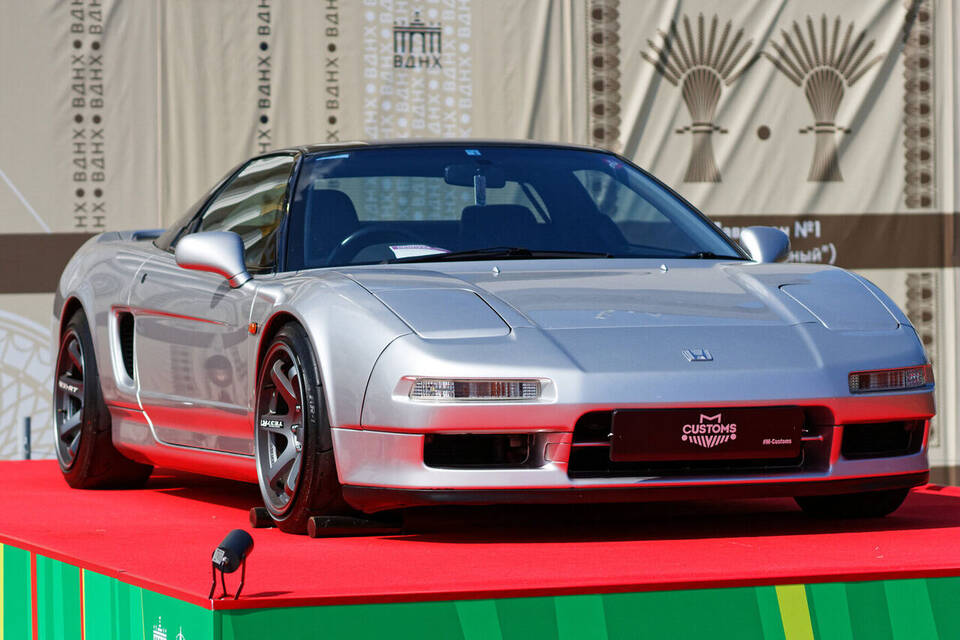
1990 Japanese-market Honda NSX displayed at a 2025 Moscow car show. · Retired electrician · CC0 1.0 Universal
Research pending
A matching completed auction sale has not been verified for this exact year, body, trim, engine, transmission and market.
Joyride shows this gap instead of substituting an asking price, unsold bid or mismatched special vehicle.
More than a set of wheels.
Honda launched the Japanese NSX in September 1990. Its engine sat sideways behind the two-seat cabin, while an aluminum monocoque and aluminum suspension parts helped cut weight. Honda paired high-revving VTEC performance with visibility, comfort and controls intended to make the car approachable, not just fast on a track. The launch car included air conditioning, cruise control, power windows and a tilt-and-telescoping steering column—useful reminders that this exotic-looking machine was meant to work on an ordinary trip too. The manual version kept unassisted rack-and-pinion steering, while the automatic received electric power assistance.
Look a little closer.
The manual NSX uses different wheel sizes front and rear: 15-inch front wheels and 16-inch rear wheels in the launch specification. Its front tires are narrower too, so the contact patches were deliberately matched to each axle's job.
Photos show an example of the model or generation. The pictured vehicle’s year, equipment, or modifications can differ from the specification described here.
A production-car aluminum milestone
Honda described the NSX as the world's first mass-produced car with an all-aluminum monocoque body. The bare body weighed 210 kg—140 kg less than Honda's steel comparison—and other aluminum parts contributed to about 200 kg total saving.
Source: Honda · 1990 Japanese NSX launch ↗High revs without a turbocharger
Honda chose a compact naturally aspirated V6 and added DOHC VTEC late in development. The system changes valve timing and lift so the engine can behave cleanly at everyday speeds and breathe better near its 8,000 rpm red zone.
Source: Honda · C30A engine technology ↗Two changeovers smooth the power curve
Below 4,800 rpm, closed shutters in the intake's resonance chamber help fill the cylinders. The shutters then open to use the moving air's inertia, and VTEC selects the high-lift cams at 5,800 rpm. Those steps were Honda's way of keeping useful low-speed torque while still letting the C30A breathe at high revs.
Source: Honda · C30A engine technology ↗A cabin for driving, not wrestling
The original equipment list included six analog instruments, leather seats with electric slide and recline, automatic climate control and a steering column that tilted and telescoped. The manual and automatic looked similar, but only the automatic received Honda's electric power steering at launch.
Source: Honda · 1990 NSX specification table ↗Why aluminum needed a different design
Aluminum was not a simple material swap. Honda compared it with reinforced plastics and composites, judging strength, stiffness, heat resistance, corrosion behavior and production practicality together. Its factbook explains that aluminum has about one-third the density of steel, but also about one-third its stiffness as a material. A thicker aluminum panel could therefore match a steel panel’s bending stiffness while still weighing less. Putting that advantage into production meant solving difficult welding and bonding problems and preventing corrosion where different metals met. The body’s low mass came from engineering the material, joints and manufacturing process as one system.
Source: Honda · 1990 NSX factbook — aluminum monocoque ↗A low suspension with room to give
The double wishbones were shaped around more than cornering grip. Honda placed the upper and lower arms within the wheels’ inner space, reducing the suspension’s height so the body could sit low. Keeping the wheels accurately aligned usually calls for stiff mountings, which can transmit sharp road impacts. The NSX’s front compliance pivot allowed the arm mountings to rotate together against a specially tuned flexible joint called a bushing. That gave the wheel controlled rearward movement under a road input while limiting unwanted alignment changes, helping reconcile precise steering with a usable ride.
Source: Honda · 1990 NSX factbook — suspension and compliance pivot ↗Visibility and comfort shaped the cabin
The low seating position did not have to mean awkward controls or a tunnel-like view. Honda moved the front wheels forward and used small-diameter front tires so the pedals could sit naturally ahead of the driver’s feet. Curved rear glass and slim rear pillars improved the view over the shoulders. A separate double-glazed partition, with dry air sealed between its panes, helped keep engine heat and sound out of the cabin while reducing misting. These details explain how a mid-engine layout could remain comfortable and easy to place on an ordinary road.
Source: Honda · 1990 NSX factbook — visibility and driving position ↗Four brakes, four independent decisions
Honda’s four-channel digital A.L.B. controlled each wheel independently. That mattered in a corner because the inside rear tire carried less load and could lock before the outside tires. On a split-friction road, where one side was slippery and the other grippy, Honda briefly softened control on the high-grip side to slow the yaw build-up. The hardware was equally deliberate: all four discs were ventilated, the front rotors were 28 mm thick with cooling guides on the lower arms, and the front used two-piston steel calipers while the rear used one-piston calipers. This was not a modern stability-control system; it was Honda’s launch-era anti-lock braking strategy for keeping braking force and direction under control.
Source: Honda · 1990 NSX factbook — four-channel A.L.B. and brakes ↗Traction control that still left room to drive
The launch NSX’s TCS watched for too much rear-wheel slip and changed engine output to help the tires stay inside their grip limit. Honda described three jobs: acceleration control on slippery surfaces, handling support if excess throttle upset the car in a bend, and a ‘grip control’ mode for high-grip pavement. The last mode deliberately relaxed intervention near the limit so an experienced driver could still manage power. The important idea is that TCS was assistance at the edge, not a claim that electronics could repeal physics.
Source: Honda · 1990 NSX factbook — TCS and A.L.B. ↗An aluminum body designed to be repaired
Honda used five aluminum-alloy formulations where their different strengths suited different jobs. Extruded side sills formed a stiff backbone; straight front side frames were shaped to absorb impact energy, and large rear frames helped protect the fuel tank. Most outer panels except the roof bolted to the frame, so a lightly damaged panel could be removed without replacing the whole structure. Some outer-sheet alloys were designed to be easy to press, then become stronger during the heat of the paint-baking process. The clever part was not simply ‘aluminum everywhere,’ but matching alloy, shape, joining method and serviceability to each part.
Source: Honda · 1990 NSX factbook — aluminum body structure ↗Two storage spaces and an everyday mission
The first-type manual car photographed here shows how the mid-engine package divides storage: a compact service and spare-wheel space under the front lid, then a separate luggage compartment behind the engine. Honda quoted 154 litres for the rear trunk using its VDA measurement method and used the long tail both for aerodynamics and practical volume. The rear structure was also designed so the tail and trunk area could absorb energy before a rear impact reached the engine or cabin. That combination helps explain the NSX brief: exotic proportions, but space for an ordinary trip.
Source: Honda · 1990 NSX factbook — cabin and 154-litre trunk ↗Why the V6 sat sideways
Honda tried several engine and transmission arrangements before choosing a transverse V6 with the gearbox mounted beside it. That compact package helped leave enough room for two people, a useful trunk and impact-absorbing structure without stretching the wheelbase or pushing the car's balance too far rearward. With one person aboard, Honda quoted a 42:58 front-to-rear weight distribution. The 70-litre fuel tank sat near the middle of the car, where using fuel would change the balance less than a tank placed at either end. It is a good example of the NSX mission: performance, space and safety had to work together rather than compete for whatever room was left.
Source: Honda · 1990 NSX factbook — mid-engine packaging and fuel tank ↗A short shift made for an 8,000-rpm engine
The five-speed manual used a 40 mm shift stroke and low-friction cable linkage, so changing gear needed a short wrist movement while keeping engine vibration away from the lever. Honda gave second gear a double-cone synchronizer because it faced especially heavy work, and used a permanently meshed synchronized reverse gear to reduce the unpleasant clash that can happen when selecting reverse. The hydraulic clutch used two small-diameter discs and a pull-type release system. Splitting the friction work between two smaller discs reduced rotating inertia while still handling the C30A's torque, helping the engine change speed quickly between shifts.
Source: Honda · 1990 NSX factbook — five-speed manual and clutch ↗The long tail was part of the wind-tunnel answer
Honda's wind-tunnel work was not only about making the drag number smaller. Engineers also considered lift and the turning force created by a crosswind. The launch body achieved a 0.32 drag coefficient, with lift coefficients of 0.02 at the front and 0.03 at the rear. The short nose, forward cabin, gently sloping rear glass, long tail and integrated rear spoiler worked as one shape. Even the pop-up headlights were compact projector units, approximately 90 mm high and 210 mm wide, to limit the aerodynamic penalty when raised. The broad rear spoiler was tuned to balance front and rear lift rather than added as decoration.
Source: Honda · 1990 NSX factbook — aerodynamics and exterior ↗Cooling a rear engine from the front
The engine sat behind the cabin, but the lightweight aluminum radiator and its fan lived in the nose. Honda placed the air-conditioning condensers to the left and right instead of stacking one in front of the radiator, helping preserve cooling airflow. Long coolant pipes can trap air, so the system included an expansion tank designed to separate air from coolant. At the engine, larger water passages, an engine-room fresh-air fan and an eleven-row oil-cooler core helped manage heat. Honda says the system was tested at maximum speed, on climbs and in extreme desert heat—conditions that put far more stress on cooling than an ordinary trip to school or the store.
Source: Honda · 1990 NSX factbook — cooling and lubrication ↗The differential was tuned to resist a wandering tail
Honda gave both launch transmissions a limited-slip differential with a job beyond helping the inside rear tire find traction. If a road undulation or crosswind tried to yaw the car, the speed difference between the driven rear wheels made the differential increase torque on the inside wheel. Honda said that produced a restoring moment opposite the unwanted turn. The design was therefore tuned for quick torque build-up and straight-line stability as well as split-friction starts. It was a passive mechanical response inside the transaxle, not rear-wheel steering or electronic stability control.
Source: Honda · 1990 NSX factbook — transmissions and limited-slip differential ↗Steering geometry traded effort for accuracy in measured steps
The front suspension used eight degrees of caster so the outside front tire gained useful camber as the driver steered into a corner. A large caster angle normally adds trail and steering effort, so Honda moved the kingpin axis rearward relative to the tire center to shorten the trail. It also held the kingpin offset at the wheel center to 34 mm to reduce kickback and shimmy. At the road surface, both axles used a minus-five-millimetre offset to improve braking stability. Those numbers show that the NSX's steering feel came from geometry, not merely from deleting power assistance on the manual car.
Source: Honda · 1990 NSX factbook — suspension geometry ↗Aluminum suspension cut mass where the springs could not hide it
Honda said about 80 percent of the major suspension components were aluminum, including the arms and knuckles, and it also made the subframes from aluminum. Knuckles and hub carriers were cast, while the other listed suspension pieces were forged. Lower unsprung mass helps each tire follow a rough road because the spring and damper have less wheel-side weight to control. Honda's one-piece skeletal arms also avoided extra joints, combining lower part count with strength. This extended the aluminum strategy beyond the body shell into the parts that determine ride and tire contact.
Source: Honda · 1990 NSX factbook — aluminum suspension ↗Four tires, four positions, and a folding spare
The launch tires were not simply a wider rear pair. Honda made the front and rear sizes different, used different rim diameters, and specified asymmetric tires dedicated to each of the four wheel positions. The forged aluminum road wheels saved about six kilograms across the set. A normal full-size spare would have consumed too much of the shallow front service bay, so Honda used a 15-inch cast-aluminum folding spare whose shoulders collapsed for storage and were restored with a compressor. The spare could serve either axle after its pressure was adjusted, unlike the four position-specific road tires.
Source: Honda · 1990 NSX factbook — tires, wheels and folding spare ↗Visibility was treated as safety equipment
Honda called one layer of the NSX safety plan “zero-stage safety”: help the driver receive information, see clearly and stay comfortable before a mistake becomes an emergency. Its forward-canopy shape produced what Honda measured as 311.8 degrees of open horizontal visibility. Supportive seats, full automatic climate control and a tilt-and-telescoping steering column were part of that same prevention-minded environment. Honda separated those ideas from first-stage accident avoidance—handling, braking, TCS, four-channel A.L.B. and the limited-slip differential—and from crash protection such as the SRS airbag, energy-absorbing body and steering column, bumpers and door beams. The useful lesson is that the launch NSX treated visibility and reduced fatigue as safety engineering, not merely comfort.
Source: Honda · 1990 NSX factbook — safety concept ↗A factory built around twenty-five cars a day
The aluminum body required more than a different material, so Honda created dedicated production equipment and a dedicated factory. The launch factbook describes a low-volume plan of 25 cars per day, about 6,000 per year, divided into 190 sections that each guaranteed the quality of its own work before passing the car onward. Honda says the line had neither a conventional belt conveyor nor mass-production work robots. Instead, equipment moved the car to a position where people could work in a natural posture, and workers checked details such as the mirror-like paint finish, door-closing feel and panel alignment with their hands, eyes and ears. This explains how the NSX's manufacturing method was designed around aluminum joining and human inspection together.
Source: Honda · 1990 NSX factbook — dedicated factory and production method ↗Ignition and exhaust were engineered as systems
Honda's engine page describes two systems that are easy to miss in a photograph. Each spark plug had its own compact ignition coil instead of relying on a distributor and long high-tension leads. Honda paired that direct ignition with platinum plugs and specified them as maintenance-free for 100,000 km. Downstream, the exhaust used a silencer with seven chambers and approximately 28 litres of volume, plus a dual-path arrangement that joined the front and rear cylinder banks partway along the system. Honda said the tuning kept the sound restrained at low engine speeds and clearer as revs rose. These facts belong to the launch C30A engineering record; the separate display-engine photograph is useful visual context, but its current Commons page contains a C30A/C30B description conflict and is not proof of one particular 1990 car.
Source: Honda · 1990 NSX factbook — high-rpm engine, direct ignition and exhaust ↗Rigidity was tuned with metal, stopwatch and welding torch
Computer analysis gave Honda a starting point for the aluminum body, but the final structure was also tuned through repeated circuit testing. At the Nürburgring, test drivers, designers and prototype technicians brought welding equipment and tried temporary reinforcements at more than twenty locations, adding and removing them to compare what the driver felt with what the structural calculations predicted. Honda then translated the useful trials into production changes in section shape and panel thickness. The published targets were 3.0 × 10^5 kg·m² in bending rigidity and 3.2 × 10^5 kg·m² per radian in torsional rigidity, with Honda saying the monocoque achieved its stiffness at about 60 percent of the weight of its steel comparison. Those are launch-era Honda measurements, not a claim that the thirty-five-year-old cars photographed today retain factory-new stiffness.
Source: Honda · 1990 NSX factbook — body rigidity and Nürburgring development ↗Aluminum demanded its own welding hardware
Honda kept resistance spot welding as the main joining method, but aluminum conducted electricity and heat too readily for ordinary steel-body equipment. The factbook contrasts roughly 7,000–12,000 amperes for steel with a momentary 20,000–50,000 amperes for aluminum, and 200–300 kgf of electrode pressure for steel with 400–800 kgf for the thicker aluminum panels. Long secondary cables would waste too much of that current, so Honda developed a spot-welding gun with the transformer built into the gun itself. Narrow flange-free parts such as the front pillars used arc welding instead. The production breakthrough was therefore a matched system of alloy selection, joint design and purpose-built equipment, not merely replacing steel sheet with aluminum sheet.
Source: Honda · 1990 NSX factbook — aluminum welding process ↗The mirror finish involved four coats and four bakes
Honda described a four-coat, four-bake paint process capped by a water-based color coat and a clear coat. During pretreatment and electrodeposition, the bare aluminum body was rotated through 180 degrees so the process reached it uniformly. Two intermediate coats supplied a base color before the slow-drying water-based top coat helped the surface level and kept metallic flakes aligned. Honda also selected resin exterior parts around the material and heat demands of that process: the front nose and rear bumper used a heat-resistant polyester elastomer, while the headlamp lids, fuel door and rear spoiler used paint-compatible resin panels. The raised-headlamp photographs in this packet illustrate the panel boundaries, but they do not authenticate the photographed car's paint as original.
Source: Honda · 1990 NSX factbook — paint process and resin exterior panels ↗VTEC used three cam profiles and hydraulic locking pins
The C30A's valve gear added a third rocker arm and a third cam profile to the conventional pair. At the changeover, oil pressure moved pins through aligned holes in the rocker arms while the cam lobes were on their base circles, locking the rockers together so the high-speed cam could control the valves. Honda's five-speed specification gives unequal 8.3 and 8.7 mm low-speed intake lifts to promote swirl, then 10.2 mm in the high-speed mode. The engine controller did not switch from rpm alone: Honda says it evaluated engine load, engine speed and vehicle speed. These details explain how the system changed valve motion mechanically rather than simply opening an electronic throttle farther.
Source: Honda · 1990 NSX factbook — VTEC mechanism and valve lift ↗Traction control acted through three engine levers
The launch TCS estimated conditions from four wheel-speed sensors and a steering-angle sensor, then also compared accelerator-pedal position with actual throttle position. When intervention was needed, its ECU could request changes in fuel delivery and ignition timing from PGM-FI while a stepper-motor actuator closed the throttle. On a high-grip surface it raised the target slip ratio so the driver could still use some power oversteer; on a slippery surface it aimed for more conservative slip. A dashboard indicator flashed during operation. The driver could switch TCS off, but Honda says it could not be cancelled while actively intervening, and the system did not apply the brakes. That last limitation is important: this was engine-output control, not a modern brake-based stability program.
Source: Honda · 1990 NSX factbook — TCS sensors, actuators and limits ↗The cockpit grouped one function under each switch
Honda arranged the driving controls as large satellite switches, assigning one function to each switch and grouping them by priority so frequently used controls required little hand movement. Six electrical analog instruments covered speed, engine speed, fuel, voltage, oil pressure and coolant temperature. For the driver's SRS airbag, Honda used a new silicone material that could be folded more compactly, helping package it inside a three-spoke steering wheel only 368 mm across while preserving both tilt and telescopic adjustment. The existing instrument-cluster photograph shows the layout, but the dimensions and airbag construction come from Honda's 1990 factbook rather than visual inference.
Source: Honda · 1990 NSX factbook — controls, instruments and compact SRS wheel ↗Driver and passenger received different zones
Honda said a full-face motorcycle helmet inspired the interior: support below the waist, open space above it and a wide field of view around the occupants. A large console divided the cabin into separate one-by-one zones. The driver's side was shaped to hold the body without obstructing control movements; the passenger's side was deliberately softer and roomier. Door trims, dashboard and console flowed together as a wraparound lower structure, while the upper door areas were hollowed out where elbows needed clearance. The idea was not symmetry for its own sake, but giving two occupants different environments within the same compact cabin.
Source: Honda · 1990 NSX factbook — double-surround cockpit concept ↗Air conditioning was repackaged for the low center console
The low mid-engine cabin left little room for a conventional climate unit. Honda replaced a large swing-type air-mix door with a sliding design and packaged the blower, evaporator and heater vertically inside the center console. It claimed about 30 percent less volume than a unit of equivalent capacity, with 4,000 kcal of cooling and 3,900 kcal of heating performance. A rotary fresh-air/recirculation door in the blower was intended to keep airflow stable during sustained high-speed travel. The same cabin also received a model-specific Bose layout with amplified and equalized enclosures at each speaker: main speakers in the doors, a woofer in the passenger footwell and a small rear-center speaker.
Source: Honda · 1990 NSX factbook — climate control and Bose audio packaging ↗What eight months at the Nürburgring were for
Honda did not use the Nürburgring as a single publicity lap. Its 1990 account says engineers worked there for eight months on the old course, a route more than 20 km long with roughly 300 m of elevation change and around 200 corners. A workshop beside the circuit let the team alter the test car and drive it again, while cars and data went back and forth to Japan. The program also covered snow and ice in Scandinavia and Canada, high-speed motorway running, and hot-weather work in American and Australian deserts. At Suzuka, Honda says Ayrton Senna and Satoru Nakajima were among the Formula One drivers who took part. The useful point is breadth: body and suspension rigidity, controls, engine and brakes were developed through repeated comparison between measurements and what drivers could feel, across different climates and road types.
Source: Honda · 1990 NSX factbook — worldwide and Nürburgring testing ↗Why power steering belonged only to the launch automatic
Launch specifications matter here: Honda's new EPS was fitted to four-speed automatic cars, while the five-speed manual profiled by Joyride retained unassisted rack-and-pinion steering. The automatic's system used signals for steering effort, vehicle speed and steering rate; a computer calculated the desired assist and varied an electric motor continuously. Honda's stated goal was little sense of assistance at speed, with help when parking or moving slowly and a more linear rise in steering effort as road speed or steering rate increased. Because it did not need a hydraulic pump or pipework and only drove the motor when required, Honda described it as lighter, simpler and lower-loss than hydraulic assistance. This is useful variant context, not a claim that the photographed manual cockpit contained EPS; it explains why contemporary descriptions of “the NSX” can disagree about whether the first car had power steering.
Source: Honda · 1990 NSX factbook — automatic-model electric power steering ↗Honda balanced three kinds of performance, not one headline number
Honda's launch explanation did not define the NSX only by power or lap speed. It set out three overlapping development themes. Vehicle dynamics meant balancing acceleration, cornering and braking. Human fitting meant making the driving position, controls, visibility and comfort work around the people inside. Road-condition adaptability meant preserving useful responses across different weather, surfaces and driving environments. Honda argued that all three depended on lower mass as well as strong engineering, because adding power alone tends to require a larger engine and a heavier body. This framework helps explain why an aluminum structure, an approachable cockpit and all-weather development belonged to the same project rather than separate convenience features. It is also a useful way for a young reader to compare cars: the biggest engine number does not automatically make the most complete sports car.
Source: Honda · 1990 NSX factbook — three-axis development concept ↗The glass canopy began with an aircraft idea
Honda says the exterior team used a small supersonic jet as an image for a shape that would put people, visibility and easy control ahead of intimidation. The cabin moved far forward, while large, highly curved and lightweight front and rear windows wrapped around the occupants. Three-dimensionally curved side glass helped the windows read as one continuous canopy. That shape was then tested in the wind tunnel so air could stay attached as it travelled from the nose, over the cabin and toward the long tail instead of breaking into turbulence behind the roof. Honda measured 311.8 degrees of open horizontal visibility, but the canopy also became a visual signature: black roof and pillar surfaces separated the glass area from the body below. The museum photograph shows that contrast clearly, but its source identifies the car as a 1990 first-type automatic. It is useful exact-year exterior evidence, not proof of the five-speed profile's transmission or mechanical specification.
Source: Honda · 1990 NSX factbook — forward canopy and glass design ↗The NSX story began with a mid-engine Honda City experiment
Honda's retrospective places the first step before the NS-X shape existed. In January 1984, engineers at the Wako R&D Center began basic research into a different drive layout because Honda's usual front-engine, front-wheel-drive arrangement limited some packaging choices. The next month they built an underfloor-midship, rear-drive test vehicle from a first-generation City. It handled very differently from the ordinary City and made a lasting impression, even though Honda says the technology available then did not give the experimental layout enough practical advantage to continue. The team shifted toward studying low-center-of-gravity vehicle dynamics, and creation of a new sports car began in earnest in autumn 1985. This sequence matters because the production NSX was not simply a styling exercise wrapped around a chosen engine. Its roots were an experiment about how changing the location of heavy parts changes balance, response and cabin packaging. Honda's 2025 design retrospective dates the design program to 1985 and calls its themes human-centered and 'comfortable F1'—a reminder that speed and a usable cabin were developed together.
Source: Honda Heritage · The NSX / 1990 ↗Honda plotted the car beyond its sports-car 'Milky Way'
Honda did not want one large horsepower figure to stand in for the whole car. Its launch material describes a chart with vehicle weight divided by engine output on one axis and vehicle weight divided by wheelbase on the other. The plotted rival cars formed a broad band that engineers nicknamed the Milky Way. Heavy, very powerful cars tended toward one part of the chart, while light but less powerful cars occupied another. Honda aimed the NSX outside that conventional band and toward the balance represented by a Formula One car, while still preserving cabin space and control that an ordinary driver could use. The chart was an engineering discussion tool, not a universal law: wheelbase-to-weight does not by itself calculate cornering grip or stopping distance. Its value was that it forced the team to discuss acceleration, mass, turning, braking and human compatibility together instead of chasing a single headline. The Japanese five-speed launch figures—4.82 kg per PS and 0.53 kg per millimetre of wheelbase—show where Honda placed its finished car on those two measures.
Source: Honda · 1990 NSX factbook — vehicle-dynamics concept ↗Fuel figures make sense only with their original test labels
Honda's launch factbook lists two very different fuel-consumption results for the Japanese five-speed NSX: 8.3 km/L on the period Japanese 10-mode government test and 16.0 km/L in a steady 60 km/h test. The larger number does not mean every NSX could double its economy in ordinary driving. A steady-speed run asks far less of the car than repeated acceleration and stopping, and neither figure is directly interchangeable with a modern EPA result. The same source specifies RON 100 gasoline for the Japanese launch car. Two knock sensors in the cylinder block allowed the control system to adjust ignition timing when it detected the vibration pattern associated with knock. That protection was not permission to ignore the specified fuel; it was part of the engine's control strategy for its 10.2:1 compression ratio. Keeping the test method, market, transmission and fuel grade attached to each number prevents an impressive-looking statistic from losing its meaning.
Source: Honda · 1990 NSX factbook — engine performance and fuel tests ↗The red 1989 NS-X was still a prototype
The bright-red car that drew a crowd at the Chicago Auto Show in February 1989 was a prototype, not yet the finished 1990 Japanese production model in this profile. Honda's history says the public name was still written NS-X and explains that X represented an unknown world the company wanted its new sports car to enter. Development also continued after the show. Honda began another series of test drives in Japan in June 1989, then took cars to the United States and Europe. In America, testing included both the difficult Laguna Seca circuit and ordinary public-road conditions; further drives followed near the Nürburgring in West Germany. Honda's later official chronology separates those development milestones from the sales dates: Acura NSX sales began in the United States in August 1990, while Honda NSX sales in Japan followed in September. That timeline matters when looking at any display-labelled 1989 car. It can show the shape and public story taking form, but it must not be used as proof that every wheel, cabin switch, suspension setting or panel detail matches the Japanese five-speed production car launched the following year.
Source: Honda Global · The NSX / 1990 ↗Honda called easier driving a performance goal
Honda's launch brief argued that a road-going sports car should not make unnecessary tension or difficult operation part of its identity. Unlike a racing car, it would share ordinary roads and should let drivers with different skill levels access its performance. Honda therefore treated easy control, comfort, safety and faithful responses to driver input as performance goals rather than concessions. That idea connects the NSX's visibility, climate control and approachable controls to the same brief as its speed.
Source: Honda NSX 1990 launch factbook — human-oriented sport concept ↗The seat was designed as a sliding system
Honda treated each seat as a complete support and adjustment system. A pressed-aluminum pan frame cut the part count to less than half that of Honda's comparison seat; the headrest base used hollow blow-molded plastic and the slide rails used aluminum extrusions. Low-density padding in the center was divided into seven load-absorbing sections while denser side pads supplied support. Both seats had power slide and recline, and mounting the belt anchors to the rails kept their relationship to the occupant consistent throughout the 240-millimetre travel.
Source: Honda NSX 1990 launch factbook — interior and seat engineering ↗What Honda measured in the original NSX sound
Honda R&D later studied the original Acura NSX cabin sound while creating the second-generation car. Its paper separates three contributions: the exhaust supplied a low-frequency powerful character dominated by third-order engine pulses and a high-rpm racing character dominated by sixth-order pulses, while the intake supplied a mid-frequency guttural note around a 450 Hz resonance. The plotted measurement was a full-throttle acceleration in third gear, not an idle clip or an exact 1990 Japanese-car recording. That distinction matters: the paper is useful evidence about what the first-generation breathing systems were engineered to make a driver hear, but it does not create playable audio for Joyride. Honda’s researchers wrote that the acoustic response rose with accelerator input and helped connect the driver to the car. In kid-friendly terms, intake and exhaust acted like two instruments in the same band: one added the middle growl, while the other carried the lower beat and the higher-rpm racing note. Because the paper discusses the original Acura NSX introduced for 1991, treat these measurements as closely related first-generation sound engineering, not a laboratory certificate for this Japanese 1990 five-speed example.
Source: Honda R&D Technical Review · Development of Sports Car Sound for Hybrid Super Sports Cars ↗Honda built a factory-backed preservation path
Honda launched Heritage Works in April 2026 with the first-generation NSX as its starting model. The program has two parts. Heritage Parts supplies selected discontinued components again: some are compatible replacements redeveloped with newer materials or manufacturing methods, while reproduction parts use the original materials and production methods. The companion restoration service operates in Japan at Takanezawa, the birthplace of the first-generation NSX and home of Honda’s earlier NSX Refresh Plan. Honda says Basic Restoration concentrates on performance-related work such as engine and suspension service. Total Restoration can go farther into exterior and interior work, including a full repaint after stripping the car to its body-in-white and reupholstery of seats, dashboard, door panels and controls. Applications for NA1-100 cars opened through Honda Cars dealers in Japan in early January 2026, with work scheduled to begin in April. This does not mean every surviving NSX has been factory-restored, and none of the museum photographs on Joyride should be labeled that way without vehicle-specific records. It does show an unusual part of the model’s long life: Honda created a current factory-backed path intended to preserve how the original car drove, looked and felt decades after launch.
Source: Honda · Honda Heritage Works launch announcement ↗Where these facts come from
- Honda · 1990 Japanese NSX launch
- Honda · 1990 NSX specification table
- Honda · C30A engine technology
- Honda · 1990 NSX factbook — aluminum monocoque
- Honda · 1990 NSX factbook — suspension and compliance pivot
- Honda · 1990 NSX factbook — visibility and driving position
- Honda · 1990 NSX factbook — four-channel A.L.B. and brakes
- Honda · 1990 NSX factbook — TCS and A.L.B.
- Honda · 1990 NSX factbook — aluminum body structure
- Honda · 1990 NSX factbook — climate control and Bose audio packaging
- Honda · 1990 NSX factbook — mid-engine packaging and fuel tank
- Honda · 1990 NSX factbook — five-speed manual and clutch
- Honda · 1990 NSX factbook — aerodynamics and exterior
- Honda · 1990 NSX factbook — cooling and lubrication
- Honda · 1990 NSX factbook — transmissions and limited-slip differential
- Honda · 1990 NSX factbook — suspension geometry
- Honda · 1990 NSX factbook — tires, wheels and folding spare
- Honda · 1990 NSX factbook — safety concept
- Honda · 1990 NSX factbook — dedicated factory and production method
- Honda · 1990 NSX factbook — high-rpm engine, direct ignition and exhaust
- Honda · 1990 NSX factbook — paint process and resin exterior panels
- Honda · 1990 NSX factbook — VTEC mechanism and valve lift
- Honda · 1990 NSX factbook — TCS sensors, actuators and limits
- Honda · 1990 NSX factbook — controls, instruments and compact SRS wheel
- Honda · 1990 NSX factbook — double-surround cockpit concept
- Honda · 1990 NSX factbook — development introduction
- Honda · 1990 NSX factbook — worldwide and Nürburgring testing
- Honda · 1990 NSX factbook — automatic-model electric power steering
- Honda · 1990 NSX factbook — three-axis development concept
- Honda · 1990 NSX factbook — forward canopy and glass design
- Honda Heritage · The NSX / 1990
- Honda · 1990 NSX factbook — vehicle-dynamics concept
- Honda · 1990 NSX factbook — engine performance and fuel tests
- Honda Design · first-generation NSX retrospective
- Honda Global · NSX production-end release and chronology
- Honda NSX 1990 launch factbook — human-oriented sport concept
- Honda R&D Technical Review · original NSX sound measurements
- Honda · Honda Heritage Works launch announcement
Selected facts checked for this edition. Some source pages link to broader model families. Last reviewed October 2, 2026.