
Lamborghini Miura P400
The Miura turned a racing-style mid-engine layout into one of the most dramatic road-car shapes of the 1960s.
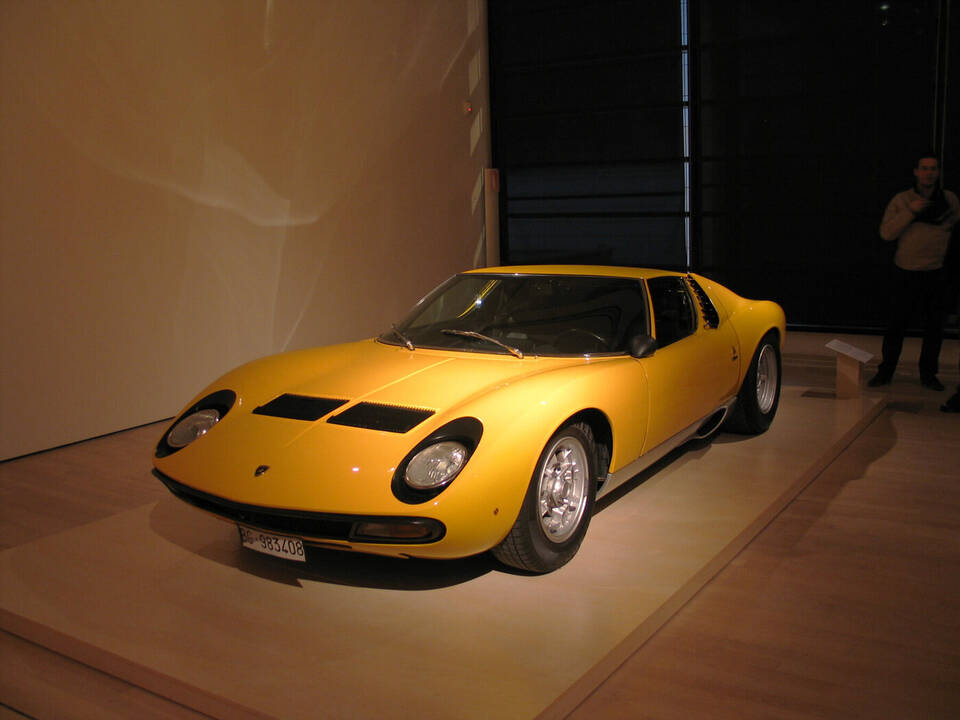
1966 Lamborghini Miura P400 (4445525383).jpg · Davide Oliva · CC BY-SA 2.0
Research pending
A matching completed auction sale has not been verified for this exact year, body, trim, engine, transmission and market.
Joyride shows this gap instead of substituting an asking price, unsold bid or mismatched special vehicle.
More than a set of wheels.
Lamborghini presented the production Miura P400 at the Geneva Motor Show in March 1966. This page follows the original 350 CV P400, not the later P400 S or SV. Its V12 sits sideways behind the two seats and ahead of the rear axle. Bertone wrapped that unusual package in a body only 110 centimeters high, and the combination helped make “supercar” a familiar word.
Look a little closer.
P400 is a tiny technical code: P points to the engine position, while 400 refers to its roughly four-litre displacement.
Photos show an example of the model or generation. The pictured vehicle’s year, equipment, or modifications can differ from the specification described here.
A chassis became a sensation
Lamborghini first showed a rolling chassis before the finished body existed. Bertone’s production shape then caused a sensation at Geneva in March 1966, proving that an engineering layout could become theater as well as transportation.
Source: Lamborghini · Miura model biography ↗The original is not the SV
Lamborghini records 265 original P400s built from 1966 through 1968. The later S and SV gained power and detail changes, so their 370 and 385 CV figures do not belong on this launch-version page.
Source: Lamborghini · Miura model biography ↗Where these facts come from
- Lamborghini · Miura model biography
- Lamborghini · company history
- Auto-Data · Miura P400 technical data
Selected facts checked for this edition. Some source pages link to broader model families. Last reviewed September 29, 2026.