
Renault Mégane Scénic RT 2.0
Renault turned the Mégane family-car platform into a tall, five-seat room with clever individual rear chairs—and created the compact MPV boom.
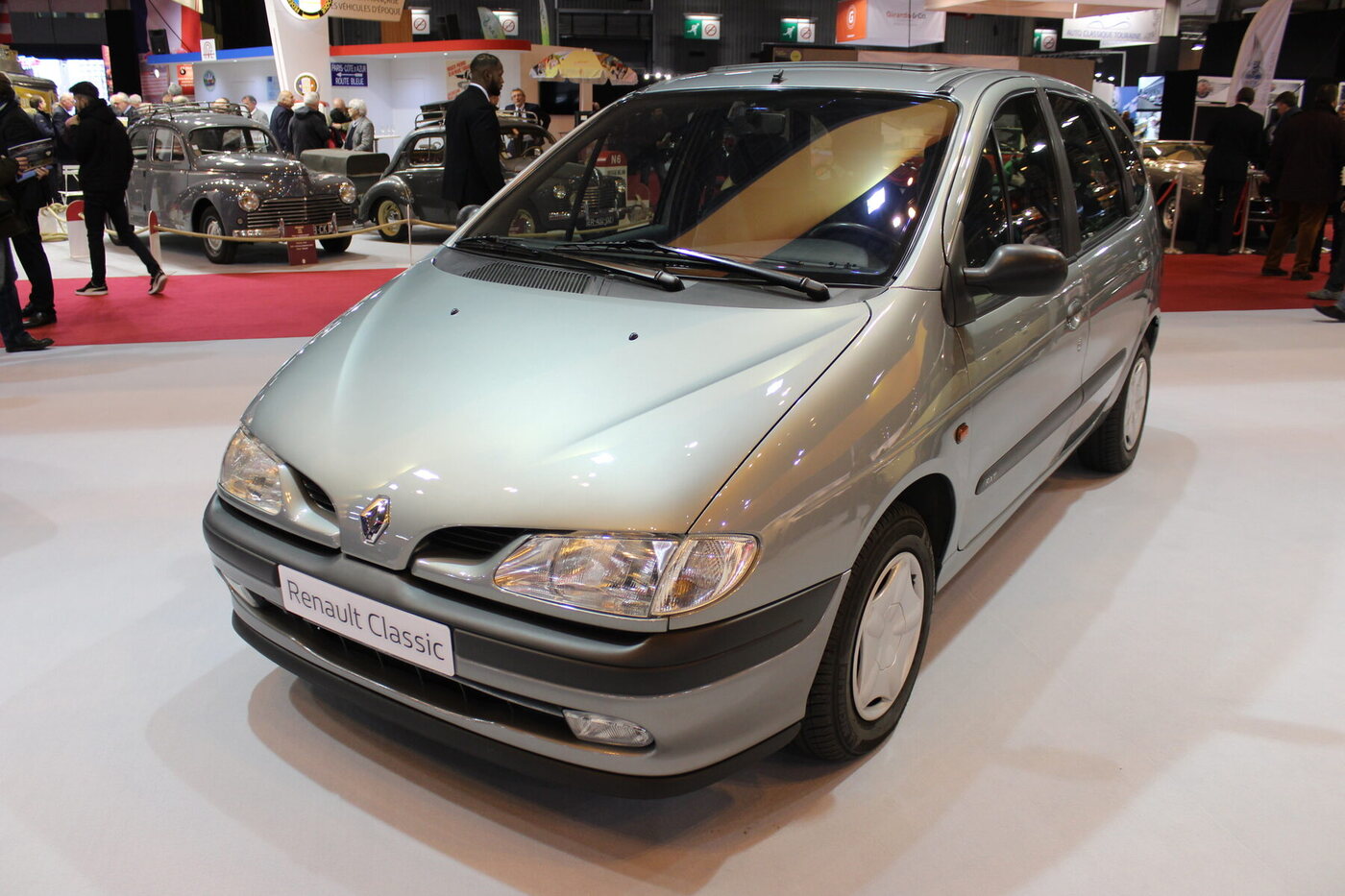
1996 Renault Mégane Scénic I Phase I · Éric Manesse · CC BY-SA 4.0
Research pending
A matching completed auction sale has not been verified for this exact year, body, trim, engine, transmission and market.
Joyride shows this gap instead of substituting an asking price, unsold bid or mismatched special vehicle.
More than a set of wheels.
The production Mégane Scénic reached European buyers in 1996 after Renault previewed the S.C.E.N.I.C. idea as a 1991 concept. It brought the one-box thinking of the larger Espace into a car only 4.13 metres long. This page follows the Netherlands-market RT 2.0 automatic launched in September 1996, keeping its four-speed gearbox and 180 km/h rating separate from the five-speed manual.
Look a little closer.
The first Scénic's name began as an acronym on the 1991 concept: Safety Concept Embodied in a New Innovative Car.
Photos show an example of the model or generation. The pictured vehicle’s year, equipment, or modifications can differ from the specification described here.
A family-car footprint with van-like space
At 4,134 mm long, the Scénic was shorter than many modern compact hatchbacks, yet its tall 1,600 mm body and upright seating created useful space for five. The removable individual rear seats made the cabin more like a toolbox than a fixed sofa.
Source: AutoWeek · 1996 Renault Mégane Scénic RT 2.0 automatic ↗The original wore a Mégane badge
Renault marketed the first model as Mégane Scénic because it shared the wider Mégane family programme. Later facelifts made Scénic a more independent name, so this launch profile keeps the full 1996 identity.
Source: Renault Scénic model history ↗Where these facts come from
- AutoWeek · 1996 Renault Mégane Scénic RT 2.0 automatic
- Haynes RTA · Mégane and Scénic I engine coverage
- Renault Scénic model history
Selected facts checked for this edition. Some source pages link to broader model families. Last reviewed September 30, 2026.