
Subaru 1000 Super Deluxe
Subaru placed a flat engine lengthwise ahead of the cabin and drove the front wheels, creating the balanced layout that still shapes the brand.
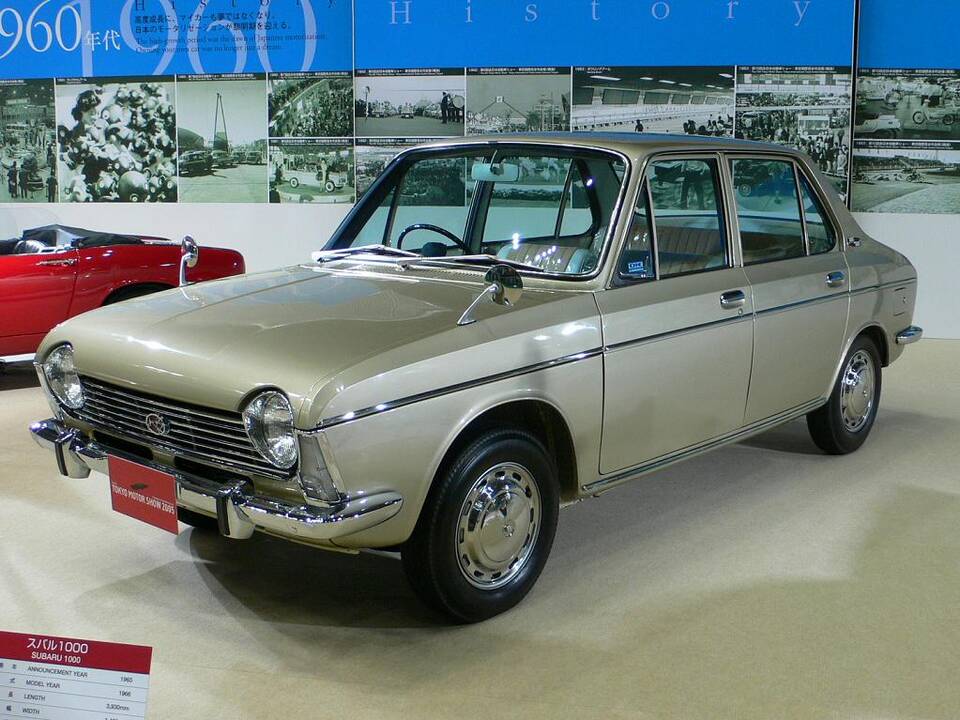
1966 Subaru 1000 Deluxe four-door sedan · Mytho88 · CC BY-SA 2.5
Research pending
A matching completed auction sale has not been verified for this exact year, body, trim, engine, transmission and market.
Joyride shows this gap instead of substituting an asking price, unsold bid or mismatched special vehicle.
More than a set of wheels.
The Subaru 1000 went on sale in Japan on May 14, 1966 as the country's first domestically mass-produced front-wheel-drive passenger car. Engineers chose a compact boxer four, inboard front brakes, a dual-radiator cooling system and independent suspension at every wheel. This page follows the May-launch four-door Super Deluxe rather than later two-door or higher-output derivatives.
Look a little closer.
Its radiator system used a small sub-radiator in normal driving and brought the main radiator into action when more cooling was needed.
Photos show an example of the model or generation. The pictured vehicle’s year, equipment, or modifications can differ from the specification described here.
The root of Subaru's modern layout
Subaru says the combination of a longitudinal horizontally opposed engine and front-wheel drive established the basic symmetrical idea behind later cars. It was chosen to improve stability and interior room, not simply to be different.
Source: Subaru Museum · Subaru 1000 ↗Many clever systems in one compact sedan
The 1000 paired four-wheel independent suspension with front brakes mounted inboard beside the transaxle, reducing unsprung weight. Its dual-radiator arrangement also allowed a belt-driven fan clutch to disconnect when extra cooling was unnecessary.
Source: Subaru FAQ · Subaru 1000 engineering ↗Where these facts come from
- Subaru Museum · Subaru 1000
- Subaru FAQ · Subaru 1000 engineering
- Subaru Corporation · 50th anniversary of the boxer engine
Selected facts checked for this edition. Some source pages link to broader model families. Last reviewed September 30, 2026.