
Subaru Vivio RX-R (KK4)
This tiny Subaru packed four driven wheels, a supercharger and four seats into Japan's kei-car size box.
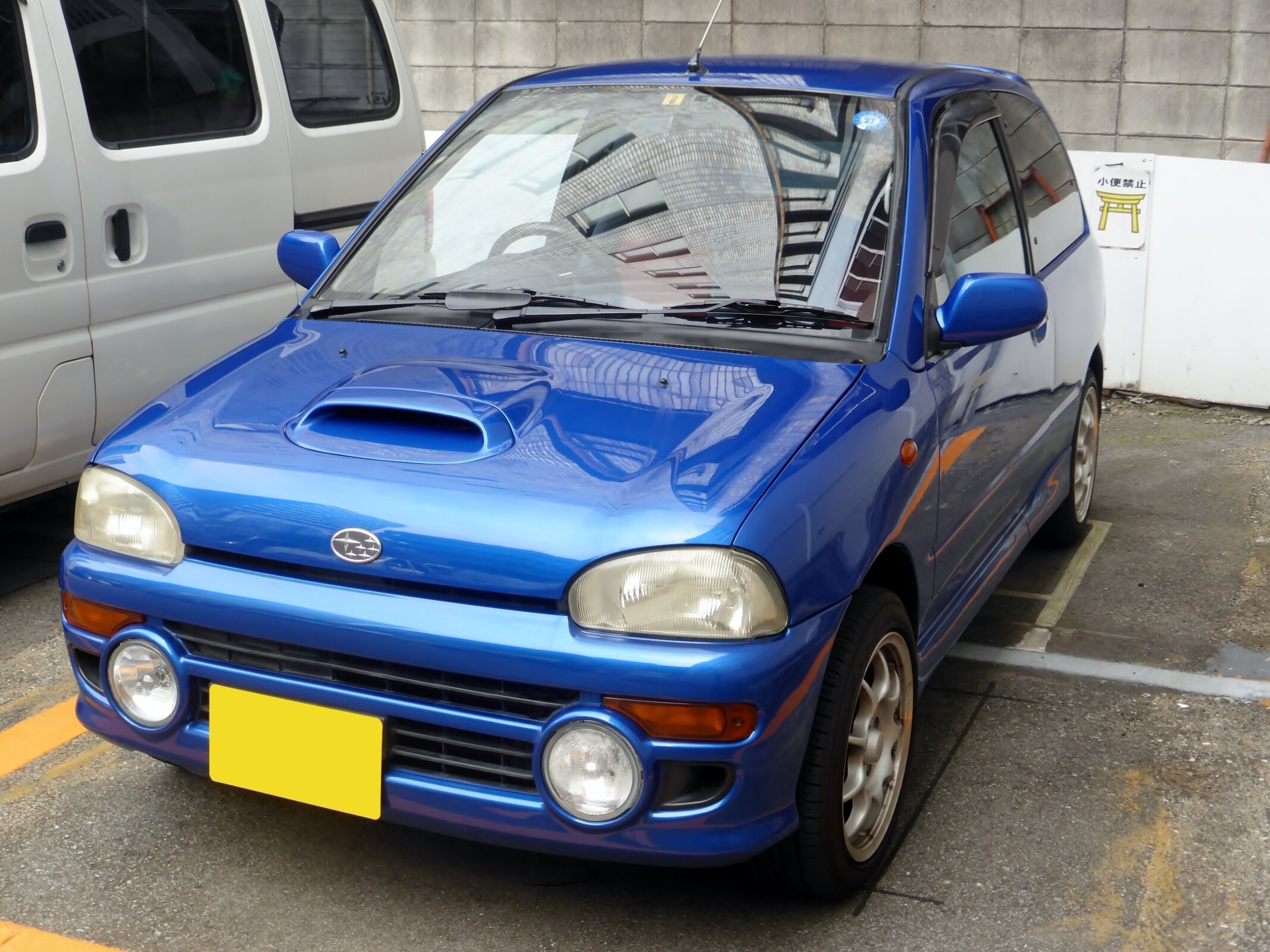
Subaru VIVIO RX-R (KK4) front.JPG · Tokumeigakarinoaoshima · CC0 1.0
Research pending
A matching completed auction sale has not been verified for this exact year, body, trim, engine, transmission and market.
Joyride shows this gap instead of substituting an asking price, unsold bid or mismatched special vehicle.
More than a set of wheels.
Subaru released the Vivio in March 1992 as its new kei passenger car. The RX-R was the energetic version: a 658 cc four-cylinder used a supercharger, twin overhead cams and 16 valves, while the KK4 sent power to all four wheels. This entry fixes the identity to the first March 1992 KK4 rather than blending in the lighter front-drive KK3, the later RX-RA competition base or special editions.
Look a little closer.
It was only 3,295 mm long—shorter than many modern city cars—yet still had four seats and four-wheel drive.
Photos show an example of the model or generation. The pictured vehicle’s year, equipment, or modifications can differ from the specification described here.
Kei rules encouraged clever engineering
The small engine and body dimensions were not accidents: they fit Japan's kei category. Subaru used boosting, four valves per cylinder and high engine speed to make strong performance without leaving that compact class.
Source: Subaru SUGDAS official catalogue · 1992 Vivio RX-R ↗RX-R does not identify one drivetrain
Subaru sold the launch RX-R as both front-drive KK3 and full-time-four-wheel-drive KK4. This profile is the KK4: a heavier and more mechanically complex version whose exact type code matters as much as the badge.
Source: Subaru SUGDAS official model list · March 1992 Vivio ↗Where these facts come from
- Subaru SUGDAS official catalogue · 1992 Vivio RX-R KK4
- Subaru SUGDAS official model list · March 1992 Vivio
- Subaru Annual Report 2019 · product timeline
Selected facts checked for this edition. Some source pages link to broader model families. Last reviewed October 2, 2026.