
Suzuki Jimny LJ10
Japan's first Jimny was tiny enough for the kei class but equipped with selectable four-wheel drive and low-range gearing for real rough-road work.
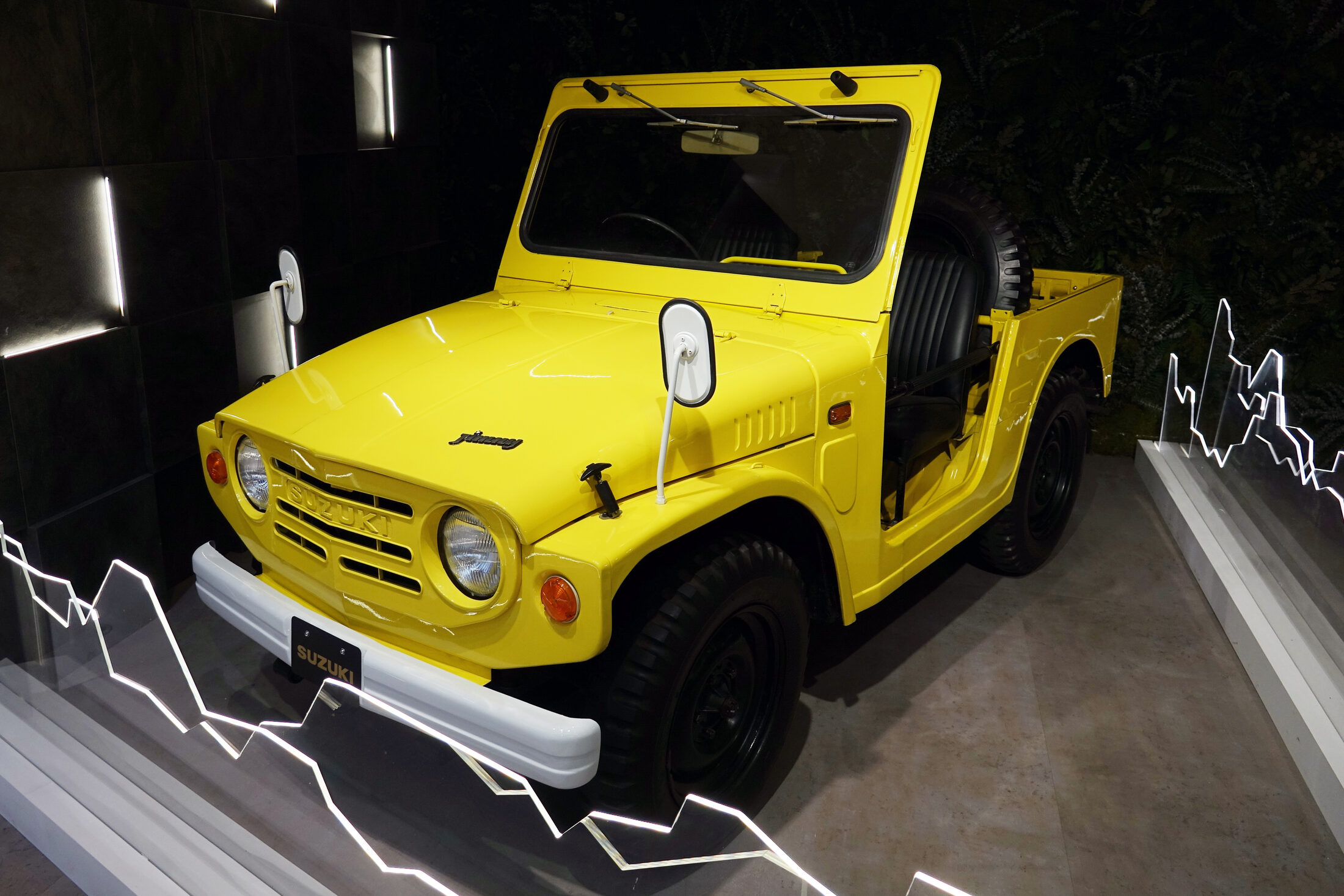
Suzuki LJ10.jpg · Y.Leclercq · CC BY-SA 4.0
Research pending
A matching completed auction sale has not been verified for this exact year, body, trim, engine, transmission and market.
Joyride shows this gap instead of substituting an asking price, unsold bid or mismatched special vehicle.
More than a set of wheels.
Suzuki began developing its lightweight four-wheel-drive idea in 1968 and put the first Jimny, the LJ10, on sale in Japan in April 1970. It combined kei-car dimensions with genuine selectable four-wheel drive, creating a tiny tool for rough roads rather than a scaled-down road car dressed like an off-roader. Suzuki identifies it as the starting point of the Jimny line and its 4WD engineering story; the Japan Automotive Hall of Fame later recognized it as a historic lightweight multipurpose 4WD kei vehicle.
Look a little closer.
Suzuki carried the spare wheel inside to stay under the kei-car length limit, leaving an unusual two-plus-one three-seat layout.
Photos show an example of the model or generation. The pictured vehicle’s year, equipment, or modifications can differ from the specification described here.
How a tiny vehicle became a real off-roader
The LJ10 was short and light, but its important parts were not pretend. Selectable four-wheel drive and low-range gearing let the engine turn the wheels slowly with more useful force. That made the little Suzuki suitable for narrow mountain paths and work sites where a bigger vehicle could be awkward. Its size was part of the engineering solution, not merely a styling choice.
Source: Global Suzuki · automobile history ↗The packaging puzzle behind three seats
Japanese kei rules rewarded very compact vehicles. Suzuki kept the LJ10 under three metres long and placed its spare wheel inside the cabin. The tradeoff was a three-seat layout, but the payoff was a remarkably narrow, maneuverable 4WD that fit Japan's vehicle category while retaining useful trail hardware.
Source: Global Suzuki · automobile history ↗Where these facts come from
- Suzuki · Jimny LJ10 historical catalog
- Global Suzuki · automobile history
- Japan Automotive Hall of Fame · 1970 Suzuki Jimny LJ10
- Miki Press · Suzuki Jimny LJ10 archive
- Goo-net · Suzuki Jimny history
- Japan Miniature Car Museum · historic LJ10
Selected facts checked for this edition. Some source pages link to broader model families. Last reviewed October 1, 2026.