
Toyota Corolla KE10 Deluxe
Toyota gave its new little family car an engine that was just a bit bigger, a floor-shift four-speed and sporty semi-fastback styling—and helped make private car ownership feel attainable in Japan.
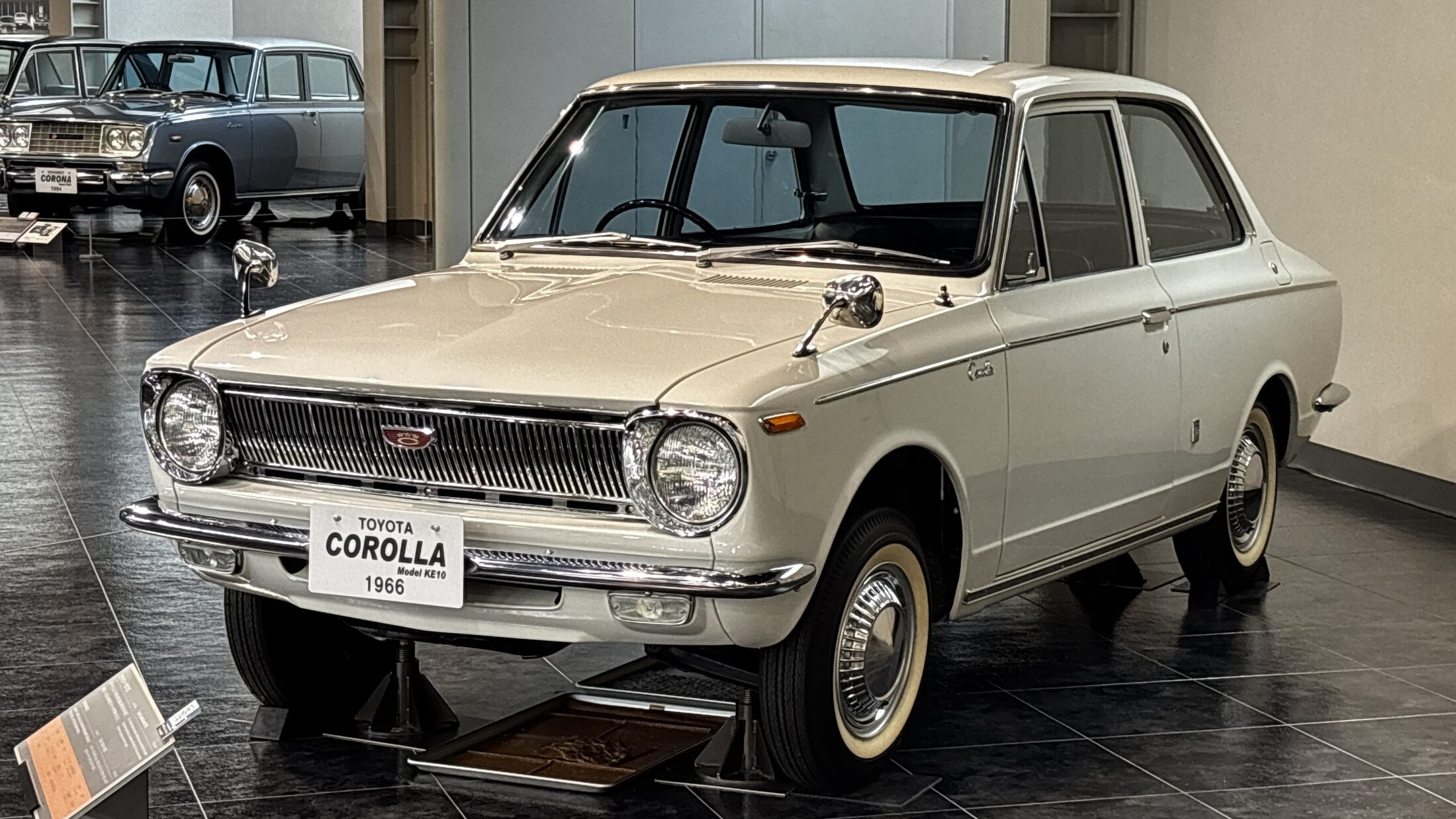
Toyota Corolla 2door Deluxe (KE10) '66 (1).jpg · Oq10pass · CC0
Research pending
A matching completed auction sale has not been verified for this exact year, body, trim, engine, transmission and market.
Joyride shows this gap instead of substituting an asking price, unsold bid or mismatched special vehicle.
More than a set of wheels.
Toyota positioned the Corolla between its simple Publica and larger Corona. Announced before the 1966 Tokyo Motor Show, it drew more than 1.3 million visitors to nationwide launch events on November 5 and 6. The first version was only a two-door sedan; Toyota's combination of comfort, easy maintenance, lively performance and value helped trigger Japan's economy-car boom. This profile fixes the identity at the original Japanese KE10-D Deluxe rather than blending in later first-generation changes.
Look a little closer.
Corolla means the ring of petals around the center of a flower—Toyota chose it to suggest a compact car that looked eye-catching rather than bare-bones.
Photos show an example of the model or generation. The pictured vehicle’s year, equipment, or modifications can differ from the specification described here.
The extra 100 cc was a deliberate idea
Toyota developed the 1,077 cc K engine so the Corolla could advertise a little more capacity than its 1,000 cc rivals. Project leader Tatsuo Hasegawa described the goal as an economy car that scored well in every everyday category, then lifted one feature above the rest. The engine's small numerical advantage became the memorable proof that an affordable car could still have 'power to spare.'
Source: Toyota · 75-Year History · Development of the Corolla ↗Practicality without looking plain
The launch Corolla used separate front seats, a four-speed floor shift and semi-fastback styling instead of presenting itself as the cheapest possible appliance. Toyota also designed long service intervals for the period: engine oil every 5,000 km, the cartridge oil filter every 10,000 km and the air-filter element every 30,000 km. That blend of aspiration and low upkeep was central to its success.
Source: Toyota · KE10 vehicle-lineage specifications ↗Where these facts come from
- Toyota · KE10 vehicle-lineage specifications
- Toyota · 75-Year History · Development of the Corolla
- Toyota Automobile Museum · Corolla KE10 database
Selected facts checked for this edition. Some source pages link to broader model families. Last reviewed October 1, 2026.