
TVR Cerbera 4.2
TVR stretched its sports-car formula into a compact four-seat coupe and, for the first time, put one of its own engines under the bonnet.
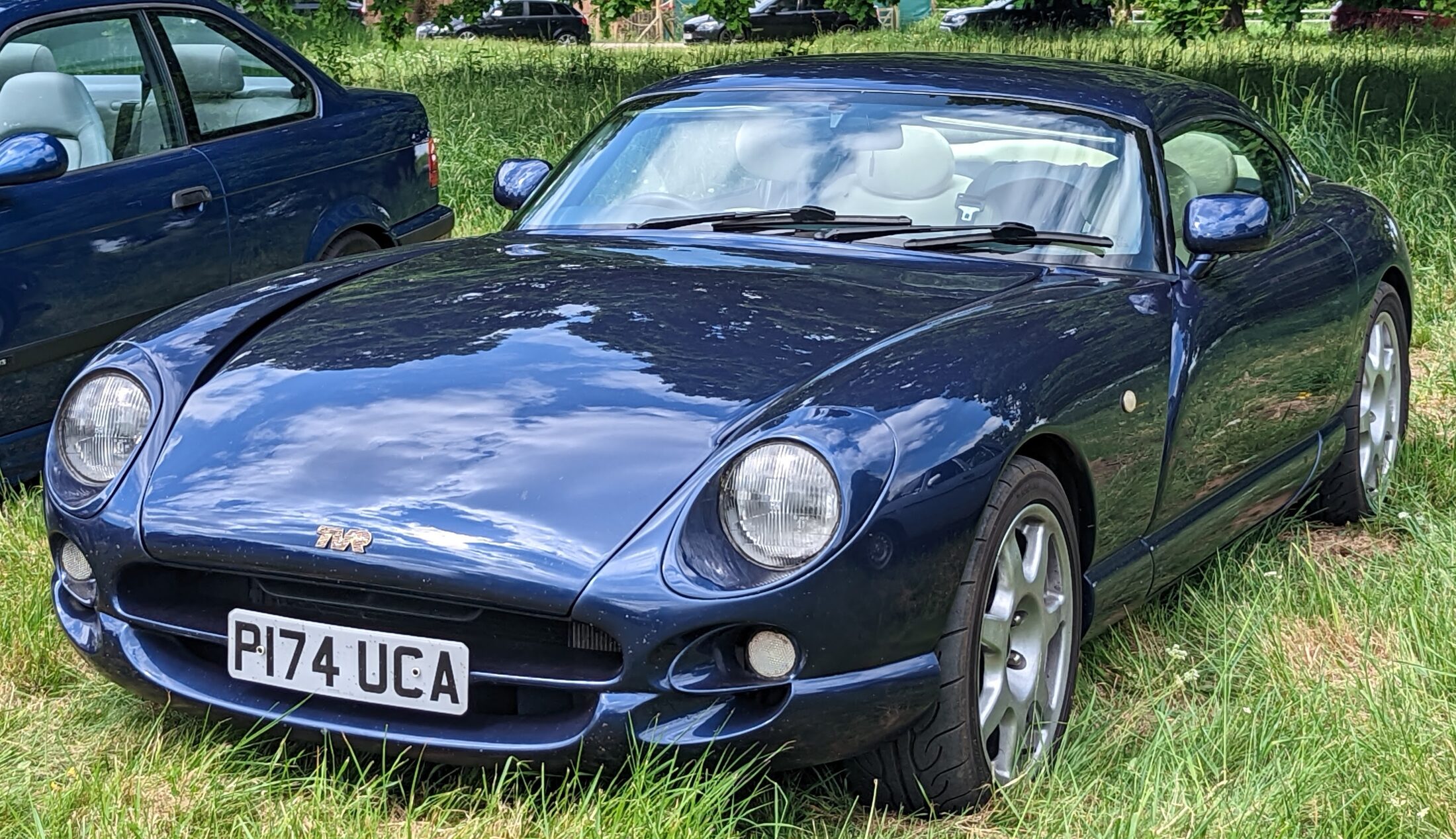
1996 Britain TVR Cerbera 4.2 · Calreyn88 · CC BY-SA 4.0
Research pending
A matching completed auction sale has not been verified for this exact year, body, trim, engine, transmission and market.
Joyride shows this gap instead of substituting an asking price, unsold bid or mismatched special vehicle.
More than a set of wheels.
The Cerbera began as a styling exercise in 1993 and reached production in 1996 after substantial development. Earlier TVR road cars used bought-in Rover V8s, but Peter Wheeler chose TVR's own AJP8 for the Cerbera. The original road version displaced 4.2 litres and sat in a new chassis beneath a separate composite body, with small rear seats making it a fast 2+2 rather than a two-seat roadster.
Look a little closer.
TVR arranged the seats more like a 3+1: the front passenger seat could slide farther forward to make extra room behind it.
Photos show an example of the model or generation. The pictured vehicle’s year, equipment, or modifications can differ from the specification described here.
A racing programme became an engine test laboratory
Before customers received Cerberas, TVR used versions of the AJP8 in its one-make Tuscan racing series. The owner's handbook says the engine had been tested there for two years, and the club history describes dozens of race drivers trying to break examples on track. Racing did not make every road engine identical, but it supplied unusually harsh running before TVR put its first in-house V8 into a production road car.
Source: TVR Engineering · Cerbera owner's handbook, May 1996 transcription ↗The cabin was designed around four unequal places
Calling the Cerbera a 2+2 hides a clever asymmetry. TVR allowed the front passenger seat to move farther forward than the driver's seat, creating useful legroom for the person directly behind it. The rear place behind the driver remained smaller. Long doors helped access both spaces, so the layout was better described as 3+1 than as four equal chairs.
Source: TVR Car Club · Cerbera model history and specifications ↗Where these facts come from
- TVR Engineering · Cerbera owner's handbook, May 1996 transcription
- TVR · Heritage: Wheeler era
- TVR Car Club · Cerbera model history and specifications
Selected facts checked for this edition. Some source pages link to broader model families. Last reviewed 2026-10-02.