
VAZ 2121 Niva
A short, car-like 4x4 that combined a unibody cabin with permanent four-wheel drive.
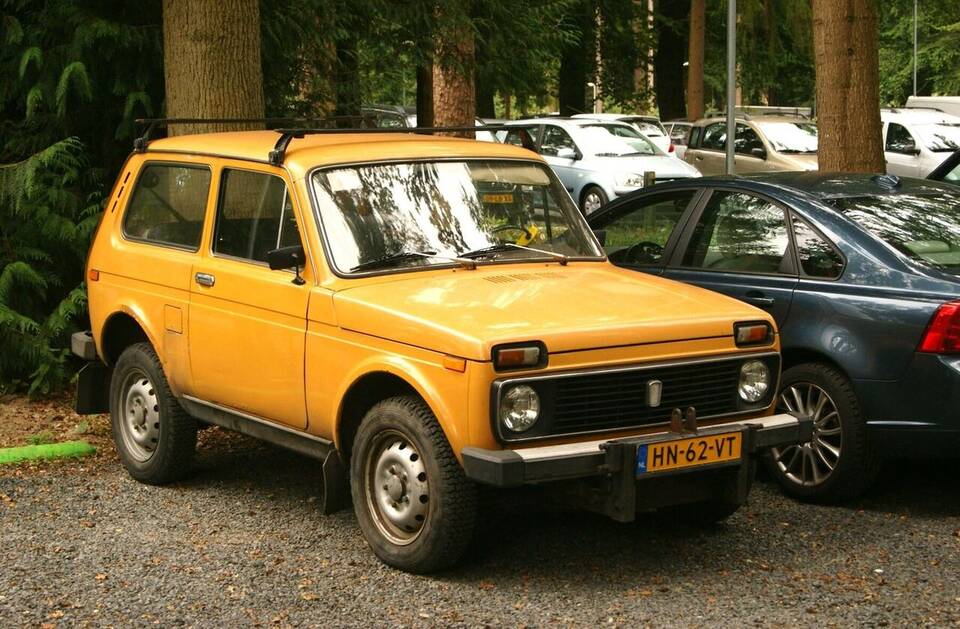
1982 Lada Niva (8870754922).jpg · Niels de Wit · CC BY 2.0
Research pending
A matching completed auction sale has not been verified for this exact year, body, trim, engine, transmission and market.
Joyride shows this gap instead of substituting an asking price, unsold bid or mismatched special vehicle.
More than a set of wheels.
The VAZ-2121 entered series production in April 1977 for travel across the Soviet Union's paved roads, dirt tracks, snow and mud. Unlike many off-road vehicles of its era, it used a self-supporting body, independent front suspension and coil springs. Its compact three-door shape and full-time four-wheel drive foreshadowed ideas later seen in small crossover SUVs.
Look a little closer.
Niva means a cultivated field—exactly the sort of rural landscape the little 4x4 was meant to cross.
Photos show an example of the model or generation. The pictured vehicle’s year, equipment, or modifications can differ from the specification described here.
Permanent 4x4, not part-time front help
The Niva drives all four wheels all the time through three differentials. A low-range transfer gear and lockable centre differential add traction without asking the driver to connect separate front hubs.
Source: VAZ-2121 Niva driver manual ↗A body shaped like a practical car
The short three-door body is self-supporting rather than placed on a separate ladder frame. Independent front suspension and a five-link live rear axle use coil springs, giving it a different character from leaf-sprung utility 4x4s.
Source: VAZ-2121 workshop manual · specifications ↗Designed for difficult rural routes
The manual describes a passenger-and-cargo vehicle for dirt roads, sand, snow, clay and shallow water. Its small dimensions and 4x4 system were tools for reaching places ordinary Soviet cars could not.
Source: VAZbook · purpose and characteristics ↗Where these facts come from
- VAZ-2121 Niva driver manual
- VAZ-2121 workshop manual · technical specifications
- AvtoVAZ 1999 company report · 1977 launch
Selected facts checked for this edition. Some source pages link to broader model families. Last reviewed September 29, 2026.