
Volvo 144 S
The faster first-year 144 wrapped a twin-carb engine, four-wheel disc brakes and a clever backup brake circuit in a clean, boxy family saloon.
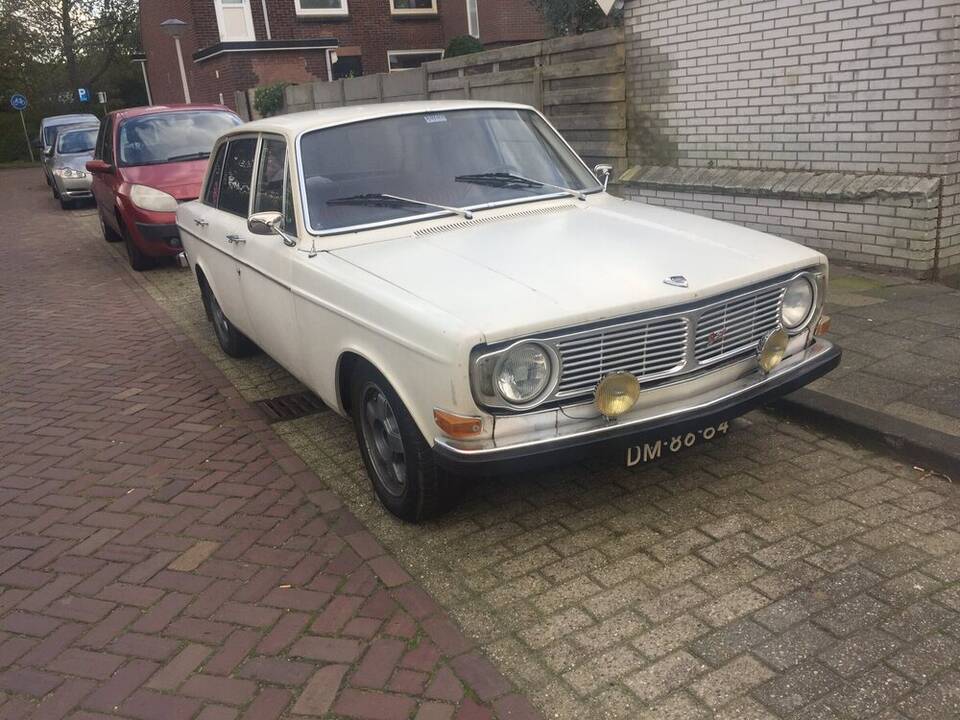
Volvo 144 S, DM-86-64 (48962191462).jpg · louisznl · CC BY 2.0
Research pending
A matching completed auction sale has not been verified for this exact year, body, trim, engine, transmission and market.
Joyride shows this gap instead of substituting an asking price, unsold bid or mismatched special vehicle.
More than a set of wheels.
Volvo revealed the 144 on 17 August 1966 and began mass production two days later for the 1967 model year. The name decoded the car: 1-series, four-cylinder engine, four doors. The S meant the stronger twin-carburettor B18B rather than the standard single-carburettor B18A. Beneath Jan Wilsgaard's square shape were crumple zones, a protective passenger structure and a triangular-split dual-circuit braking system.
Look a little closer.
In 144, the first digit named the series, the second counted cylinders and the third counted doors.
Photos show an example of the model or generation. The pictured vehicle’s year, equipment, or modifications can differ from the specification described here.
A brake circuit shaped like a safety net
A conventional split system can leave only one end of a car braking after a failure. Volvo's triangular split kept both front brakes plus one rear brake working when one circuit failed. Pressure-reducing valves also helped keep wheels from locking during hard stops, while discs on all four wheels improved heat control.
Source: Volvo Cars · The 140 becomes Volvo's first million seller ↗Why two power numbers survive
Volvo's 2016 retrospective rates the twin-carb early engine at 96 hp DIN. An older Volvo UK historical review calls the B18B 115 hp but does not label the measurement convention. Those figures should stay attached to their source standards instead of being treated as two different engines or silently converted.
Source: Volvo Cars UK · 1960–1969 historical review ↗Where these facts come from
- Volvo Cars · The 140 becomes Volvo's first million seller
- Volvo Cars UK · 1960–1969 historical review
- Volvo Cars · 140 series overview and specifications
Selected facts checked for this edition. Some source pages link to broader model families. Last reviewed 2026-10-01.