
Wartburg 353
The Wartburg 353 wrapped an airy square sedan body around an unusual water-cooled three-cylinder two-stroke and front-wheel drive.
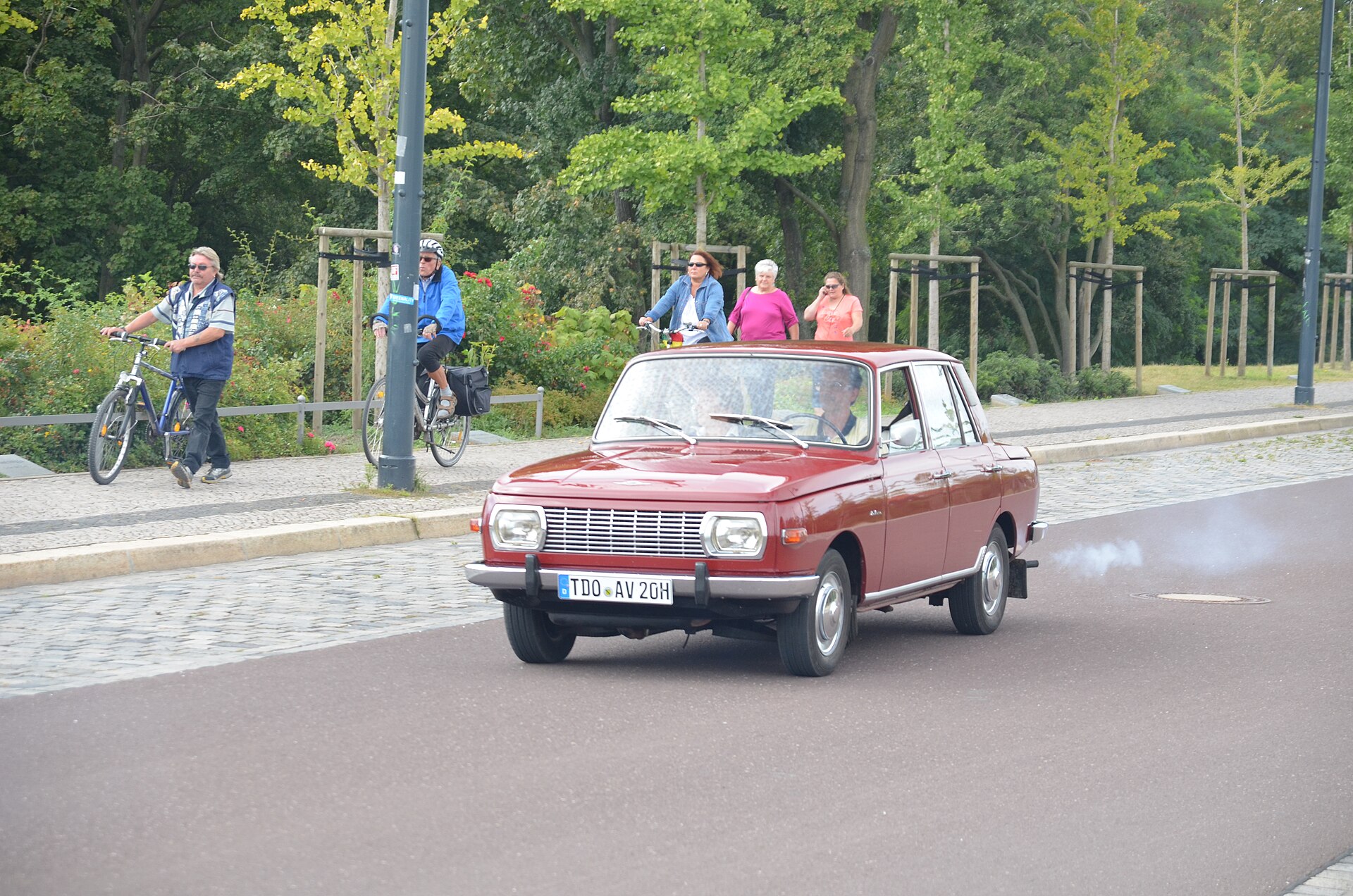
Early-body Wartburg 353 sedan on a historic-car drive · Torsten Maue · CC BY 2.0
Research pending
A matching completed auction sale has not been verified for this exact year, body, trim, engine, transmission and market.
Joyride shows this gap instead of substituting an asking price, unsold bid or mismatched special vehicle.
More than a set of wheels.
VEB Automobilwerk Eisenach began series production of the Wartburg 353 on 1 July 1966. Its new body sat on a coil-sprung chassis whose roots had appeared in the transition-model 312. The first 353 kept the marque's three-cylinder two-stroke idea: only three cylinders, but one power stroke from each cylinder every crankshaft revolution. It became one of East Germany's best-known family cars, but this profile freezes the launch specification before later power and braking updates.
Look a little closer.
Its 991-992 cc engine had just three cylinders, yet the roomy body was designed to carry five people.
Photos show an example of the model or generation. The pictured vehicle’s year, equipment, or modifications can differ from the specification described here.
A new body on a separately developed chassis
The Wartburg 312 had already introduced the coil-sprung chassis in September 1965 while retaining the older body. The 353 completed the transformation in July 1966 with its clean, angular body. Looking at both dates explains why calling every mechanical feature 'new for 1966' would be misleading.
Source: Automobile Welt Eisenach · manufacturing timeline ↗Why the three-cylinder two-stroke feels different
With ports rather than a four-stroke valve train and a firing event every revolution, the engine is mechanically simple but asks its lubrication and exhaust systems to do unusual jobs. The launch car's 45 PS figure is important: later 353 engines gained power, so a 50 PS number does not belong on this 1966 profile.
Source: Wartburg-Service · technical settings ↗Where these facts come from
- Automobile Welt Eisenach · manufacturing timeline
- Auta5P · Wartburg 353 1966 catalogue entry
- Wartburg-Service · period technical data
Selected facts checked for this edition. Some source pages link to broader model families. Last reviewed 2026-10-02.