
Ford Model A Runabout
Ford's first company car was a tiny two-seater whose engine hid under the bench and pulled the rear wheels by chain.
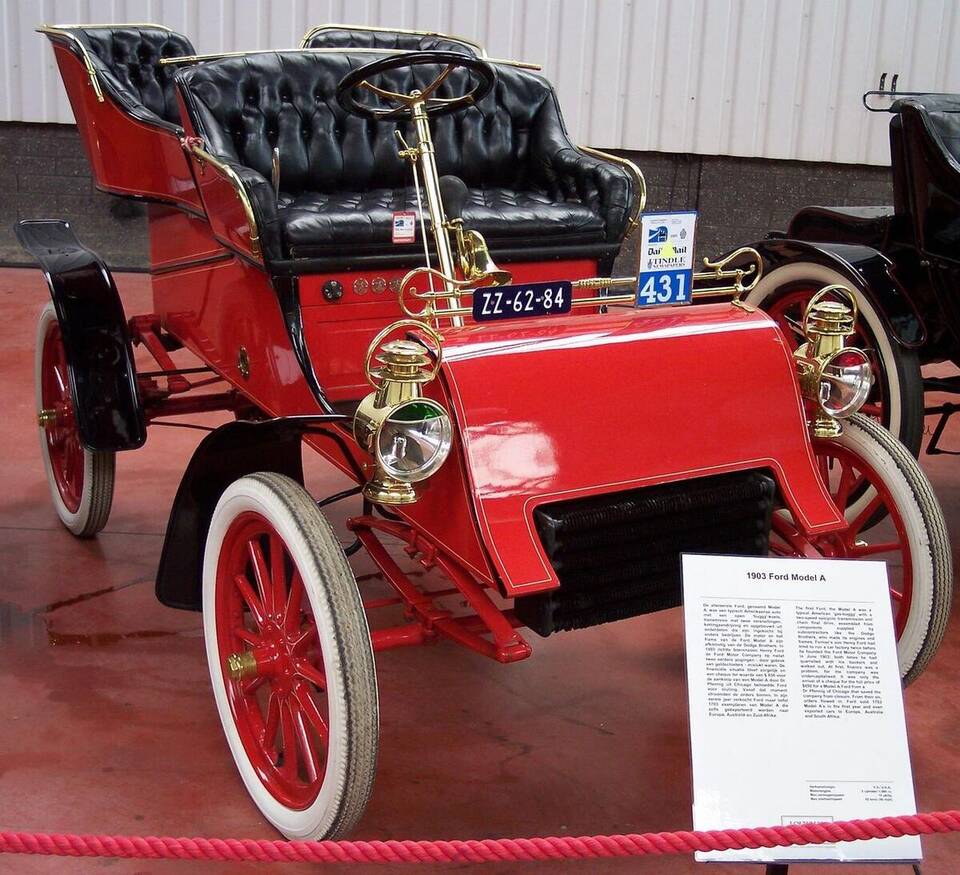
Ford Model A 1903.jpg · de:Benutzer:Stahlkocher · CC BY-SA 3.0
What did this one sell for?
Make a guess, then reveal one identity-matched completed auction result. It is a comparison point, not a price promise.
Reveal the auction result
Based on a completed sale at Gooding & Company, an estimated value for this vehicle is $173,600.
Why this sale: Exact 1903 U.S. first-series Ford Model A two-seat Runabout, not the rear-entry tonneau and not the later Model AC. Engine no. 230; 100.4 cu. in. two-cylinder; two-speed planetary manual transmission with reverse and chain drive. Beautifully presented older restoration by Ralph Buckley, acquired by Mark Smith in 2019 after 55 years of single-family ownership. The saleroom addendum says it was titled as 0230, its engine number.
All-in auction result including the 12% buyer's premium. The $173,600 result implies a $155,000 final bid; taxes, title fees, transport and recommissioning are excluded. One auction result is a reference, not an appraisal; condition, history, options, location and market timing can change value. Accepted because year, body, engine architecture, transmission and market match the profile and the optional rear tonneau is absent. Older restoration and engine-number title should remain visible.
More than a set of wheels.
Ford Motor Company was incorporated in Detroit in June 1903 after Henry Ford's two earlier car businesses had failed. Its first product was the Model A, and the first customer car was sold on July 15. By the standards of 1903 the Model A was conventional rather than radical: it looked like a light carriage, steered with a tiller, placed its two-cylinder engine beneath the seat and used chains to drive the rear wheels. That modest machine mattered because its sales gave the new company a working start. The Henry Ford records more than 670 examples before the model was retired during 1904; this profile stays with the two-seat runabout rather than treating the optional tonneau as the same body.
Look a little closer.
The museum's price comparison says an average worker in 1903 would need about one year and nine months of wages to equal the car's $850 price.
Photos show an example of the model or generation. The pictured vehicle’s year, equipment, or modifications can differ from the specification described here.
The little car that made a third attempt stick
Henry Ford had already been involved in two unsuccessful automobile companies. The Model A belonged to the third attempt, Ford Motor Company, backed by twelve investors with $28,000. A real sale on July 15, 1903 turned a newly incorporated workshop into an operating carmaker. The Model A was not yet the mass-production breakthrough of the later Model T; its importance is that a practical, saleable first product kept the company moving long enough to reach those later ideas.
Source: Ford Motor Company · Henry Ford biography ↗Why an early car looks like a carriage
In 1903 there was no settled recipe for an automobile. Ford used familiar carriage proportions and a bench seat, then tucked the compact opposed-cylinder engine underneath. Chain drive was visible, understandable machinery, while a two-speed transmission was enough for the low road speeds of the day. The result helps explain a transition: builders began with carriage habits, then gradually reorganized the engine, body and controls into the layout children recognize as a car today.
Source: The Henry Ford · 1903 Model A Runabout ↗Where these facts come from
- The Henry Ford · 1903 Ford Model A Runabout
- Ford Motor Company · Henry Ford biography
- The Henry Ford · Model A outside Dearborn Engineering
- The Henry Ford · 1903 Model A advertisement
Selected facts checked for this edition. Some source pages link to broader model families. Last reviewed October 1, 2026.