
Cadillac Model 30 Touring
An electric starter helped end the dangerous job of hand-cranking a big engine—but its controls were not yet like a modern car’s.
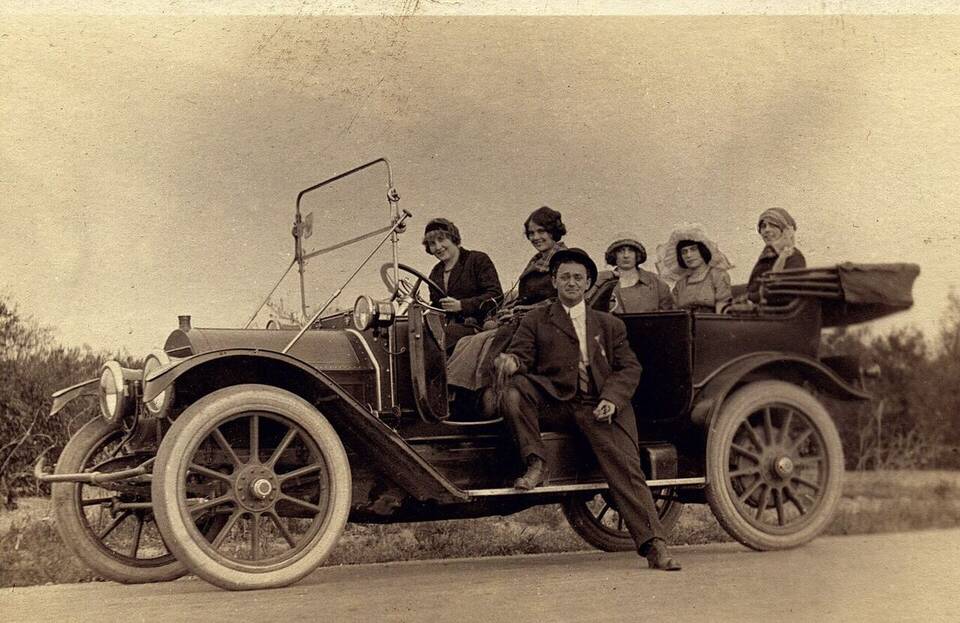
1912 Cadillac Model 30 Touring car · William Creswell · CC BY 2.0
Research pending
A matching completed auction sale has not been verified for this exact year, body, trim, engine, transmission and market.
Joyride shows this gap instead of substituting an asking price, unsold bid or mismatched special vehicle.
More than a set of wheels.
Cadillac's Model 30 family had already helped prove interchangeable manufacturing. For 1912, engineers Charles Kettering and Delco supplied an electric system that started the engine and powered the lamps. That made the large four-cylinder touring car easier and safer to operate. The system earned Cadillac a second Dewar Trophy and helped electric starting become a normal expectation rather than a luxury experiment.
Look a little closer.
Cadillac became the first manufacturer to win Britain's Dewar Trophy twice—first for interchangeable parts and again for the 1912 starter-and-lighting system.
Photos show an example of the model or generation. The pictured vehicle’s year, equipment, or modifications can differ from the specification described here.
A small electric motor changed every journey
Hand cranks could kick back when an engine fired, making starting difficult and sometimes dangerous. Cadillac's production electric starter let the driver start a large engine from the controls. Its importance was not extra speed; it removed a physical barrier to using the car.
Source: GM Heritage Collection · 1912 Cadillac Model 30 ↗Starter, generator and lights worked as a system
The 1912 breakthrough was more than one button. Cadillac combined electric starting with electric lighting, using a battery and generator system to make the car easier to live with after dark and easier to restart. That complete system is why the car received the Dewar Trophy.
Source: Toyota Automobile Museum · Cadillac Model Thirty ↗Starting and reading the car in 1912
A contemporary Progress report describes a more involved start than a modern push-button car: the driver retarded the spark and pushed the clutch pedal forward, engaging the electrical starting drive. Releasing the pedal after the engine fired disengaged that drive, and the electrical machine resumed generating. The report also identifies a gasoline gauge on the dash and a lamp for the speedometer, so the electrical system helped the driver read information after dark as well as light the road. A small lever at the steering wheel adjusted carburettor air. These are period operating descriptions, not instructions for starting a surviving museum car.
Source: Progress · The 1912 Cadillac, November 1, 1911, p.866 (Papers Past) ↗Where these facts come from
- GM Heritage Collection · 1912 Cadillac Model 30
- Toyota Automobile Museum · Cadillac Model Thirty
- Cadillac-LaSalle Club Museum · 1912 Cadillac Touring Car
- Reynolds Museum · 1912 Cadillac Model 30 Roadster record
- Progress · The 1912 Cadillac, November 1, 1911, p.866 (Papers Past)
Selected facts checked for this edition. Some source pages link to broader model families. Last reviewed October 1, 2026.