
DeSoto Airflow Series SE Sedan
The DeSoto Airflow tried to make a whole family car behave more like an airplane moving through the wind—and then wrapped its passengers inside a strong steel structure.
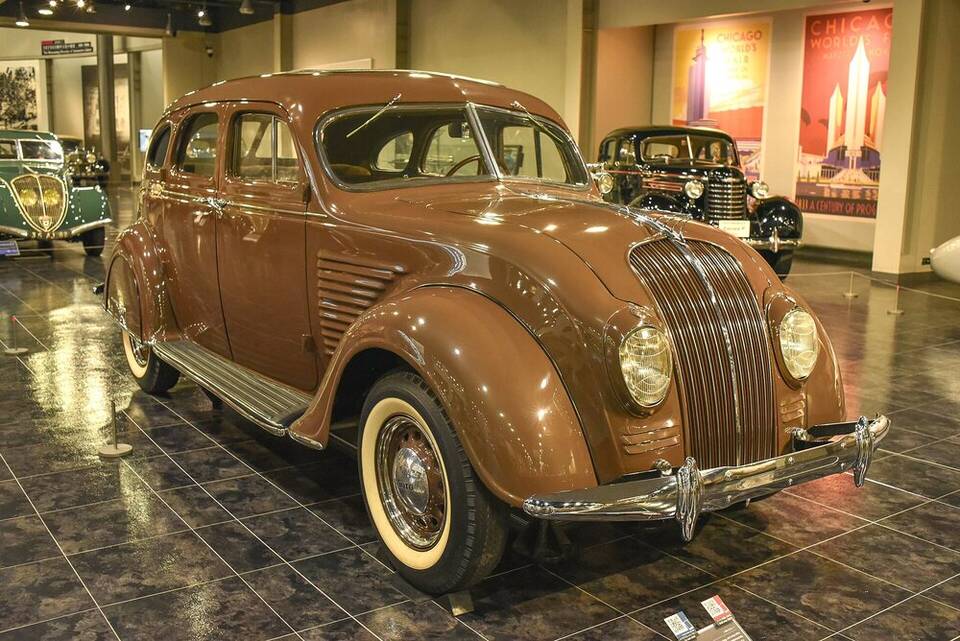
1934 DeSoto Airflow Sedan.jpg · Coolalabright · CC BY 4.0
Research pending
A matching completed auction sale has not been verified for this exact year, body, trim, engine, transmission and market.
Joyride shows this gap instead of substituting an asking price, unsold bid or mismatched special vehicle.
More than a set of wheels.
Chrysler engineers Carl Breer, Fred Zeder and Owen Skelton used wind-tunnel work to challenge the tall, separate-box shapes of early 1930s cars. DeSoto made the 1934 Series SE Airflow its only model line that year. Its rounded nose, swept-back grille and cabin placed farther forward looked startling, and buyers did not embrace it, but the car demonstrated ideas about airflow, weight distribution and passenger packaging that would become normal much later.
Look a little closer.
Every 1934 DeSoto Airflow body style carried the same $995 base price, whether it was the five-passenger coupe or this six-passenger sedan.
Photos show an example of the model or generation. The pictured vehicle’s year, equipment, or modifications can differ from the specification described here.
A shape tested with moving air
The engineering team studied airflow instead of simply decorating a traditional upright body. The rounded front and smoother roofline reduced the sharp changes that make air tumble, while the wheels and cabin were packaged into one visual shape. It was an early American attempt to design a production car as one aerodynamic object.
Source: National DeSoto Club · 1934 ↗Passengers moved toward the middle
The Airflow's cabin and seats were positioned more fully between the axles than in conventional cars of the day. That helped spread weight and gave six occupants useful room within a 115.5-inch wheelbase. Its steel construction joined the body and supporting structure more closely than a normal body simply bolted onto a separate ladder frame.
Source: The Henry Ford · 1934 DeSoto Airflow Sedan ↗Where these facts come from
- The Henry Ford · 1934 DeSoto Airflow Sedan
- National DeSoto Club · 1934
- Airflow Club of America · The Airflow DeSoto
- Toyota Automobile Museum · De Soto Airflow Series SE
Selected facts checked for this edition. Some source pages link to broader model families. Last reviewed September 30, 2026.