
Tatra 77a
A center fin, three headlights and an air-cooled V8 in the tail made this Czech streamliner look like a machine from tomorrow.
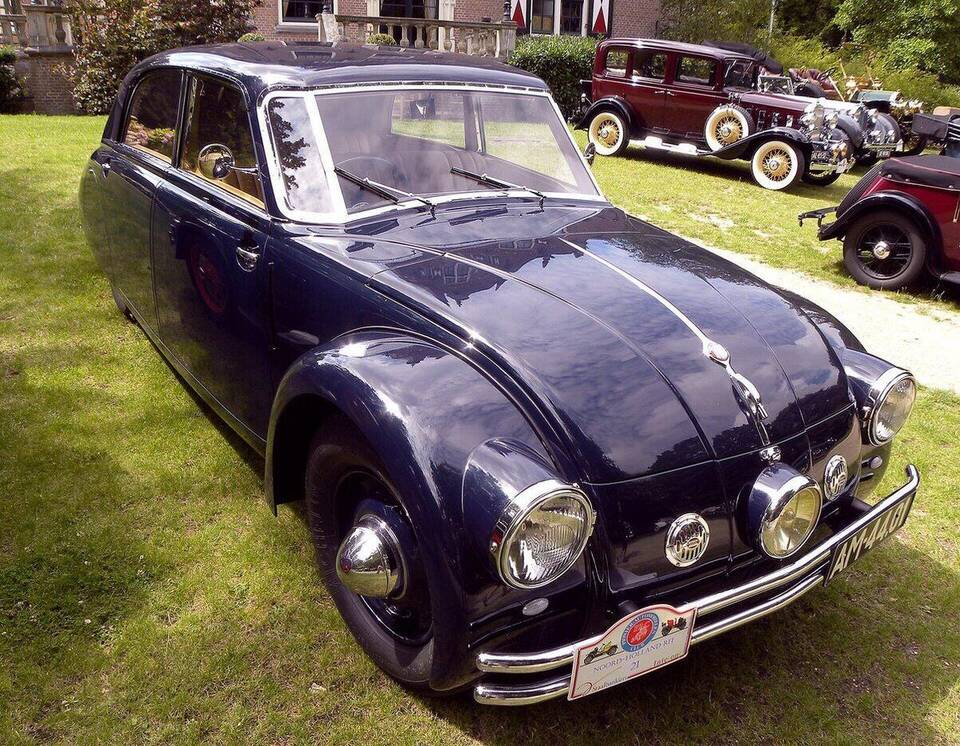
Tatra 77A in the Netherlands · joost j. bakker · CC BY 2.0
Research pending
A matching completed auction sale has not been verified for this exact year, body, trim, engine, transmission and market.
Joyride shows this gap instead of substituting an asking price, unsold bid or mismatched special vehicle.
More than a set of wheels.
Tatra's Hans Ledwinka, Erich Übelacker and Erich Ledwinka developed a large car around airflow instead of decorating a conventional upright body. The original Tatra 77 appeared in 1934; the modernized 77a followed in 1936 with a larger 3.38-liter V8 and detail changes. Its engine sat behind the rear axle, freeing the nose for a smooth shape and keeping engine heat and fumes away from passengers. The result could reach 150 km/h with only 70 metric horsepower.
Look a little closer.
The restored National Technical Museum car was laser-scanned into about 30 million surface points so a 1:5 tactile model could let blind visitors explore its shape.
Photos show an example of the model or generation. The pictured vehicle’s year, equipment, or modifications can differ from the specification described here.
Streamlining made modest power go farther
The National Technical Museum records 150 km/h from a 1,850 kg car with 70 metric hp, noting that a conventionally shaped contemporary needed almost twice the power for similar speed. That is the clearest lesson of the 77a: reducing air resistance can matter as much as adding engine output.
Source: National Technical Museum · Tatra 77a exhibition catalogue ↗Restored to document, not to drive
The museum's 1937 survivor was deliberately preserved as evidence. Restorers returned its appearance while avoiding mechanical repairs or replacement parts that would erase wear. It remains non-operational because authenticity mattered more than making it run.
Source: National Technical Museum · Tatra 77a: From Miracle to Wreck and Back ↗Where these facts come from
- National Technical Museum · Tatra 77a exhibition catalogue
- National Technical Museum · Tatra 77a: From Miracle to Wreck and Back
- Czech Ministry of Culture · National Technical Museum restored 1937 Tatra 77a
Selected facts checked for this edition. Some source pages link to broader model families. Last reviewed September 30, 2026.