
Tama Electric Car E4S-47-I
A postwar electric sedan built when Japan had little gasoline but spare generating capacity.
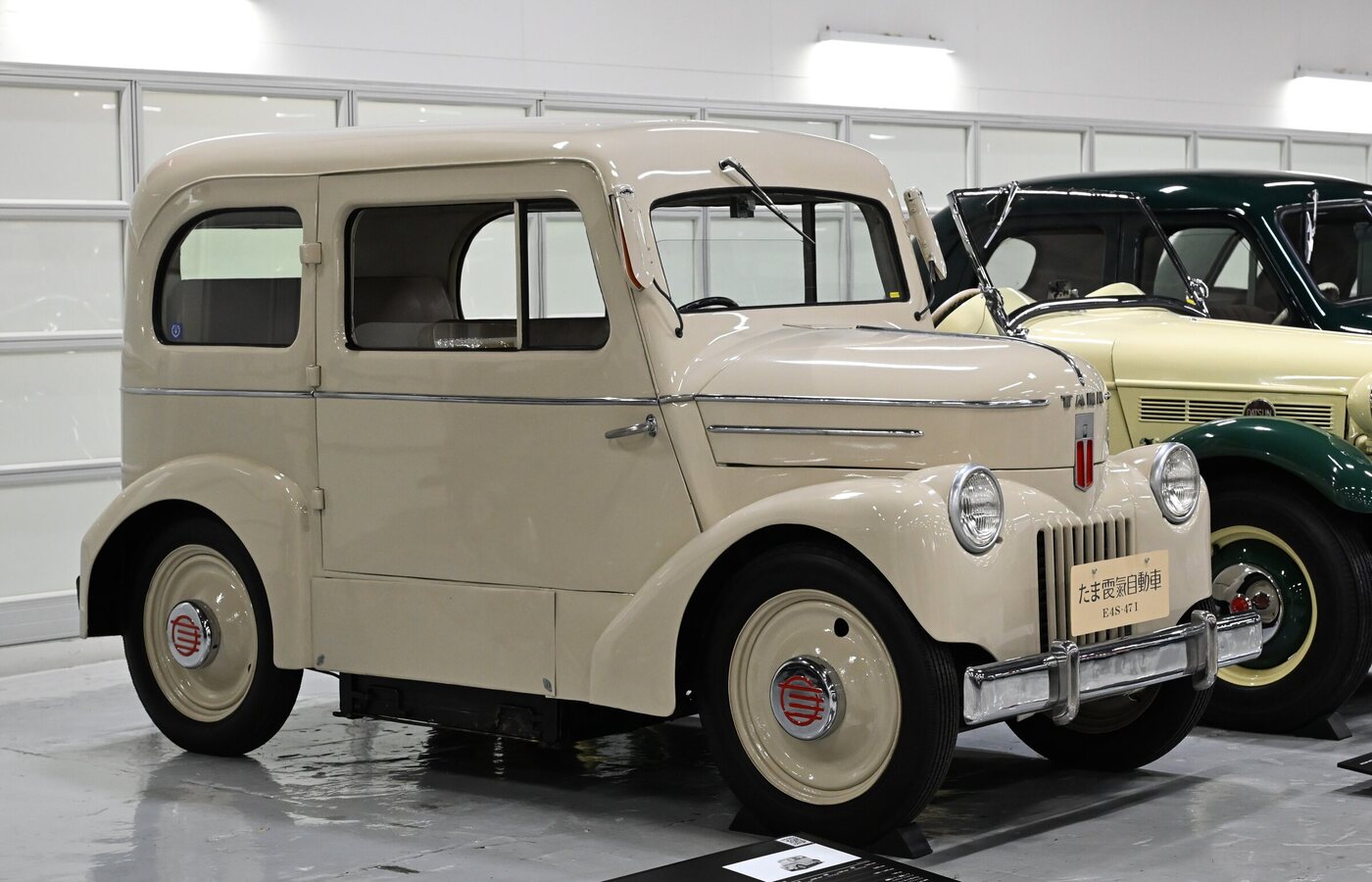
1947 Tama Electric Car E4S-47-I · TTTNIS · CC0 1.0
Research pending
A matching completed auction sale has not been verified for this exact year, body, trim, engine, transmission and market.
Joyride shows this gap instead of substituting an asking price, unsold bid or mismatched special vehicle.
More than a set of wheels.
After World War II, former Tachikawa Aircraft engineers turned from airplanes to road vehicles. Gasoline was tightly restricted, while electricity from hydroelectric plants was comparatively available, so the new Tokyo Electro Automobile company developed an electric car. Its four-seat Tama appeared in 1947 and later worked as a taxi. The company eventually became part of Prince Motor, which merged with Nissan in 1966. Nissan restored this E4S-47-I to its 1947 specification and returned it to running condition in 2010.
Look a little closer.
Its code is a compact description: E means electric, 4S means four-seat sedan, 47 is the year, and I means the initial type.
Photos show an example of the model or generation. The pictured vehicle’s year, equipment, or modifications can differ from the specification described here.
Why 65 km and 96 km can both be true
Nissan's specification table lists a normal cruising range of 65 km per charge. The same archive says the Tama achieved 96 km in Japan's first electric-vehicle performance test. One is the catalog-style operating figure; the other is a result under a particular test. Keeping the labels prevents a test record from becoming an everyday promise.
Source: Nissan Heritage Collection · Tama Electric Car E4S-47-I ↗A car born from an energy mismatch
The Tama was not electric because batteries had suddenly beaten gasoline in every way. Japan's immediate postwar conditions made electricity comparatively available while oil was scarce. Engineers chose the energy source the country could supply, a reminder that vehicle design responds to infrastructure as well as invention.
Source: Japan Society of Mechanical Engineers · Mechanical Engineering Heritage No. 40 ↗Where these facts come from
- Nissan Heritage Collection · Tama Electric Car E4S-47-I
- Society of Automotive Engineers of Japan · Tama Electric Vehicle landmark
- Japan Society of Mechanical Engineers · Mechanical Engineering Heritage No. 40
- Nissan News · Long before LEAF: the 1947 Tama electric car
Selected facts checked for this edition. Some source pages link to broader model families. Last reviewed September 30, 2026.