Porsche 356 No. 1 Roadster
Porsche's first name-bearing sports car was a hand-built aluminium roadster with its tiny flat-four mounted just behind the seats.
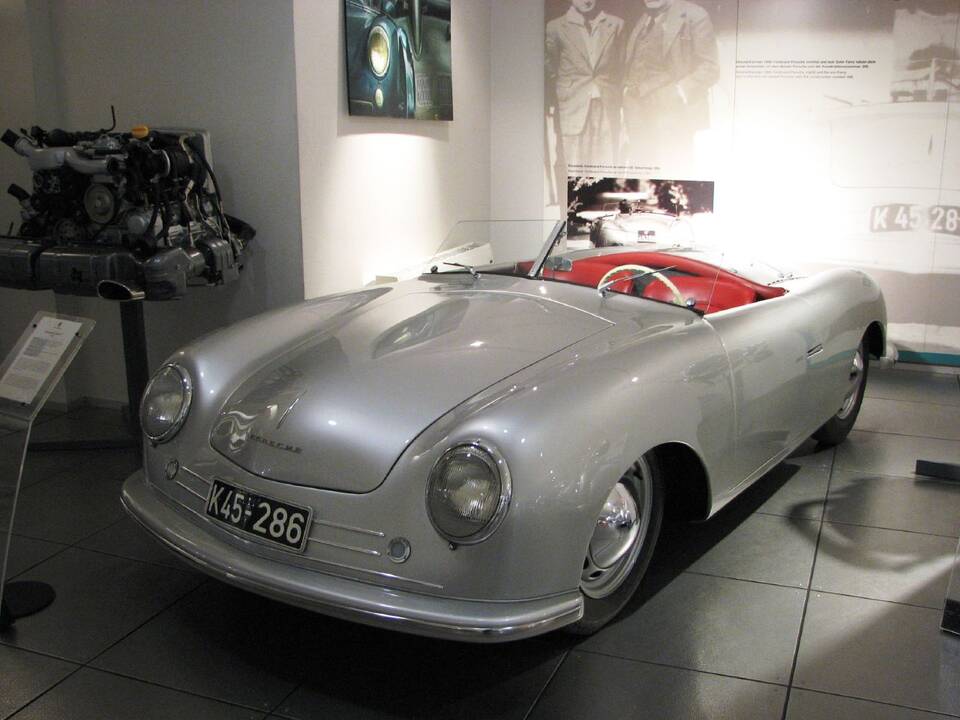
Porsche 356 Nr. 1 Roadster 1948.jpg · leduardo · CC BY 2.0
Research pending
A matching completed auction sale has not been verified for this exact year, body, trim, engine, transmission and market.
Joyride shows this gap instead of substituting an asking price, unsold bid or mismatched special vehicle.
More than a set of wheels.
Ferry Porsche and the Gmünd team created chassis 356.001 in post-war Austria, initially calling the project VW Sport. It received its general operating permit on 8 June 1948, the date Porsche treats as the brand's birth. The No. 1 stayed unique: the 356/2 cars developed alongside it used a box-section frame, moved the engine behind the rear axle and became the first small production series.
Look a little closer.
Porsche's detailed history says Herbert Kaes drove the No. 1 for a demonstration lap at Innsbruck on 11 July 1948, just over a month after its Austrian approval.
Photos show an example of the model or generation. The pictured vehicle’s year, equipment, or modifications can differ from the specification described here.
Volkswagen pieces arranged into a new sports car
The engine, front axle, steering, wheels and brakes came from the Volkswagen Beetle, but Porsche changed their job and surroundings. A steel lattice-tube frame carried a hand-shaped aluminium body, and the engine moved ahead of the rear axle to concentrate weight near the middle for cornering grip.
Source: Porsche Newsroom · The Number 1 lives on ↗One prototype, then a different production answer
The 356 No. 1 was not simply the first production 356. The 356/2 that followed used a steel box frame, a rear-mounted 40-PS engine and room for tiny rear seats and luggage. The prototype therefore matters both as the first Porsche and as an experiment whose lessons were rearranged for production.
Source: Porsche Newsroom · Made in Austria ↗One big dial for a very small roadster
The preserved No.1's driver area is pared back to a large, centrally placed speedometer, small warning lights and a few switches behind a thin-rim three-spoke wheel. The readable museum photograph explains how little separated the driver from the essentials, while remaining evidence of the car's present display configuration rather than proof that every knob and finish is unchanged from launch day.
Source: Wikimedia Commons · Porsche No1 dash ↗The museum car is the survivor, but not an untouched 1948 shape
Porsche says the No. 1 changed hands repeatedly, was damaged, repaired, modernized and converted, so its 1948 body form is now lost and cannot simply be restored. The surviving car remains chassis 356.001, but present-day museum photographs document its later physical state. Porsche's archive identifies several visible differences: the 1948 tail tapered more sharply, its nose projected farther, and a single rear lid once ran from the cockpit to just above the bumper. A later two-part arrangement put a side panel over the engine and a shorter cover over the luggage area. This distinction protects children from treating every current panel seam as a launch-day fact.
Source: Porsche Newsroom · Back to the Roots ↗A scan helped rebuild the lost outline—but did not become a public 3D model
For the 2018 anniversary show car, Porsche Museum specialists scanned the survivor in three dimensions, overlaid that scan with digitized 1948 drawings, checked period photographs and journals, and corrected radii from fixed reference points. A milling machine then cut a full-size foam form, and craftspeople shaped aluminium with hand tools and original wooden gauges. Paint samples hidden beneath the dashboard helped them approach the earlier color. The result is a research-based, non-driving interpretation of the original shape, not an untouched second 1948 car. Porsche has not exposed the scan or reconstruction geometry as a reusable public viewer or downloadable model, so Joyride must not count the source page as tested 3D.
Source: Porsche Newsroom · Back to the Roots ↗The first long test came before the birthday date
Porsche's anniversary dossier quotes engineer Karl Rabe's diary for 27 May 1948: the team returned to Gmünd at 9 p.m. after covering 256 kilometres on the final test drive. The first chassis outing was on 5 February, but Porsche accounts differ on whether Ferry Porsche drove it that day; Karl Rabe's diary places Ferry's test on 6 February. Those waypoints help separate development from legal identity. The car existed and was being tested before 8 June; the later date matters because that was when chassis 356.001 received its general operating permit, which Porsche treats as the brand's birth date.
Source: Porsche Newsroom · Early 356 chronology ↗Approval did not freeze the car's development state
The approval date was not the end of development. Porsche's institutional history quotes Karl Rabe's diary: on 13 May the open-bodied Type 356 stood in yellow primer, was weighed and driven by Ferry Porsche. On 22 May Rabe met engineer Ernst from Lind about the car's type approval. The same chronology records that the painted roadster returned to the Gmünd factory from Spittal on 14 June—six days after Austria issued the individual approval. These entries form a construction timeline; they do not prove that today's silver body or trim matches the 1948 state.
Source: Porsche Newsroom · Early 356 chronology ↗Its first press audience was Swiss, not a production-car launch
Porsche presented the officially named Sport 356/1 around the Swiss Grand Prix at Bremgarten, where motoring journalists were already gathered. The first driving report appeared in Automobil-Revue on 7 July 1948 and praised the little car's stability and usefulness for both everyday sporting drivers and competition. This was publicity for the unique mid-engined roadster. The rear-engined 356/2, completed separately, was the small-series answer that followed; it is the wrong identity for No. 1 specifications, photos and sound.
Source: Porsche Newsroom · The Number 1 lives on ↗The survivor's unusual road back to Porsche
The one-off was sold to Swiss architect Peter Kaiser for CHF 7,500 and received the Zürich plate ZH 20640 on 20 December 1948. Porsche reports that Kaiser converted the cable brakes to hydraulics and altered the script to read Pesco. Later owner Hermann Schulthess had Porsche install new brakes and a 1.5-litre engine for slaloms; after an Opel rear-ended the car, repairs brought larger wheel arches and round tail lamps. Further owners followed before Porsche recovered the car in 1958 by exchanging a new 356 Speedster for it. These changes explain why identity and present physical condition must be stated separately.
Source: Porsche Newsroom · The Number 1 lives on ↗What driving the conserved original asks of its driver
During Porsche's 2018 Swiss drive, the mid-mounted engine produced noticeable heat, the fuel system formed bubbles in 31-degree weather, and the unsynchronised four-speed needed double-clutching. Porsche also says the engine still carries its original number. These are observations from the conserved and modified survivor on that drive, not proof that a factory-fresh 1948 car behaved identically. They nevertheless make the engineering tangible: the gearbox does not synchronize its own shaft speeds, so the driver helps them match between shifts.
Source: Porsche Newsroom · The Number 1 lives on ↗Why the mid-engine layout did not become the production recipe
The No. 1 placed its Volkswagen-derived flat-four ahead of the rear axle. A 2023 first-hand drive notes the useful consequence: luggage space existed at both the nose and tail. The same arrangement also made the prototype difficult to cool, required a long and notchy shift linkage, and left little room for a passenger. Those packaging costs help explain the decisive change in the 356/2: moving the engine behind the axle simplified production and released more usable cabin space. This is a comparison of Porsche's exact chassis 356.001 with its immediate production-development successor, not a claim that later rear-engine 356 specifications apply to the No. 1. The driving source concerns the preserved and historically altered survivor, so present-day control feel should not be treated as an untouched June 1948 baseline.
Source: Car and Driver · We Drove 356/1, the First Street-Legal Porsche Ever Made ↗The original and the 2018 show car had different jobs
Porsche's 2018 anniversary tour used two visually related but mechanically different vehicles. The original chassis 356.001 was the running participant: Porsche records parade laps at Le Mans Classic, a hill-climb appearance at Goodwood, a Bernese mountain drive and stages of the Ennstal Classic. The companion research show car reconstructed the early body shape for display and, as Porsche's separate build account states, was deliberately non-running and had no engine. That division matters when identifying event photographs: motion at those named events can belong to the conserved original, while the champagne-colored display reconstruction is not the record car and must remain labelled a show car. Porsche's reported tour distances describe worldwide transport and appearances, not mileage driven by either vehicle, so they should not be entered as odometer or road-distance facts.
Source: Porsche Newsroom · Around the world with the Porsche 356 No. 1 Roadster ↗Where these facts come from
- Porsche Museum · 356 No. 1 Roadster
- Porsche Classic · Model 356
- Porsche Newsroom · Made in Austria
- Porsche Newsroom · The Number 1 lives on
- Porsche Newsroom · Back to the Roots
- Porsche Christophorus · Brand Moments
- Porsche Newsroom · Early 356 chronology
- Car and Driver · We Drove 356/1, the First Street-Legal Porsche Ever Made
- Porsche Newsroom · Around the world with the Porsche 356 No. 1 Roadster
Selected facts checked for this edition. Some source pages link to broader model families. Last reviewed October 5, 2026.