
Austin Seven
By turning the engine sideways and tucking the gearbox beneath it, the Austin Seven put four useful seats into a car barely over three metres long.
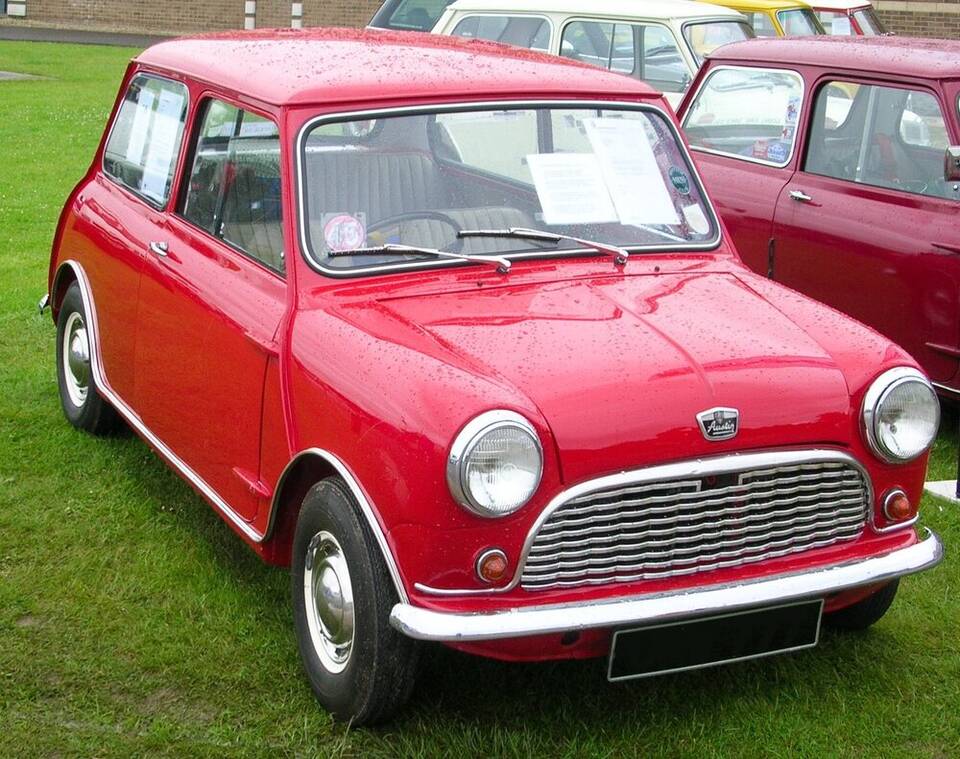
1959 Austin Seven · DeFacto · CC BY-SA 4.0
What did this one sell for?
Make a guess, then reveal one identity-matched completed auction result. It is a comparison point, not a price promise.
Reveal the auction result
Based on a completed sale at Iconic Auctioneers / Classic Car Auctions, an estimated value for this vehicle is £16,875.
Why this sale: Exact 1959 UK-market Austin Mini Seven DeLuxe two-door saloon, chassis AA2S7 7363, engine 8A-U-H-7080 and manual transmission. The auction described a delightful early Austin Seven DeLuxe with just over 15,000 miles. The reading and catalogue description do not independently prove total mileage, untouched trim or unrestored mechanical condition.
Sold price including buyer premium; the sale catalogue states 12.5% buyer premium plus VAT (15% including VAT). Taxes, registration, transport and remedial work are excluded. One auction result is a reference, not an appraisal; condition, history, options, location and market timing can change value. Accepted as an exact year, Austin-badged body, UK-market and manual-transmission completed sale. It is a single disclosed-condition result, not a generic appraisal or a claim about the globally latest sale.
More than a set of wheels.
BMC revealed two badge-engineered versions of Alec Issigonis's tiny ADO15 on 26 August 1959: the Austin Seven and Morris Mini-Minor. The first production Austin Seven had already left Longbridge on 4 April. Fuel shortages shaped the brief, but clever packaging made the result far more than an economy car.
Look a little closer.
The 1959 Austin Seven and Morris Mini-Minor differed mainly in their badges, grilles, hubcaps and colours; the shared shape did not officially become a make called MINI until decades later.
Photos show an example of the model or generation. The pictured vehicle’s year, equipment, or modifications can differ from the specification described here.
A packaging puzzle solved sideways
Issigonis's team reduced the planned A-series engine from 948 to 848 cc, turned it across the nose and placed the gearbox in the sump. That left enough cabin room for four people while the whole car measured about 3.05 metres. Rubber-cone springs also occupied less space than long steel coils.
Source: BMW Group Press · Fifty Years of MINI ↗Why the corners matter
A 2.03-metre wheelbase fills much of the short body, leaving tiny overhangs. Independent suspension is carried on front and rear subframes, while the low stance and wide track for its size helped the Mini feel agile. The same decisions that saved space also made the car unusually eager to change direction.
Source: MINI · 1959: The Mini was born ↗A launch-year car is not always a launch-day car
The National Motor Museum dates its blue Austin Mini Seven to October 1959. It is a launch-year survivor, built after the August public reveal. Its cabin photograph is useful for exploring the central instrument layout, but an October museum car does not establish every fitting on an August car or prove that its trim is unrestored.
Source: National Motor Museum · Austin Mini Seven ↗Where these facts come from
- BMW Group Press · 1959–2009: Fifty Years of MINI
- BMW Group Classic · Morris Mini-Minor
- MINI · 1959: The Mini was born
- MINI · World of MINI
- National Motor Museum · October 1959 Austin Mini Seven
Selected facts checked for this edition. Some source pages link to broader model families. Last reviewed October 5, 2026.