
Austin-Healey Sprite Mk I
A tiny, affordable roadster turned an Austin family-car engine into one of Britain's friendliest sports cars.
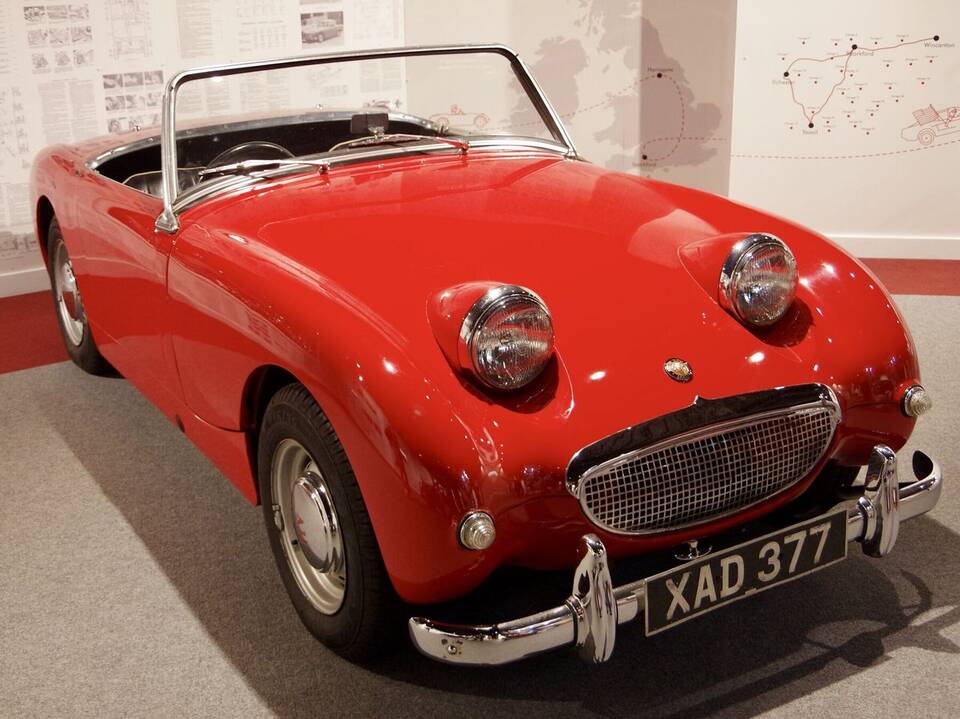
1959 Austin-Healey Sprite Frogeye at Haynes Motor Museum · Dave Hamster · CC BY 2.0 Generic
Research pending
A matching completed auction sale has not been verified for this exact year, body, trim, engine, transmission and market.
Joyride shows this gap instead of substituting an asking price, unsold bid or mismatched special vehicle.
More than a set of wheels.
Austin-Healey launched the Sprite in 1958 as a simple sports car that more people could afford. This page follows a standard 1959 Mk I, known as the Frogeye in Britain and Bugeye in the United States. Its whole nose tilts forward, while the original body has no outside boot lid: luggage is reached from behind the seats. The cover's exact year and market are stated in its photo note rather than assumed from its appearance.
Look a little closer.
The raised headlamps were originally intended to retract, but the production car kept them fixed—creating the face that earned its Frogeye and Bugeye nicknames.
Photos show an example of the model or generation. The pictured vehicle’s year, equipment, or modifications can differ from the specification described here.
A body that does the heavy work
Instead of sitting on a separate chassis, the Sprite's steel body carries most structural loads. Front chassis legs support the engine and the one-piece hinged nose, while the compact rear structure saves weight and cost.
Source: Toyota Automobile Museum · Austin Healey Sprite ↗Small-car parts, sports-car purpose
The Sprite shared its basic 948 cc A-Series engine with ordinary BMC cars, then added twin SU carburettors. Its low seating position, rack-and-pinion steering and light mass made cornering fun even when straight-line speed was modest.
Source: Austin-Healey Sprite Driver's Handbook ↗Where these facts come from
- Austin-Healey Sprite Driver's Handbook
- Toyota Automobile Museum · Austin Healey Sprite
- Christie's · 1959 Austin-Healey Sprite
Selected facts checked for this edition. Some source pages link to broader model families. Last reviewed September 29, 2026.