Jaguar Mark 2 3.8-Litre Saloon
The Mark 2 put sports-car pace, four doors and powerful disc brakes into one compact Jaguar saloon.
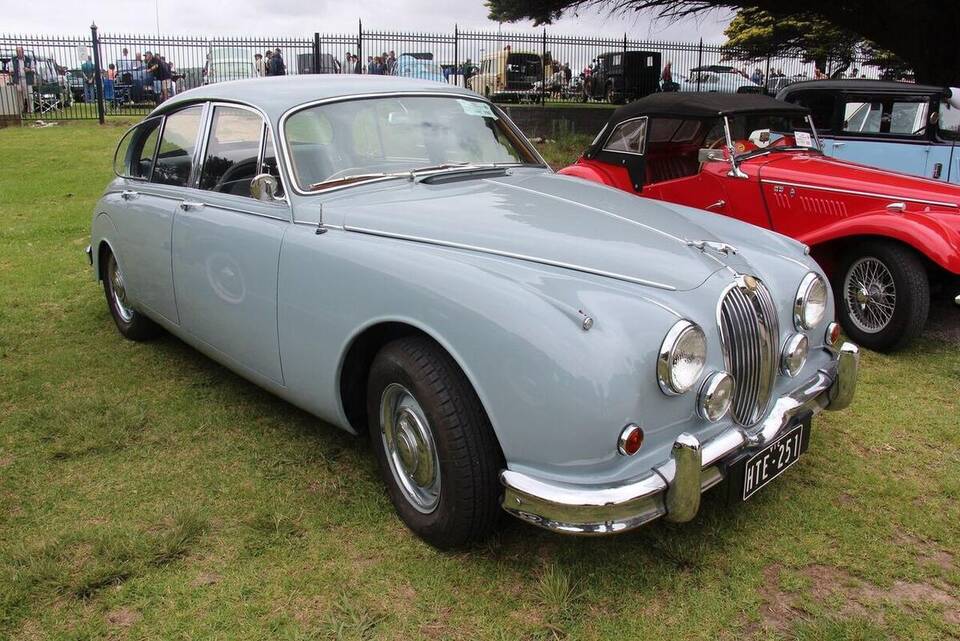
1962 Jaguar MK II 3.8 Saloon (16162061878).jpg · Sicnag · CC BY 2.0
Research pending
A matching completed auction sale has not been verified for this exact year, body, trim, engine, transmission and market.
Joyride shows this gap instead of substituting an asking price, unsold bid or mismatched special vehicle.
More than a set of wheels.
Jaguar introduced the Mark 2 in 1959 as a thorough development of its compact unit-body saloon. More glass and slimmer pillars made the cabin brighter, while a wider rear track and redesigned upper body improved the stance. The new 3.8-litre option brought the XK engine's largest road-car displacement to the compact saloon, backed by four-wheel Dunlop disc brakes. Its mix of speed, leather-and-wood comfort and practical seating made it equally visible in business, police service, touring-car competition and popular culture.
Look a little closer.
Jaguar increased the glass area by 18 percent, making the redesigned saloon much easier to see out of.
Photos show an example of the model or generation. The pictured vehicle’s year, equipment, or modifications can differ from the specification described here.
A faster car that was also easier to see from
Jaguar's redesign above the waist was not merely cosmetic. Slimmer pillars and 18 percent more glass reduced the closed-in feel of the earlier compact saloon. The same car gained a wider rear track and preserved a relatively small footprint, so the Mark 2 combined better visibility with a more planted stance rather than becoming a much larger luxury car.
Source: Jaguar · Icons: Mark II ↗Why the 3.8 changed the saloon formula
The launch brochure couples a 220-bhp twin-cam six with servo-assisted Dunlop discs at all four wheels. A 1960 Motor Sport test described 125 mph and a standing quarter-mile a little over 16 seconds, then emphasized how easily the car covered distance. The deeper achievement was balance: acceleration, braking, seating and refinement in one production four-door, not a racing engine inserted into an otherwise unaltered family car.
Source: Motor Sport · Jaguar 3.8 Mk II road test ↗Where these facts come from
- Jaguar Daimler Heritage Trust · Mark II 3.8
- Jaguar · Icons
- Jaguar · 3.4 & 3.8 Litre Mark 2 brochure scan
- Motor Sport · Jaguar 3.8 Mk II road test
- Jaguar Mark 2 press information scan
Selected facts checked for this edition. Some source pages link to broader model families. Last reviewed October 1, 2026.