
Honda T360
Honda's first production four-wheeler put a tiny, high-revving four-cylinder engine beneath a useful little truck.
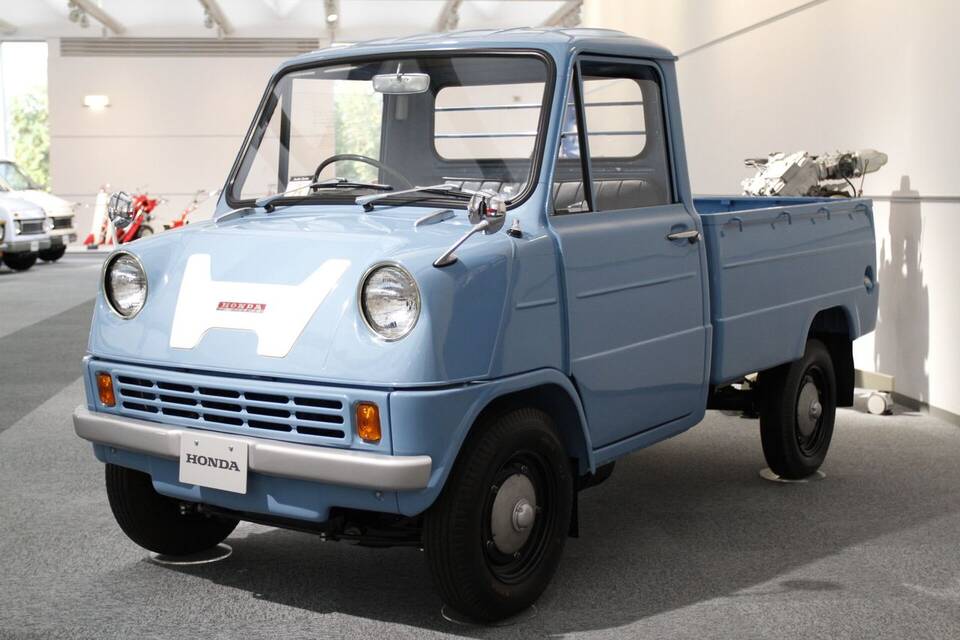
1963 Honda T360 · baku13 · CC BY-SA 2.1 Japan
Research pending
A matching completed auction sale has not been verified for this exact year, body, trim, engine, transmission and market.
Joyride shows this gap instead of substituting an asking price, unsold bid or mismatched special vehicle.
More than a set of wheels.
Honda had already built motorcycles when it chose a commercial mini-truck as its first production automobile. The T360 appeared publicly in 1962 and went on sale in August 1963, two months before the S500 sports car. Its kei-class size helped it fit narrow streets and tax rules while its engine showed unmistakable motorcycle thinking.
Look a little closer.
Honda displayed the T360 beside the S360 sports-car prototype at the 1962 Japan National Auto Show, but the little truck reached customers first.
Photos show an example of the model or generation. The pictured vehicle’s year, equipment, or modifications can differ from the specification described here.
Why Honda began with a truck
Honda's history explains that a mini-truck could serve a clear commercial need and could be sold through a network already accustomed to the company's motorcycles. Engineers began prototype work in 1960 and kept testing the design before launch.
Source: Honda Heritage · Launching the S360 and T360 ↗A complicated path through the factories
Honda’s production history assigns T360 engines and final assembly to Wako, with bodies shipped from Suzuka. The S500 shared the engine and body supply sites but went to Hamamatsu for final assembly. That distinction matters: Honda’s early car-making system was dispersed, but the two models did not have the same final assembly location.
Source: Honda 75-Year History · The road to producing automobiles ↗Why a work truck could rev so high
Honda’s engineering history describes an aluminum, water-cooled four-cylinder with two overhead camshafts, four CV carburetors and equal-length exhaust runners. It records 30 PS at 8,500 rpm for the T360’s AK250E. That is an engine-output speed, not a recommended constant driving speed or a tachometer redline.
Source: Honda · The first automobile engines ↗Where these facts come from
- Honda · T360 product archive, August 1963
- Honda Heritage · Launching the S360 and T360
- Honda 75-Year History · The road to producing automobiles
- Honda · T360 AK250E engine architecture and output
Selected facts checked for this edition. Some source pages link to broader model families. Last reviewed October 5, 2026.