
Laverda 1000 Jota
Born in Breganze and sharpened in Herefordshire, the first Jota combined Laverda's rugged 981 cc triple with racing cams, high-compression pistons and a freer exhaust. It became a production-racing champion and one of the fastest road bikes of its day.
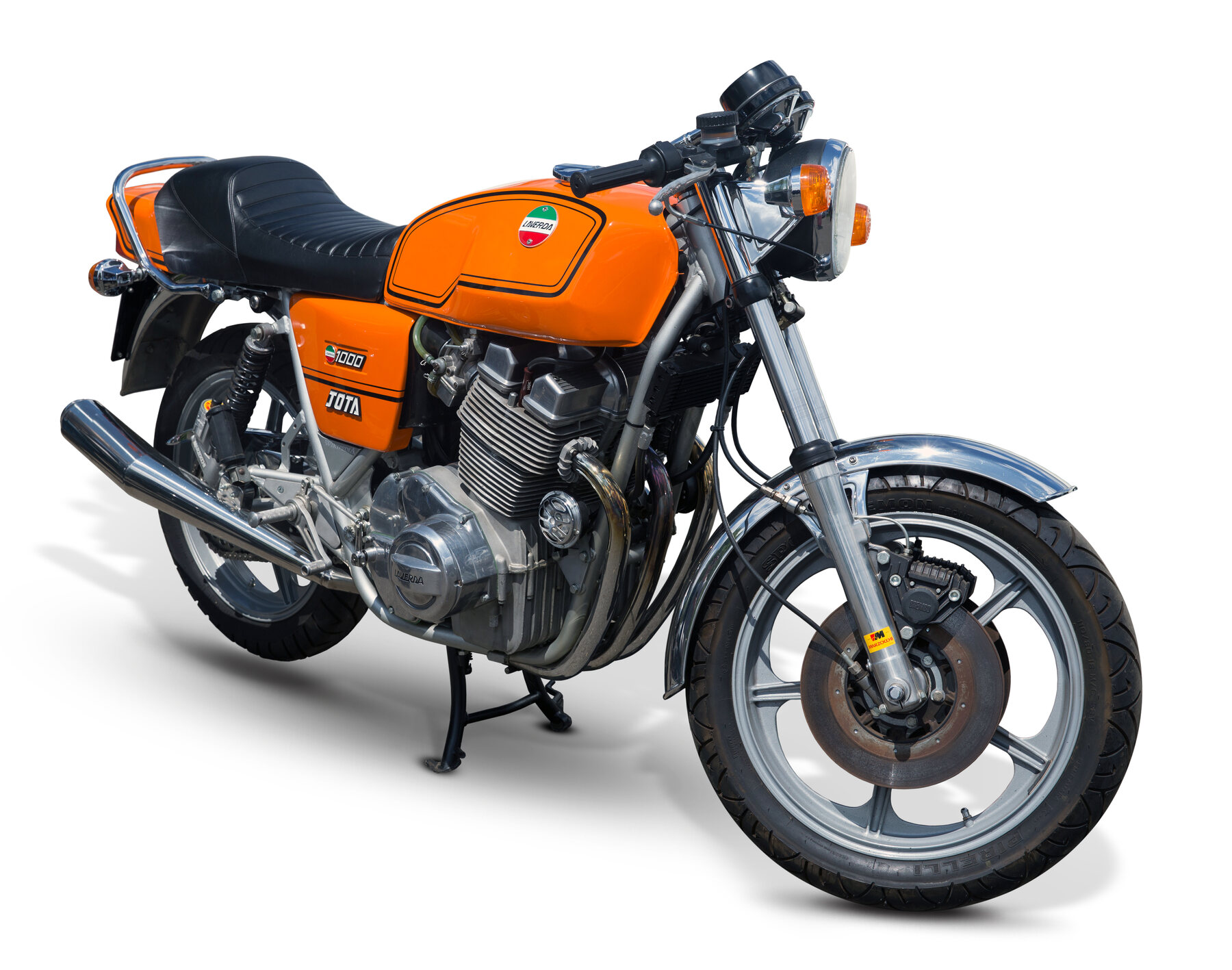
1976 Italy Laverda Jota 1000 · Mr.choppers (source photograph); Auge=mit (cutout, retouching) · CC BY-SA 4.0
Research pending
A matching completed auction sale has not been verified for this exact year, body, trim, engine, transmission and market.
Joyride shows this gap instead of substituting an asking price, unsold bid or mismatched special vehicle.
More than a set of wheels.
Laverda's 1000 triple evolved into the cast-wheel, three-disc 3CL in 1975. British importers Roger and Richard Slater had already been tuning 3Cs with optional 4C racing camshafts, 10:1 pistons, revised steering hardware and a freer exhaust, calling the package 3CE. In 1976 Massimo Laverda agreed to build that specification for the UK, where it was named Jota. Peter Davies won the Avon production series on one, validating a road bike that was expensive, demanding and extraordinarily fast. Later markets and later 120-degree engines require separate profiles.
Look a little closer.
Laverda built the Jota in Italy, but the original model was created with its British importer for the UK market.
Photos show an example of the model or generation. The pictured vehicle’s year, equipment, or modifications can differ from the specification described here.
An Italian motorcycle co-authored by an importer
The Jota was not merely a factory model exported to Britain. Slater Brothers identified the 3C's racing potential, combined factory optional parts with their own exhaust and geometry choices, and proved the package in production racing. Factory manufacture in 1976 turned that importer-developed recipe into a real variant.
Source: La 1000 Jota ↗Why '180-degree' sounds stranger than it is
The nickname describes crank positions, not a perfectly even firing sequence. The two outer pistons move together and the center piston opposes them, producing strong vibration pulses and a distinctive exhaust beat. Laverda later adopted a smoother 120-degree crank, but that changes the personality enough that collectors treat it as a separate Jota generation.
Source: La 1000 Jota ↗Where these facts come from
Selected facts checked for this edition. Some source pages link to broader model families. Last reviewed October 2, 2026.