
Škoda 105 S
This simple family sedan kept its engine behind the back wheels but moved its radiator to the nose, sending coolant through long pipes beneath the floor.
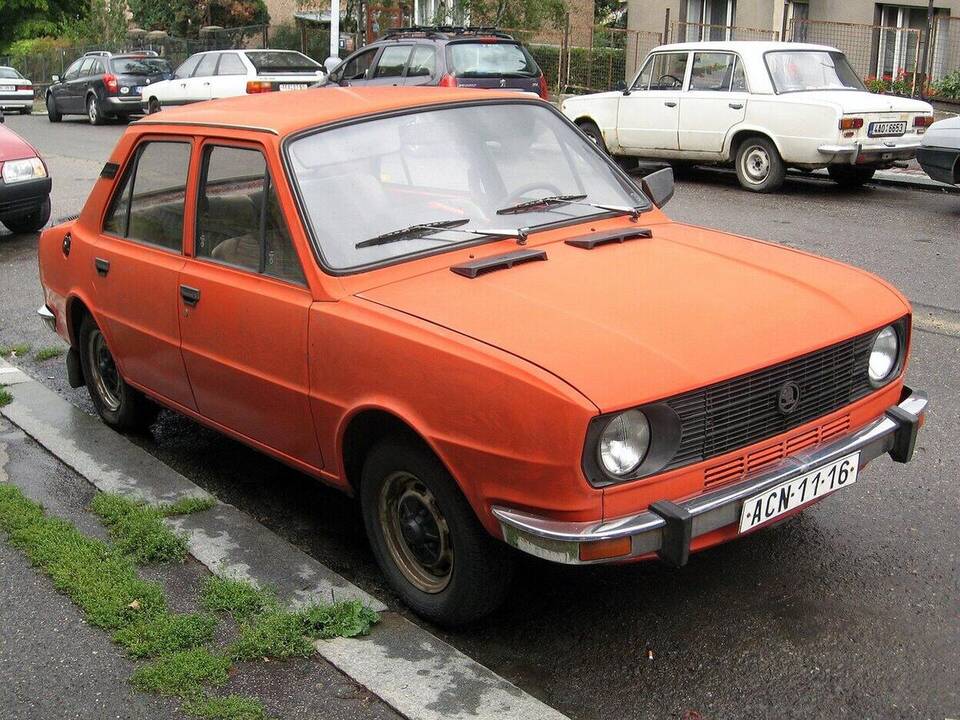
Škoda 105 S · Ludek · CC BY-SA 3.0
Research pending
A matching completed auction sale has not been verified for this exact year, body, trim, engine, transmission and market.
Joyride shows this gap instead of substituting an asking price, unsold bid or mismatched special vehicle.
More than a set of wheels.
Škoda replaced the 100/110 family with the Type 742 series in 1976. The basic 105 S and better-equipped 105 L shared a 1,046 cc engine, while 120 versions used a larger unit. Political and industrial limits kept the familiar rear-engine layout, but the body was new, roomier and more angular. The 105 S was deliberately sparse—the letter S meant Standard—and served as the entry point to a family of cars that became part of daily life across Eastern Europe.
Look a little closer.
In France, the 105 badge became 1050 because Peugeot protected three-digit model names with a zero in the middle.
Photos show an example of the model or generation. The pictured vehicle’s year, equipment, or modifications can differ from the specification described here.
A new body around a familiar idea
The Type 742 kept a rear engine and rear-wheel drive but replaced the 100/110 with a squarer five-seat sedan. Official Škoda history dates the 105/120 debut to autumn 1976. A front luggage compartment and radiator used the otherwise empty nose, while another small storage space sat behind the rear seat.
Source: Škoda Storyboard · Creator of famous prototypes ↗What the S leaves out
The 105 S was the basic launch trim, below the 105 L. It used the same 1,046 cc engine and four-speed transmission but fewer comfort details. That distinction matters for photographs: later GL cars, rectangular-headlamp facelifts and 120 models can share the body shape while showing equipment that a 1976 S never had.
Source: Škoda Poland archive · 40 years of 105/120 ↗Where these facts come from
- Škoda Storyboard · Creator of famous prototypes
- Škoda Poland press archive · 40 years of 105/120
- 1976 Škoda 105/120 French brochure archive
- ŠKOldtimer · 105 S technical specifications
- Škoda 105 Type 742 technical overview
Selected facts checked for this edition. Some source pages link to broader model families. Last reviewed September 30, 2026.