
Citroën BX 16 TRS
The BX 16 TRS looked as if it had been folded from paper, yet it was a roomy family hatchback with Citroën's famous self-leveling hydropneumatic suspension. This profile uses the exact 1.6-liter French launch specification from September 1982.
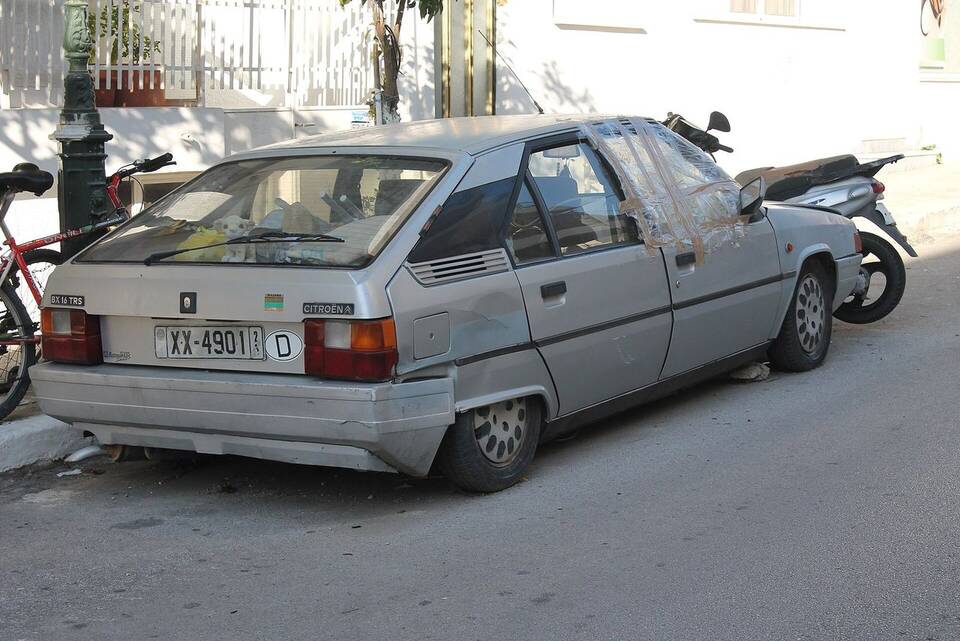
1982 Citroën BX 16 TRS · Charlie from United Kingdom · CC BY 2.0
Research pending
A matching completed auction sale has not been verified for this exact year, body, trim, engine, transmission and market.
Joyride shows this gap instead of substituting an asking price, unsold bid or mismatched special vehicle.
More than a set of wheels.
Citroën revealed the BX beneath the Eiffel Tower on September 23, 1982, then put it on sale at the Paris Motor Show one week later. Marcello Gandini at Bertone shaped the crisp five-door body. Underneath, the BX mixed a transverse PSA engine with clever lightweight construction and hydraulic suspension, helping it replace the GSA while moving Citroën into a larger family-car class.
Look a little closer.
The early dashboard placed unusual 'satellite' controls beside the steering wheel, so the driver could reach many functions without moving a hand far from the rim.
Photos show an example of the model or generation. The pictured vehicle’s year, equipment, or modifications can differ from the specification described here.
A launch date with a landmark backdrop
Citroën unveiled the BX on September 23, 1982 beneath the Eiffel Tower and began selling it at the 69th Paris Motor Show a week later. The launch range contained five versions, including both BX 16 RS and BX 16 TRS. This packet stays with the TRS rather than blending in later 16-valve, diesel, estate or facelift specifications.
Source: Citroën / Stellantis Media — BX celebrates its 40th birthday ↗Light weight and hydraulic comfort
The launch data lists a minimum wet mass of 950 kg for the 1.6-liter cars, unusually light for a roomy five-door. Citroën combined that low mass with hydropneumatic suspension, 444 liters of luggage room and a 90-hp engine. The official 11.3-second 0–100 km/h and 176 km/h maximum-speed figures are period manufacturer claims, not modern instrumented tests.
Source: Citroën / Stellantis Media — BX launch technical sheet ↗Shape by Bertone, controls by Citroën
Citroën asked Italian coachbuilder Bertone to design the BX, and Marcello Gandini proposed its sharp, simple shape. Inside, Citroën kept its own experimental spirit with controls grouped around the steering wheel and a backlit tachometer. Citroën Origins preserves period BX 16 TRS imagery and brochures that help separate the square early dashboard from the completely redesigned 1987 interior.
Source: Citroën Origins — BX ↗Where these facts come from
- Citroën / Stellantis Media — BX celebrates its 40th birthday
- Citroën Origins — BX
- Citroën UK brochures archive — 1981–1983
Selected facts checked for this edition. Some source pages link to broader model families. Last reviewed September 30, 2026.