
Honda Civic 25i (AH)
The sharp-edged Wonder Civic put a fuel-injected 100-PS engine, a long roof and clever seating into a hatch barely longer than many modern city cars.
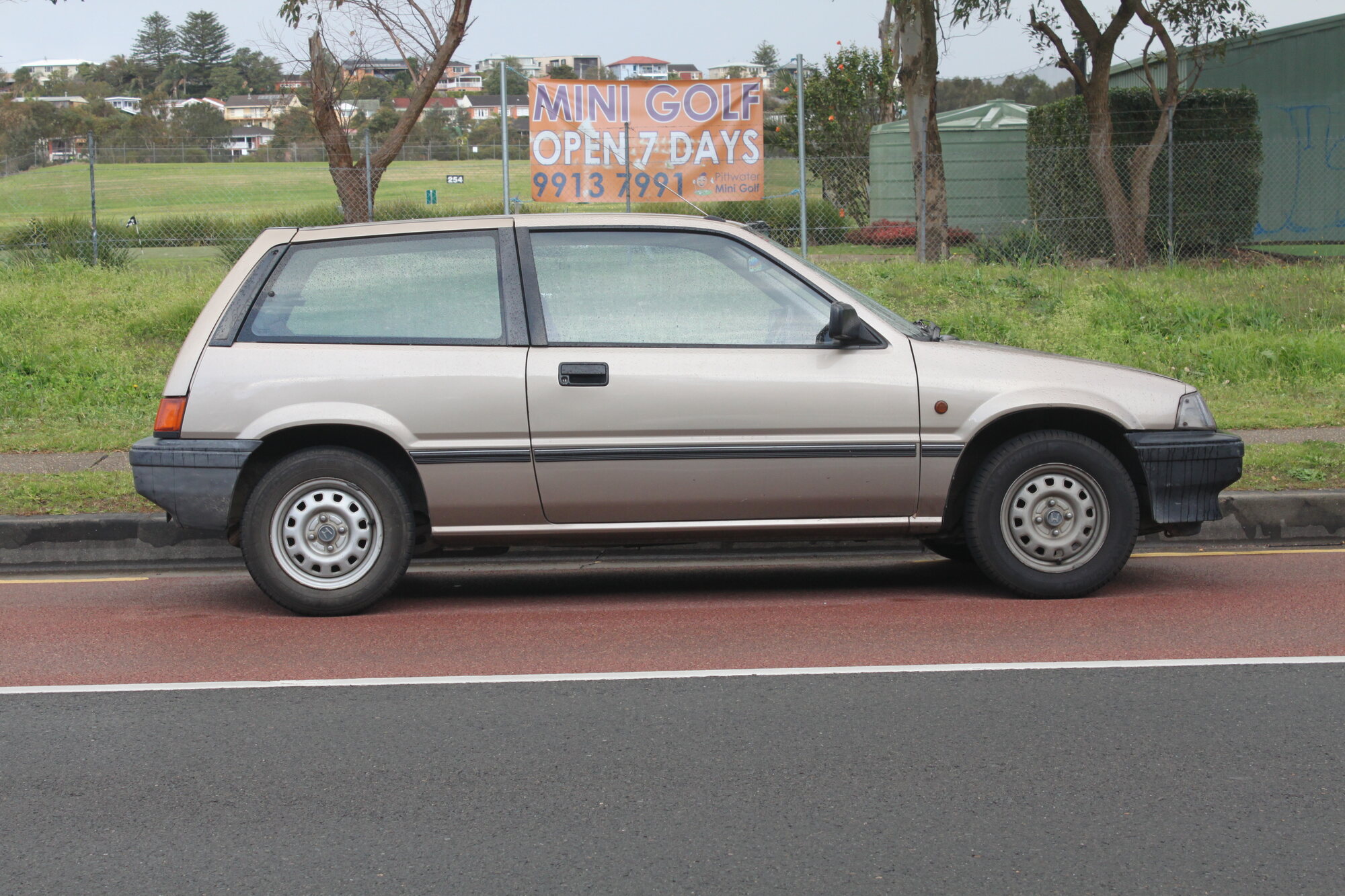
1985 Honda Civic 1.5i GT three-door hatchback · Jeremy · CC BY 2.0
Research pending
A matching completed auction sale has not been verified for this exact year, body, trim, engine, transmission and market.
Joyride shows this gap instead of substituting an asking price, unsold bid or mismatched special vehicle.
More than a set of wheels.
Honda released the third-generation three-door Civic in Japan on September 23, 1983. Its M/M idea—maximum room for people, minimum room for machinery—shaped a long-roof hatch only 3.81 metres long. The Japanese 25i sat at the technical end of the launch range, combining programmed fuel injection with Honda's compact 12-valve crossflow engine, while a sliding rear seat made the small body adaptable. The date is a Japanese launch-year fact, not a North American model-year label.
Look a little closer.
Honda's maximum-man/minimum-machine idea was physical packaging, not just a slogan. The car is 3.81 metres long, yet its wheelbase reaches 2.38 metres and the roof remains long over the rear seat. A 100 mm sliding bench lets passengers trade knee room for luggage space, while the transverse engine and front-wheel drive avoid a long propeller shaft to the rear axle.
Photos show an example of the model or generation. The pictured vehicle’s year, equipment, or modifications can differ from the specification described here.
M/M was visible in the measurements
Honda's maximum-man/minimum-machine idea was physical packaging, not just a slogan. The car is 3.81 metres long, yet its wheelbase reaches 2.38 metres and the roof remains long over the rear seat. A 100 mm sliding bench lets passengers trade knee room for luggage space, while the transverse engine and front-wheel drive avoid a long propeller shaft to the rear axle.
Source: Honda launch release — all-new Civic and Ballade ↗Why the 25i mattered inside an economy-car family
The 25i shows how an economical hatch could also be technically ambitious. Electronic injection controlled fuel delivery, the crossflow 12-valve head helped the engine breathe, ventilated front discs managed braking heat and the low-drag body reduced the work needed to push through air. Together, those choices show 1980s engineers using precision rather than sheer size.
Source: Honda launch release — all-new Civic and Ballade ↗Two ways to read the 25i's instruments
The Japanese 25i could greet its driver with analog dials or an optional colored LCD display. Honda's ordinary twin-dial layout paired a speedometer and tachometer with fuel and coolant-temperature gauges, using orange illumination on the 25i. The LCD alternative displayed speed digitally and engine speed graphically. There is an important catch when studying Honda's archive: its LCD photograph shows the all-segment check, not a normal driving readout. Neither that publicity image nor a generic third-generation Civic cabin establishes which cluster a particular surviving 25i originally carried.
Source: Honda 1983 Civic factbook — three-door cockpit and instruments ↗Where these facts come from
- Honda launch release — all-new Civic and Ballade
- Honda 1983 Civic factbook — three-door cockpit and instruments
- Honda heritage summary — Civic generations
Selected facts checked for this edition. Some source pages link to broader model families. Last reviewed October 15, 2026.