Yamaha VMAX 1200
The first VMAX looked like a cruiser but launched like a drag bike, using a clever intake system to wake up its V4 at high revs.
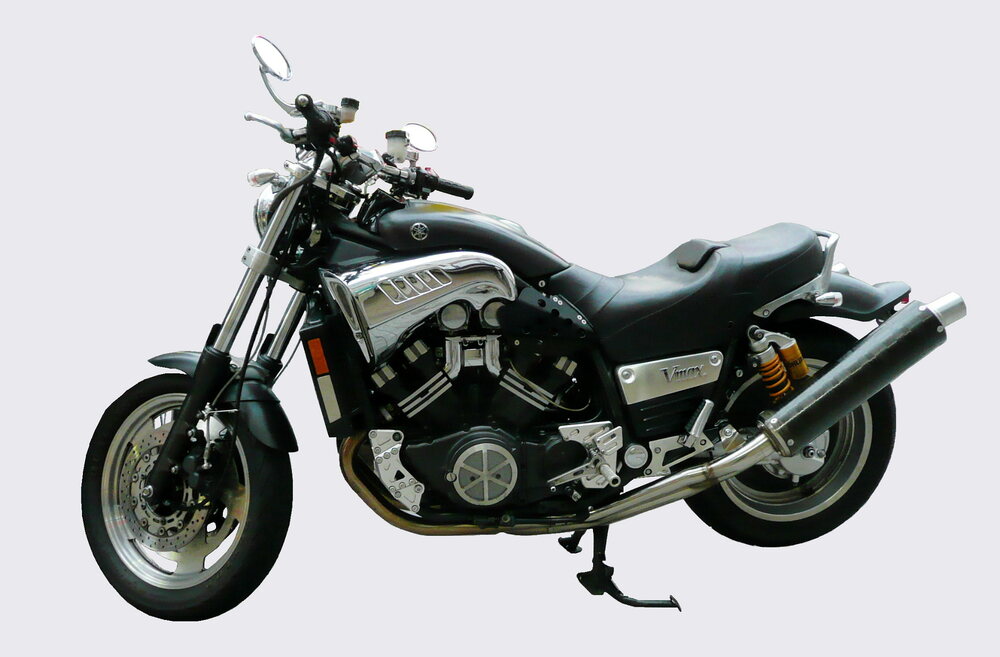
YAMAHA Vmax.jpg · PekePON · CC BY-SA 3.0
What did this one sell for?
Make a guess, then reveal one identity-matched completed auction result. It is a comparison point, not a price promise.
Reveal the auction result
Based on a completed sale at Bring a Trailer, an estimated value for this vehicle is $6,000.
Why this sale: Exact first-year 1985 U.S.-market Yamaha VMX12N/V-Max 1200 with full-power V-Boost, liquid-cooled 1,198 cc DOHC V-four, five-speed transmission and enclosed shaft drive. 3,800 miles shown and same-family ownership represented for 35 years, but the bike had been stored from 1988 until 2022. It retained the V-Boost intake and four-into-two exhaust; the front tire had been replaced while the rear was due for replacement. A tinted windscreen was fitted.
Winning bid; Bring a Trailer's 5% buyer service fee in effect for the listing, taxes and transport are excluded. One auction result is a reference, not an appraisal; condition, history, options, location and market timing can change value. Accepted instead of a newer March 2026 sale because the newer bike had its V-Boost removed, a Dynojet Stage 7 kit, K&N filters and aftermarket intake/exhaust. The accepted bike preserves the defining U.S. launch powertrain.
More than a set of wheels.
Yamaha created the VMAX for the American market in 1985 and shaped it around straight-line acceleration. Its 1,198 cc V4 came from the Venture tourer but gained bigger carburettors, revised breathing and V-Boost. The result was a new ‘muscle bike’ category whose basic idea lasted more than twenty years.
Look a little closer.
The shiny side scoops looked like ram-air intakes, but the real breathing trick was hidden under the tank-shaped cover.
Photos show an example of the model or generation. The pictured vehicle’s year, equipment, or modifications can differ from the specification described here.
V-Boost, not a turbocharger
The name sounds like forced induction, but no compressor squeezed air into the engine. A servo opened butterfly valves linking the intake pairs. Yamaha says opening began at 5,750 rpm; period technical descriptions say the passages were fully open by about 8,000 rpm. The rider felt a second wave of naturally aspirated power.
Source: Yamaha Motor Europe · 1985 VMAX 1200 ↗A drag-bike personality with touring-bike bones
The V4 began with Yamaha's Venture touring engine, but the VMAX used altered cams, larger valves and 35 mm carburettors. A long shaft drive and 1,590 mm-class wheelbase helped straight-line stability, while the under-seat four-gallon tank made room for the large airbox and intake plumbing above the engine.
Source: Rider Magazine · Retrospective: Yamaha VMX12 V-Max 1200 ↗The fuel cap hides beneath the middle of the seat
The tank-shaped cover ahead of the rider is not where you refuel. In Cycle World's May 1985 test, the fuel filler sat under the seat's middle section: that section lifted and pivoted forward, rather than the whole saddle hinging open. The testers found the side releases and deeply recessed filler awkward to reach. It is a distinctive launch-bike packaging detail, not a claim that later or modified seats use identical fittings.
Source: Cycle World · Yamaha: V-Max road test · May 1985 ↗Where these facts come from
- Yamaha Motor · 2009 VMAX release with first-generation history
- Yamaha Motor Europe · 1985 VMAX 1200
- Rider Magazine · Retrospective: Yamaha VMX12 V-Max 1200
Selected facts checked for this edition. Some source pages link to broader model families. Last reviewed October 1, 2026.