
Toyota Celica GT-Four
Toyota's first Celica GT-Four arrived in Japan on 1 October 1986, combining a 1,998 cc turbo engine, five-speed manual and centre-differential full-time four-wheel drive in the fourth-generation three-door body.
1986 Toyota Celica GT-Four ST165 · Charles (Flickr user usf1fan2) · CC BY 2.0
Research pending
A matching completed auction sale has not been verified for this exact year, body, trim, engine, transmission and market.
Joyride shows this gap instead of substituting an asking price, unsold bid or mismatched special vehicle.
More than a set of wheels.
This page follows the exact Japanese launch car, E-ST165-BLMVZ, rather than blending it with the front-wheel-drive ST162, later viscous-centre-differential ST165s, export-market figures or rally specifications. Toyota paired its 185 PS 3S-GTE with four-wheel independent strut suspension and a full-time 4WD system designed to behave naturally in tight turns while still offering a driver-selectable centre lock.
Look a little closer.
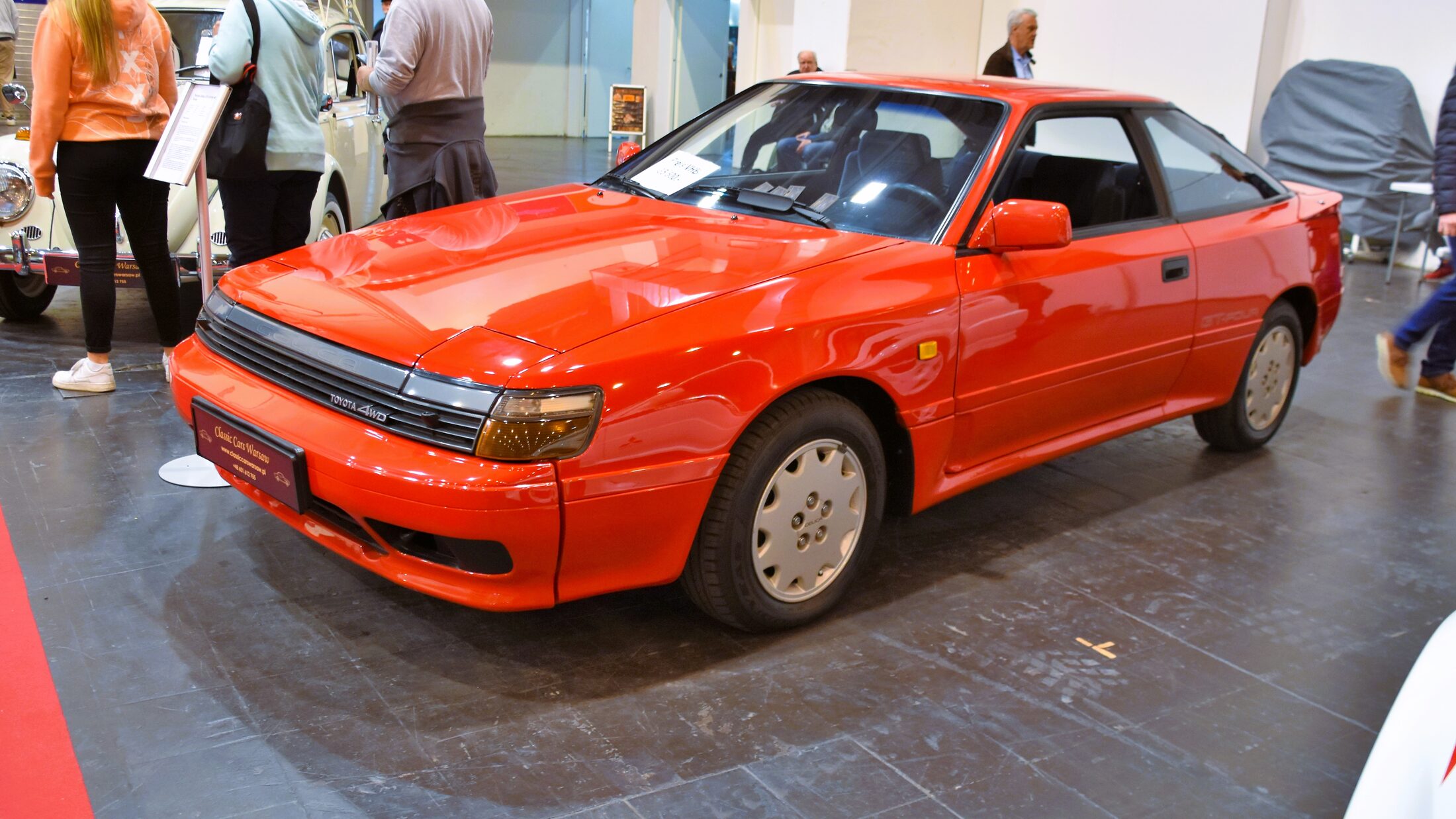
The cover is a rights-cleared photograph of a 1988 ST165 Celica GT-Four at a German exhibition; its original sales market is undocumented. It is used only as a clearly labeled representative of the same body and generation, not as evidence for the 1986 Japanese launch date, E-ST165-BLMVZ suffix, hidden engine, gearbox or original mechanical condition.
Photos show an example of the model or generation. The pictured vehicle’s year, equipment, or modifications can differ from the specification described here.
Why the centre differential matters
In a tight corner the front and rear axles need to travel different distances. A rigid connection can resist that speed difference and create the tight-corner braking effect Toyota described. The launch GT-Four's centre differential absorbs the difference during ordinary driving, while its locking mechanism can connect the axles more firmly when extra traction is useful.
Source: Toyota · Celica GT-Four Japanese launch ↗Leather accents, not an all-leather cabin claim
Toyota's 1 October 1986 Japanese launch announcement describes genuine leather on part of the standard seats. That is a narrower claim than an entirely leather-trimmed interior: the announcement does not identify every upholstered surface or establish the material on a surviving car. It helps explain the GT-Four's position as a high-grade road car alongside its turbo engine and four-wheel drive. The representative 1988 exhibition cover cannot verify this launch-market seat specification or the originality of any later retrim.
Source: Toyota — 1 October 1986 GT-Four launch, exterior and interior ↗Road car first, rally legacy second
The ST165 became the production foundation for Toyota's World Rally Championship program and later carried Carlos Sainz to the 1990 drivers' title. That history explains the car's importance, but competition output, suspension, homologation equipment and gearbox specifications are not borrowed for this 1986 showroom profile.
Source: Toyota · Celica vehicle lineage ↗Where these facts come from
- Toyota · Celica GT-Four Japanese launch
- Toyota · Celica vehicle lineage
- Toyota GAZOO · Celica Japanese catalogue
Selected facts checked for this edition. Some source pages link to broader model families. Last reviewed 2026-10-06.