
Ferrari F40
Ferrari celebrated forty years by building a road car with turbo punch, a race-style structure and almost nothing that did not help it go faster.
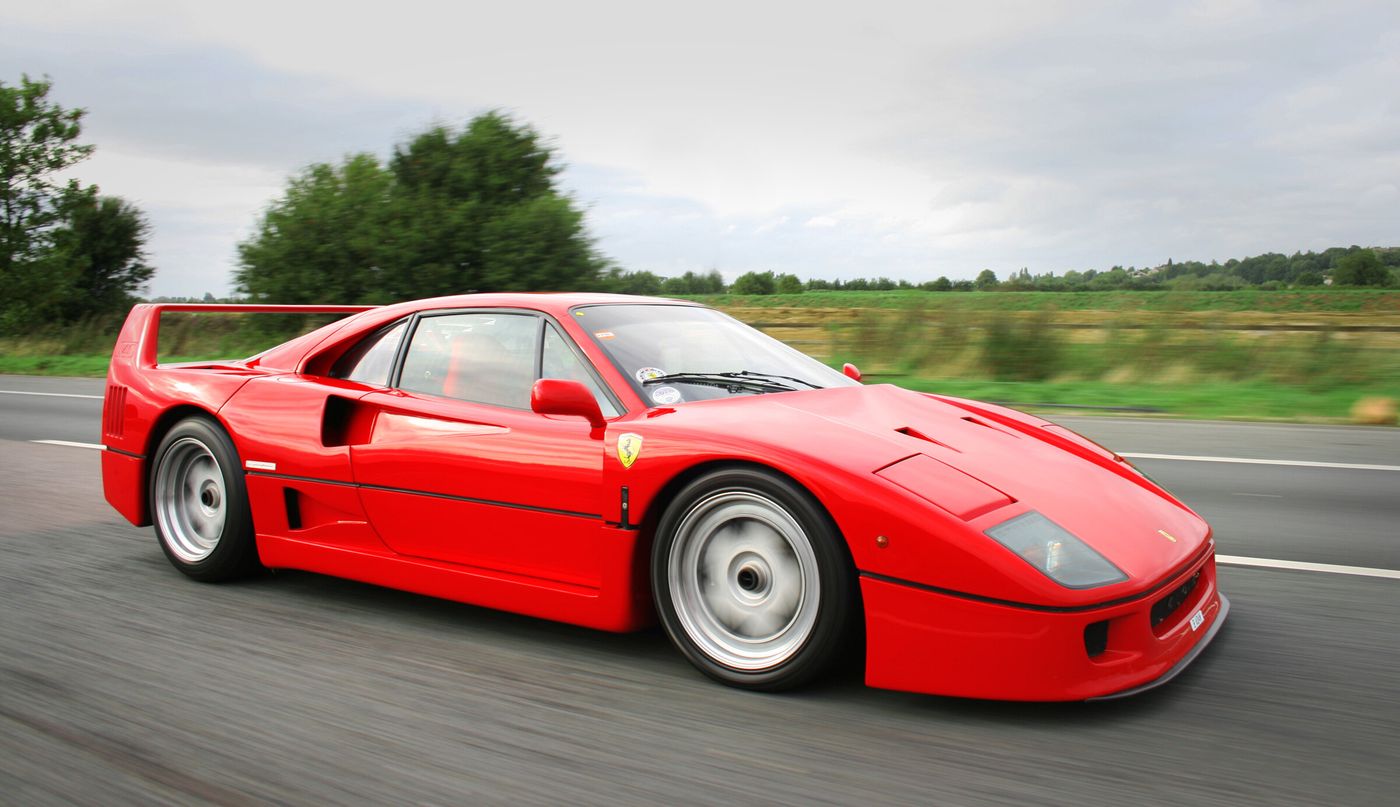
F40 Ferrari 20090509.jpg · Will ainsworth · CC BY-SA 3.0
Research pending
A matching completed auction sale has not been verified for this exact year, body, trim, engine, transmission and market.
Joyride shows this gap instead of substituting an asking price, unsold bid or mismatched special vehicle.
More than a set of wheels.
Ferrari unveiled the F40 at Maranello's Centro Civico on July 21, 1987. Pininfarina wrapped Nicola Materazzi's engineering package in a wind-tunnel-shaped body with a huge fixed wing. The twin-turbo V8 made 478 CV, while composite panels and a spare cabin helped keep Ferrari's quoted weight to 1,100 kg.
Look a little closer.
Ferrari says 900 orders arrived when the F40 was officially unveiled, even though its original list price was 380 million lire.
Photos show an example of the model or generation. The pictured vehicle’s year, equipment, or modifications can differ from the specification described here.
Lightness was part of the engine story
Power alone did not create the F40's performance. Ferrari bonded Kevlar reinforcement panels to a tubular steel structure and used carbon-fibre doors, bonnet and rear deck. The body and sparse cabin cut mass, so each unit of engine power had less car to accelerate. Ferrari quoted 0–100 km/h in 4.1 seconds and 324 km/h maximum speed.
Source: Ferrari · Enzo's Dream ↗A road car that refused to pretend it was luxurious
There was no ABS, no power assistance for the steering or brakes, and no carpet, sound deadening or normal interior door handles. Early cars could have sliding plastic windows. That austerity was not neglect: it was the visible result of choosing feel, mass and performance over grand-touring comfort.
Source: Ferrari Magazine · Enzo's final masterpiece: The F40 ↗Where these facts come from
- Ferrari History · F40 garage
- Ferrari History · Enzo's Dream
- Ferrari Magazine · Enzo's final masterpiece: The F40
Selected facts checked for this edition. Some source pages link to broader model families. Last reviewed October 1, 2026.