
Ferrari F430
Eight cylinders. One unforgettable voice. A little Formula 1 thinking for the road.
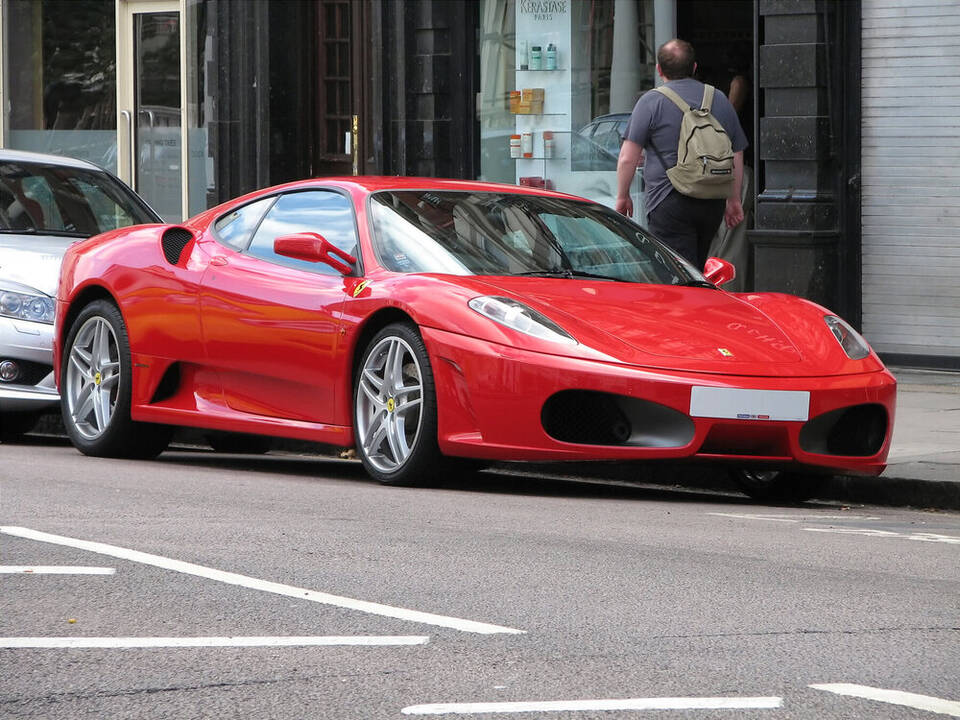
Front three quarter view f430.jpg · Tyler Brenot · CC BY 3.0
Research pending
A matching completed auction sale has not been verified for this exact year, body, trim, engine, transmission and market.
Joyride shows this gap instead of substituting an asking price, unsold bid or mismatched special vehicle.
More than a set of wheels.
The F430 brought Ferrari’s racing ideas into a two-seat road car. Its steering-wheel selector, called the manettino, lets the driver change the car’s settings. An electronically controlled differential helps manage how power reaches the rear wheels.
Look a little closer.
The little steering-wheel dial has an Italian name: manettino. It means “little lever.”
Photos show an example of the model or generation. The pictured vehicle’s year, equipment, or modifications can differ from the specification described here.
Reading the instruments
The rev counter shows engine speed; the speedometer shows road speed. The F430 also monitors oil pressure, oil temperature, coolant temperature and fuel level. These tell different stories: pressure indicates how the lubrication system is working, while temperature shows how hot a fluid has become. Warning lights and a multi-function display share the panel. The digital gear display belongs to the F1-transmission version, so a manual car should not be described as having identical equipment.
Source: Ferrari owner’s manual · instrument panel, page 29 ↗Controls within reach
The steering-wheel area groups the starter, driving-mode selector and horn controls. Cars with the F1 transmission add separate upshift and downshift paddles. Those paddles request a gear change without a conventional hand-operated shift lever; the manual version is a separate specification. When exploring the cabin photographs, look for the controls as well as the upholstery.
Source: Ferrari owner’s manual · steering-wheel controls, page 21 ↗An engine designed to breathe
Ferrari moved from the preceding 360’s five valves per cylinder to four in the F430. Valve timing helped the new V8 deliver its power at high engine speed. The original braking specification also needs care: Ferrari describes steel discs as standard and carbon-ceramic discs as an option. A photographed car’s brakes therefore should not be assumed from the model name alone. Spider, Scuderia and Challenge versions have their own equipment and identity.
Source: Ferrari · Technological Masterclass ↗Where these facts come from
- Ferrari · F430 history and specifications
- Ferrari · Technological Masterclass
- Ferrari · F430 owner’s manual
Selected facts checked for this edition. Some source pages link to broader model families. Last reviewed 2026-10-01.