
Alfa Romeo SZ
A computer-aided composite body wrapped proven Alfa transaxle hardware in one of the 1980s' boldest shapes.
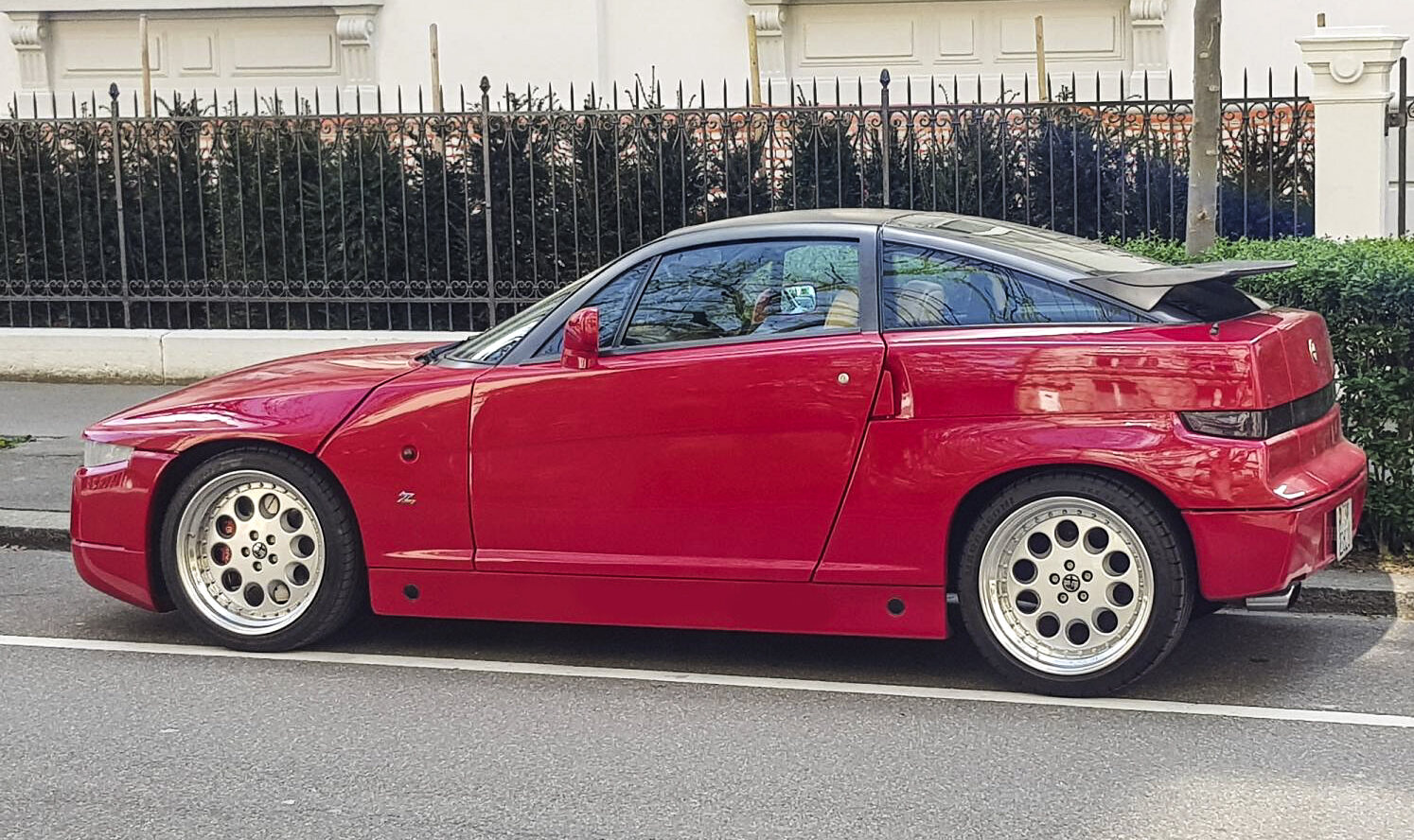
1989 Italy Alfa Romeo SZ · Lanciatype840 · CC BY 3.0
Research pending
A matching completed auction sale has not been verified for this exact year, body, trim, engine, transmission and market.
Joyride shows this gap instead of substituting an asking price, unsold bid or mismatched special vehicle.
More than a set of wheels.
Fiat initiated project ES30—Experimental Sportscar, 3.0 litre—to reassert Alfa Romeo's rear-wheel-drive sports-car tradition after the 1986 takeover. Alfa Romeo, Fiat and Zagato design teams contributed, while Zagato assembled the cars near Milan. The SZ appeared at Geneva in March 1989 after a development programme Alfa says lasted only 19 months. It combined Alfa 75-derived mechanical architecture with composite body panels and early CAD/CAM production methods. Alfa's later anniversary record says 1,036 SZ coupés reached customers between 1989 and 1993.
Look a little closer.
Almost every production SZ was Alfa red with a dark grey roof and natural-colour cabin; Alfa says Andrea Zagato's all-black car was the exception.
Photos show an example of the model or generation. The pictured vehicle’s year, equipment, or modifications can differ from the specification described here.
Nineteen months with computers in the loop
Alfa says the programme went from brief to Geneva-ready car in 19 months. CAD/CAM tools helped the teams move from shape to production with fewer late changes. The steel underbody carried composite exterior panels, so the body was neither a conventional all-steel shell nor a simple one-piece plastic tub.
Source: Alfa Romeo Heritage · SZ: tradition and innovation ↗Familiar hardware, deliberately rearranged
The ES30 project started from Alfa 75 architecture, placing the five-speed gearbox with the differential at the rear. Engineers added a limited-slip differential, revised suspension and more power from the three-litre V6 through camshaft and engine-control changes. This is why calling the SZ merely a rebodied 75 misses the engineering work between the shared foundation and the finished coupé.
Source: Alfa Romeo · 30 years of project ES30 ↗Grand-touring comfort behind the angular body
Alfa's anniversary history lists air conditioning, leather seats, a leather-trimmed dashboard and electric windows as standard equipment. It describes the instrument-panel finish as carbon-fibre-look trim, not proof of a structural carbon-fibre dashboard. These are production SZ cabin claims; the distinctive Balocco development car is not a universal trim reference.
Source: Alfa Romeo · 30 years of project ES30, production cabin equipment ↗A lift for awkward entrances
Alfa's anniversary account describes roughly six centimetres of ground clearance and an electrically operated levelling system that could raise the body by five centimetres when needed, for example at an entrance. Those are the manufacturer's historical figures, not a clearance measurement for every surviving car or a claim of modern adaptive suspension.
Source: Alfa Romeo · 30 years of project ES30, ground clearance and levelling ↗Where these facts come from
- Alfa Romeo Heritage · SZ: tradition and innovation
- Alfa Romeo · 30 years of project ES30, history and technical table
- Stellantis Heritage · 1989 Alfa Romeo SZ ex-works car
Selected facts checked for this edition. Some source pages link to broader model families. Last reviewed October 15, 2026.