
Opel Calibra 2.0i 16V
The Calibra 16V wrapped a 150 PS twin-cam engine and four real seats in one of the slipperiest production-car shapes of its day.
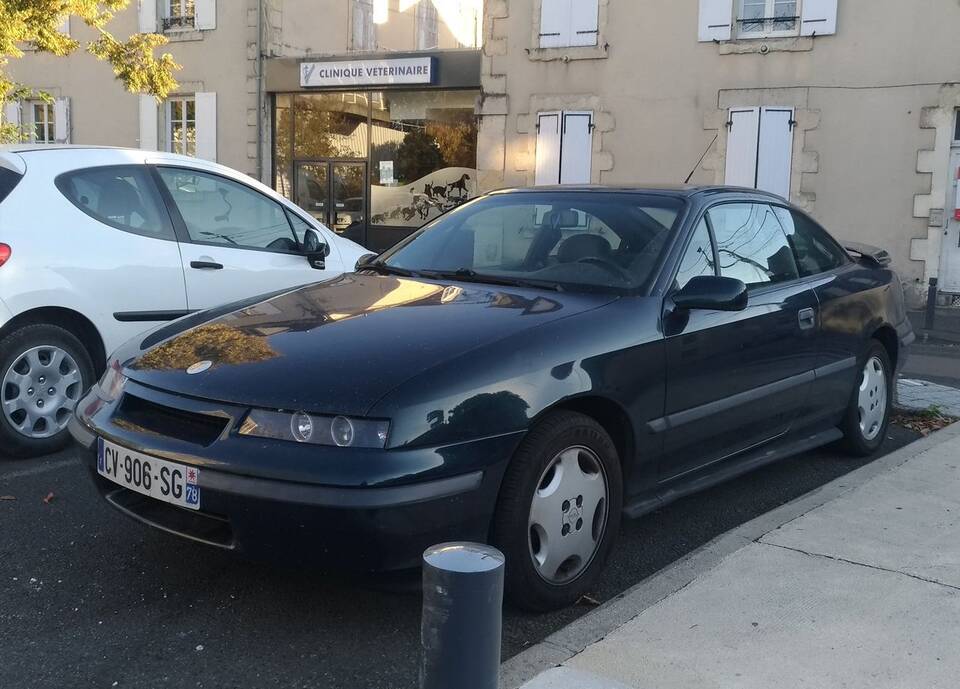
Opel Calibra (32117349528).jpg · Guillaume Vachey from Chalon sur Saone, France · CC0
Research pending
A matching completed auction sale has not been verified for this exact year, body, trim, engine, transmission and market.
Joyride shows this gap instead of substituting an asking price, unsold bid or mismatched special vehicle.
More than a set of wheels.
Opel revealed the Calibra at the Frankfurt Motor Show in September 1989, but series production did not begin until June 1990. Erhard Schnell's four-seat coupé used the first-generation Vectra platform and offered 300 litres of luggage space. Opel's heritage account celebrates a range-best drag coefficient of 0.26, without identifying a front-drive 16V test configuration; that headline is not a verified specification for this variant. The launch engines were a 115 PS eight-valve and a 150 PS twin-cam 16-valve. Opel built 238,647 Calibras before production ended in 1997.
Look a little closer.
The Calibra's celebrated 0.26 drag figure is a range-level headline in Opel's heritage account, not a verified figure for every engine and equipment combination.
Photos show an example of the model or generation. The pictured vehicle’s year, equipment, or modifications can differ from the specification described here.
A show-year is not a production year
The Calibra's public story began at Frankfurt in September 1989, which is why heritage summaries often attach 1989 to the model. Opel's more precise retrospective says production began in June 1990. This profile therefore uses 1990 for the buildable 2.0i 16V while preserving 1989 as the reveal date—an important distinction between an event on a motor-show stand and customer cars leaving a factory.
Source: Opel Italy · 25 Years of Calibra ↗Aerodynamics: design and specification are different
Opel describes a carefully chosen front-spoiler height, an inward-tapering rear and rocker mouldings that control air spilling out from under the Calibra. Its heritage article pairs that design story with a 0.26 range headline, but does not identify the engine, wheels or test configuration behind it. We therefore retain the design explanation without assigning that coefficient to this 150 PS front-drive 16V.
Source: Opel · Kings of Aerodynamics ↗Where these facts come from
- Opel Italy · 25 Years of Calibra
- Opel Italy · 30 Years of Calibra
- Opel · Kings of Aerodynamics
- Opel Germany · 11th Paul Pietsch Classic
Selected facts checked for this edition. Some source pages link to broader model families. Last reviewed October 1, 2026.