
Daihatsu Hijet Truck
A two-seat Japanese kei work truck with a 659 cc three-cylinder engine, five-speed manual gearbox and selectable four-wheel drive, the 1994 S110P Hijet packed a useful load bed into a body barely 3.3 metres long.
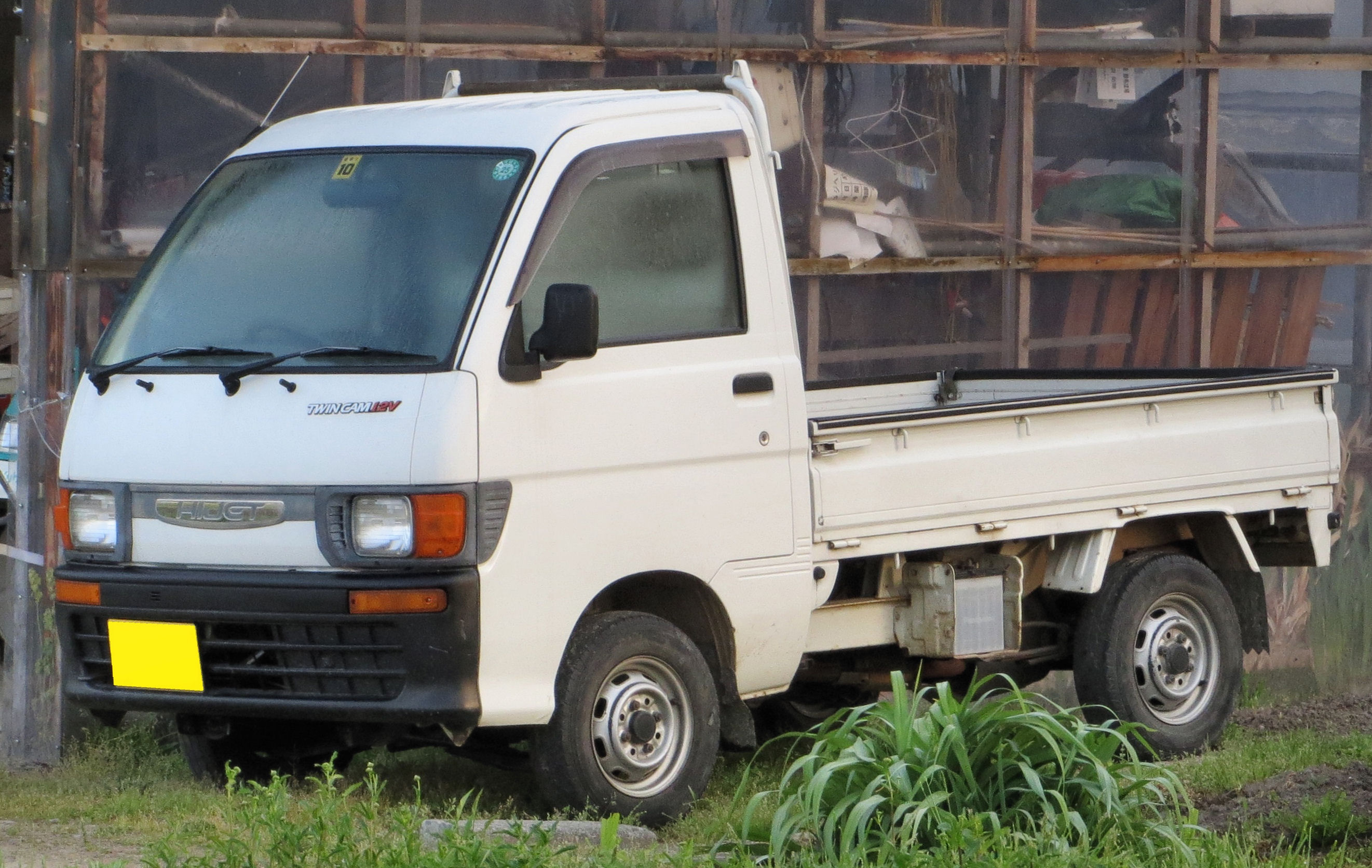
Daihatsu Hijet S110P 4WD representative · DY5W-sport · CC BY-SA 3.0
Research pending
A matching completed auction sale has not been verified for this exact year, body, trim, engine, transmission and market.
Joyride shows this gap instead of substituting an asking price, unsold bid or mismatched special vehicle.
More than a set of wheels.
Daihatsu introduced its eighth-generation Hijet in January 1994. This profile is pinned to the Japanese-market Super Deluxe-E truck, model code V-S110P, so its figures do not silently spread to every S110P grade. The cab seated two, the sides of the load bed folded down, and the whole truck measured only 3,295 mm long. A naturally aspirated 659 cc three-cylinder engine drove through a five-speed manual gearbox. Part-time 4WD let the driver connect the front axle when extra grip was needed, while rear leaf springs were chosen for carrying work rather than limousine softness. The specification is charmingly direct: manual steering, no ABS, no airbags, front discs, rear drums and 145R12 tyres. That simplicity makes the Hijet easy to explain, but it also means the page must not suggest modern crash or driver-assistance features it never had.
Look a little closer.
The 3.8 m turning radius helped this tiny truck reach farms, alleys and job sites that could feel cramped in a full-size pickup.
Photos show an example of the model or generation. The pictured vehicle’s year, equipment, or modifications can differ from the specification described here.
Built to fit the kei box
Japan's kei category rewards compact dimensions, and this Hijet used nearly every millimetre thoughtfully. The cab and load bed fit inside a footprint 3,295 mm long and 1,395 mm wide, while the 1,900 mm wheelbase helped leave room for the bed. Two seats and a cab-over shape kept the driver close to the front of the truck instead of placing a long bonnet ahead. The result was not a scaled-down fashion pickup; it was a working tool that could turn within a 3.8 m radius and reach narrow farms, alleys and job sites. Its 730 kg vehicle weight also shows how little mass the 44 PS engine had to move before cargo was added.
Source: Hijet 60th Anniversary: History of the Hijet ↗Selectable grip and load-carrying hardware
Part-time 4WD means the truck did not permanently drive every wheel. On firm roads the driver could use the simpler normal mode, then connect the front axle when loose soil or snow demanded more traction. A five-speed manual gearbox gave the small engine useful choices between pulling force and road speed. At the back, a solid axle and leaf springs spread loads through sturdy metal strips rather than prioritising a plush ride. Front disc brakes did most of the stopping work, with drums at the rear. The catalogue lists no limited-slip differential, power steering, ABS or airbags for this Super Deluxe-E, so its ability came from compact size, mechanical simplicity and the driver's judgement—not hidden modern electronics.
Source: Hijet Truck Super Deluxe-E — January 1994 catalogue specifications ↗Where these facts come from
- Hijet 60th Anniversary: History of the Hijet
- Hijet Truck Super Deluxe-E — January 1994 catalogue specifications
- File: Daihatsu Hijet Truck S110P 0421.JPG
Selected facts checked for this edition. Some source pages link to broader model families. Last reviewed October 3, 2026.