
Honda Integra Type R
Honda turned the everyday Integra coupe into a high-revving road racer with a hand-finished engine, close gears, less weight and a differential that helped the front tires pull through corners.
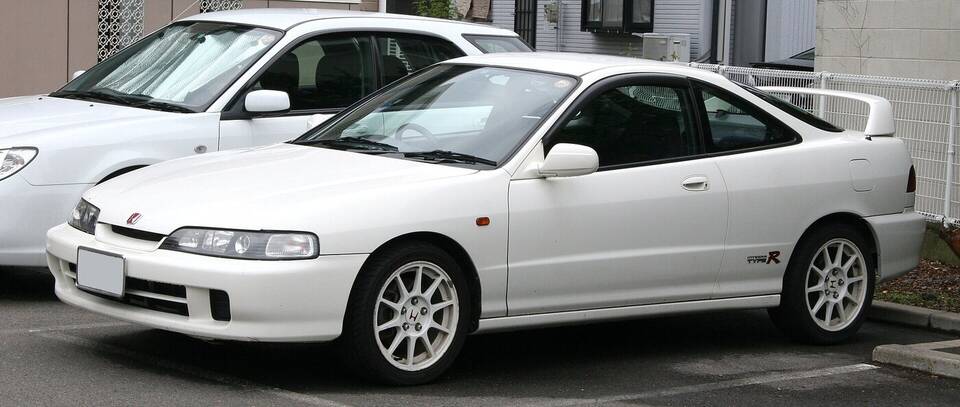
Honda Integra Type-R DC2.jpg · TTTNIS · Public domain
Research pending
A matching completed auction sale has not been verified for this exact year, body, trim, engine, transmission and market.
Joyride shows this gap instead of substituting an asking price, unsold bid or mismatched special vehicle.
More than a set of wheels.
Honda announced the first Integra Type R on August 24, 1995 and put it on sale in Japan on October 16. Engineers applied lessons from the NSX Type R to the lighter, front-wheel-drive Integra: roughly 60 dedicated engine parts, hand-polished intake ports, closer gearbox ratios, a helical limited-slip differential, firmer suspension and carefully removed mass. This profile is the original Japanese DC2 96-spec three-door—not the DB8 sedan, later 98-spec update or export-market versions.
Look a little closer.
At its 8,400-rpm permitted maximum, Honda calculated an average piston speed of 24.4 metres per second—part of the engineering story behind its unusually high specific output.
Photos show an example of the model or generation. The pictured vehicle’s year, equipment, or modifications can differ from the specification described here.
Power came from precision, not boost
The 1.8-litre B18C used an 11.1:1 compression ratio, reduced intake and exhaust losses, lower internal friction and dozens of Type R-specific parts. Honda even hand-polished the intake ports. The result was 200 PS without a turbocharger, but the figure belongs to Japanese premium fuel and the original net-rating method stated in Honda's fact book.
Source: Honda Integra 1995 Fact Book — engine and transmission ↗Front-wheel drive treated as a complete system
Honda did not rely on engine output alone. The DC2 paired a torque-sensitive helical LSD with double-wishbone suspension at both ends, quicker steering, lower ride height, high-grip tires and body reinforcement. That system was designed to let the driver add power earlier while keeping the car responsive rather than merely fighting wheelspin.
Source: Honda Integra 1995 Fact Book — Type R development ↗Where these facts come from
- Honda — 1995 Integra Type R launch release
- Honda Integra 1995 Fact Book — Type R development
- Honda Integra 1995 Fact Book — engine and transmission
- Honda Integra 1995 Fact Book — specifications
Selected facts checked for this edition. Some source pages link to broader model families. Last reviewed October 1, 2026.