
Yamaha YZF-R1
The first R1 squeezed liter-bike power into a motorcycle as light and compact as many 600s. Its trick was not only a strong engine: Yamaha shortened that engine so the bike could combine a short wheelbase with a remarkably long swingarm.
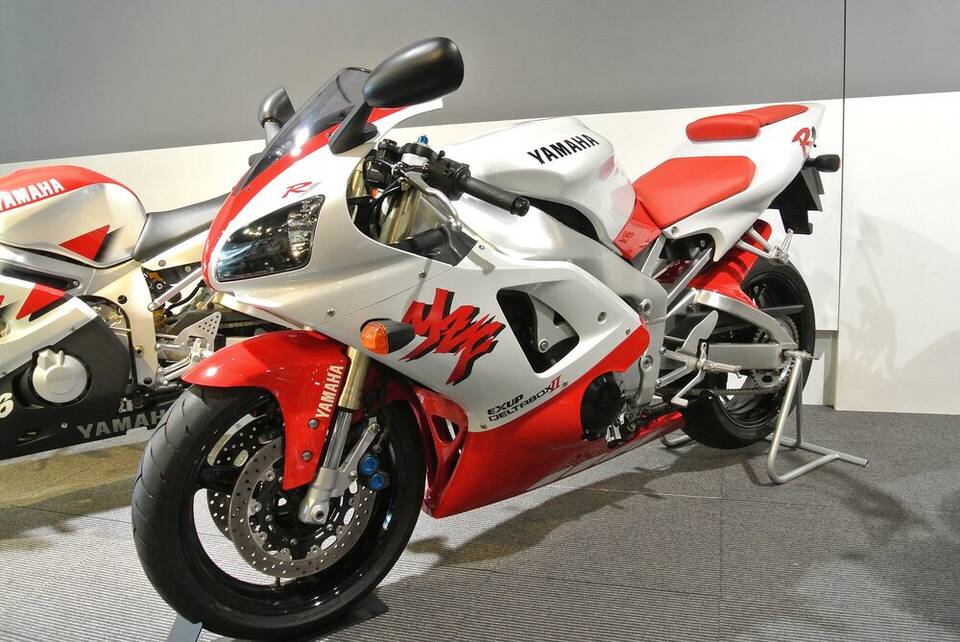
1998 Yamaha YZF-R1 in the Yamaha Communication Plaza.JPG · Rainmaker47 · CC BY-SA 4.0
Research pending
A matching completed auction sale has not been verified for this exact year, body, trim, engine, transmission and market.
Joyride shows this gap instead of substituting an asking price, unsold bid or mismatched special vehicle.
More than a set of wheels.
Yamaha unveiled the first YZF-R1 at the Milan show in September 1997 and sold it as a 1998 production model. At a time when 750 cc machines defined much of the supersport class, the R1 paired 998 cc, 150 PS and a 177 kg dry mass. Yamaha says that combination created a new supersport category centered on acceleration and cornering on winding roads.
Look a little closer.
The swingarm measured 42 percent of the wheelbase—an unusually large share that helped the bike stay calmer as its rear suspension moved under acceleration.
Photos show an example of the model or generation. The pictured vehicle’s year, equipment, or modifications can differ from the specification described here.
Three shafts, one compact engine
Conventional engines often line up the crankshaft and gearbox shafts one behind another. The R1 moved them into a triangular stack. The output sprocket could sit close behind the crankshaft, shrinking the engine and helping centralize mass without reducing the 998 cc displacement.
Source: Yamaha Handling Vol. 9 — From YZF1000R to YZF-R1 ↗A long arm inside a short bike
Yamaha chose a 1,395 mm wheelbase for eager turning, then used the compact engine to make space for a 582 mm swingarm. The longer arm reduced changes in chassis attitude as the suspension compressed and made it easier for the rear tire to deliver the engine's force when leaving a corner.
Source: Yamaha Handling Vol. 9 — From YZF1000R to YZF-R1 ↗The numbers that started the R1 line
Yamaha's museum record lists 998 cc, 150 PS, 108.3 N·m and 177 kg for the overseas production model. The company's history calls that mass dry and calculates 1.18 kg per PS. Later fuel-injected and crossplane R1s are important descendants, but their technology does not belong in this carbureted 4XV profile.
Source: Yamaha Communication Plaza — 1998 YZF-R1 ↗Where these facts come from
- Yamaha Communication Plaza — 1998 YZF-R1
- Yamaha Motor — R1 History 1998–2017
- Yamaha Handling Vol. 9 — From YZF1000R to YZF-R1
- 1998 Yamaha YZF-R1 4XV factory service manual mirror
Selected facts checked for this edition. Some source pages link to broader model families. Last reviewed October 1, 2026.