
Toyota MR-S S Edition
Toyota's 1999 MR-S put its engine just behind the two seats and kept curb mass below one tonne. This page follows the Japanese launch S Edition, model GH-ZZW30-AKMQH(S), with the 1ZZ-FE engine and five-speed manual—not the sequential-transmission version added in 2000 or the overseas MR2 nameplate.
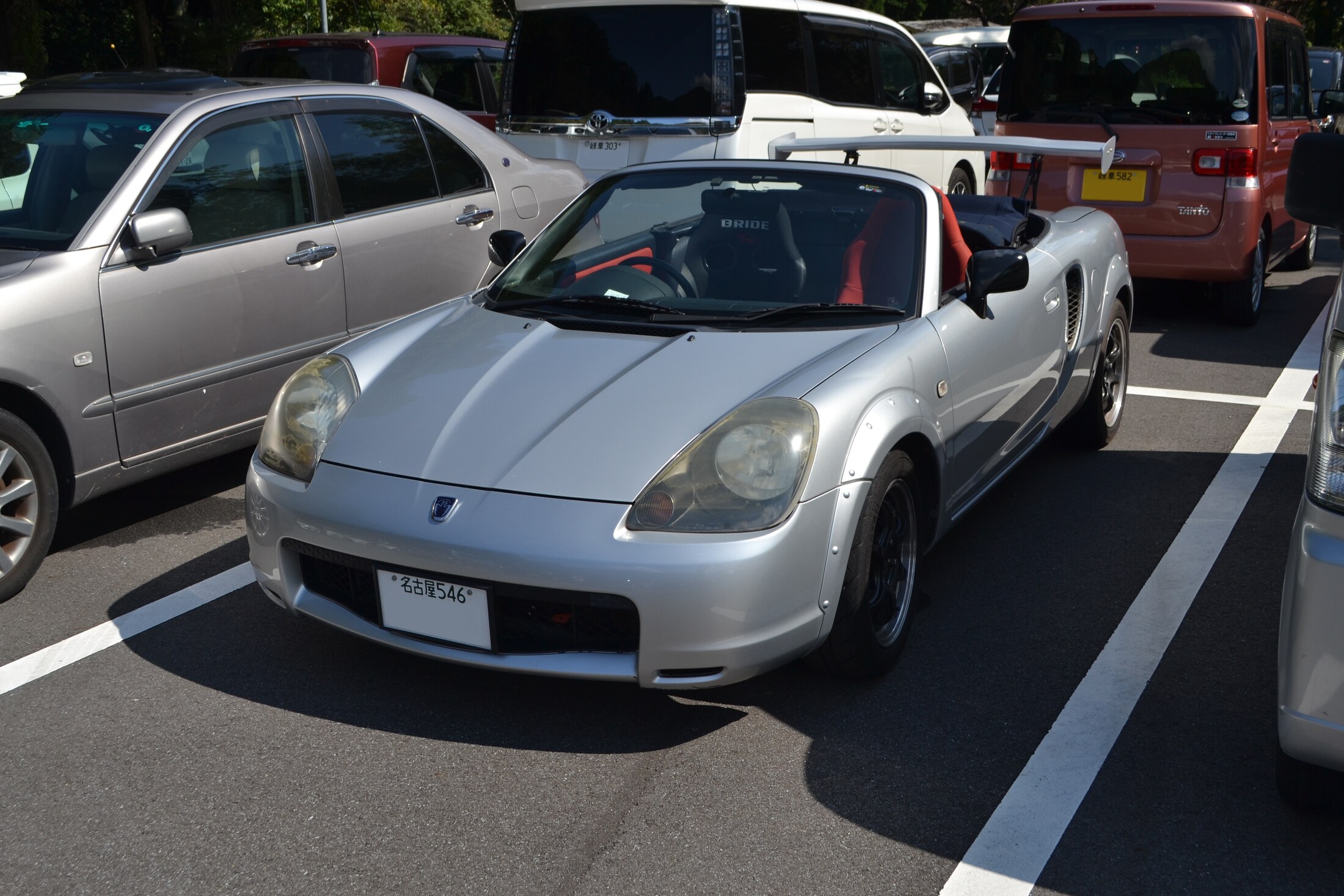
Toyota MR-S S Edition front three-quarter · 先従隗始 · CC0 1.0
Research pending
A matching completed auction sale has not been verified for this exact year, body, trim, engine, transmission and market.
Joyride shows this gap instead of substituting an asking price, unsold bid or mismatched special vehicle.
More than a set of wheels.
Toyota began Japanese sales on October 12, 1999, calling the MR-S the third generation of its MR2 family. The small roadster used a long wheelbase and short overhangs, a soft top with a glass rear window and different front and rear tire sizes. The S Edition also added useful storage beneath the front hood and behind the seats, while the helical limited-slip differential remained an option rather than standard equipment.
Look a little closer.
MR-S means Midship Runabout-Sports. Toyota kept the MR2 name for overseas versions, so a Japanese MR-S and an export MR2 Roadster can belong to the same broad family without being the same market specification.
Photos show an example of the model or generation. The pictured vehicle’s year, equipment, or modifications can differ from the specification described here.
Less than a tonne, with the engine in the middle
Toyota listed the S Edition at 970 kg and placed the engine behind the occupants but ahead of the rear axle. Combined with a 2,450 mm wheelbase inside a 3,885 mm body, that layout reduced the tendency of mass at the ends of the car to resist turning. It explains why Toyota emphasized response and balance rather than headline horsepower.
Source: Toyota 75 Years · first-generation MR-S ↗A roadster built around different front and rear jobs
The launch car used 185/55R15 front tires and wider 205/50R15 rears to match the rearward load of its mid-engine layout. Toyota paired an L-arm MacPherson-strut front suspension with a dual-link MacPherson-strut rear, and made a torque-sensitive helical limited-slip differential optional. The staggered tires and optional differential must not be mistaken for proof that every surviving MR-S has the same original equipment.
Source: Toyota launch release · MR-S ↗Where these facts come from
- Toyota launch release · MR-S
- Toyota 75 Years · first-generation MR-S
- Toyota certified-used catalog · 1999 MR-S S Edition
Selected facts checked for this edition. Some source pages link to broader model families. Last reviewed 2026-10-06.