
Honda EV Plus
A practical four-seat battery car from the 1990s, built around nickel-metal-hydride cells and real customer leases.
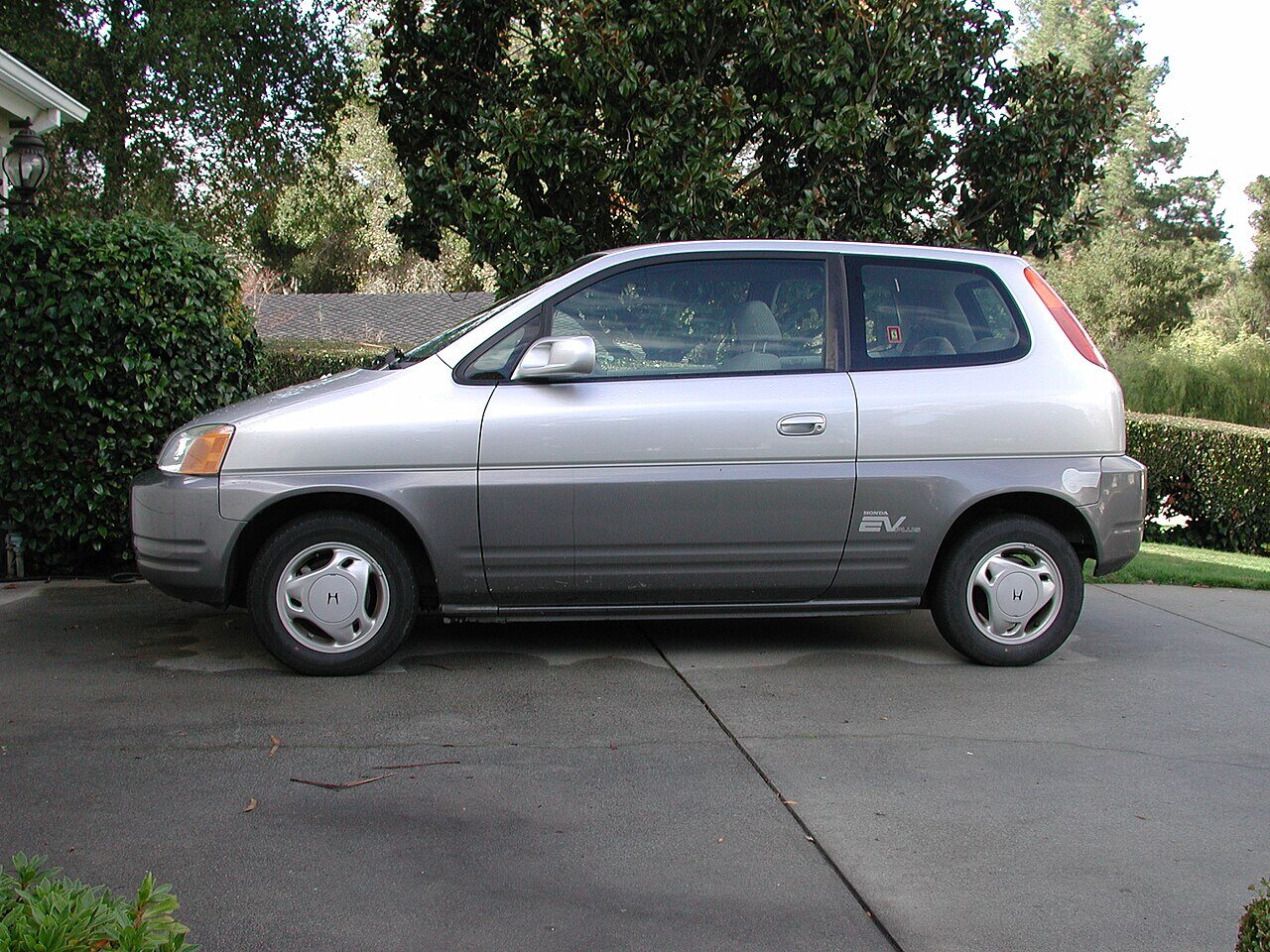
1997-1999 Honda EV Plus · Evplus at English Wikipedia · Public domain (author release)
Research pending
A matching completed auction sale has not been verified for this exact year, body, trim, engine, transmission and market.
Joyride shows this gap instead of substituting an asking price, unsold bid or mismatched special vehicle.
More than a set of wheels.
Honda began its dedicated electric-vehicle research in 1988 and tested development cars for about 80,000 miles in California. The production EV Plus used its own three-door body rather than converting a gasoline model, and the first one left Honda's Takanezawa line in April 1997. For the 1999 U.S. model year Honda listed it in California and New York as a zero-emission vehicle. Fifteen EV Plus cars also served more than 200 students and staff in a UC Riverside car-sharing study during 1999.
Look a little closer.
Its dashboard computer estimated miles remaining, but a government test noted that the starting estimate depended on how efficiently the car had been driven before charging.
Photos show an example of the model or generation. The pictured vehicle’s year, equipment, or modifications can differ from the specification described here.
Range changes when the job changes
U.S. testing recorded 105.3 miles on an urban loop with a light payload and no auxiliary load, but 81.7 miles with the heavy payload and auxiliary load. Freeway-loop results ranged from 78.8 to 90.6 miles. The battery did not change; payload, accessories, temperature and route did.
Source: U.S. DOE/Idaho National Laboratory · EV Plus performance characterization ↗Why a one-speed reduction replaced an automatic
Honda's development history records a change from a torque-converterless three-speed automatic in a test car to a fixed-ratio gearbox in the EV Plus. An electric motor can work across a broad speed range, so it does not need the same stack of ratios as a small gasoline engine. Fewer shifting parts also fit the car's purpose-built electric design.
Source: Honda 75 Years · EV Plus development and hardware changes ↗Where these facts come from
- Honda · U.S. 1999 low-emission vehicle listing
- Honda 75 Years · EV Plus development and hardware changes
- U.S. DOE/Idaho National Laboratory · EV Plus performance characterization
- Honda · 1999 UC Riverside IntelliShare announcement
- Honda · original EV Plus characteristics and dimensions
Selected facts checked for this edition. Some source pages link to broader model families. Last reviewed September 30, 2026.