
Toyota Prius G
The second Prius could move with its gasoline engine, its electric motor or both. Its battery captured some energy during slowing, and its five-door body gave families a much more useful cargo opening than the first Prius sedan.
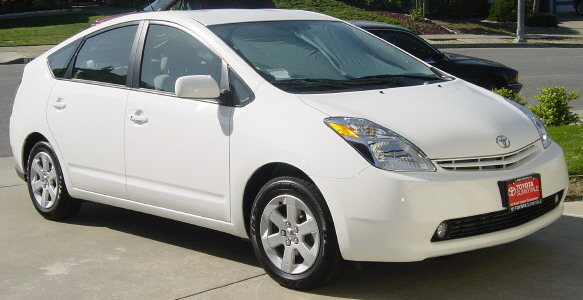
2004 Toyota Prius G cover · Kowloonese at English Wikipedia · CC BY-SA 3.0
Research pending
A matching completed auction sale has not been verified for this exact year, body, trim, engine, transmission and market.
Joyride shows this gap instead of substituting an asking price, unsold bid or mismatched special vehicle.
More than a set of wheels.
Toyota launched the second-generation Prius in Japan on September 1, 2003, so a car built in calendar 2004 retained the NHW20 launch architecture. The new five-door liftback was longer, wider and roomier than the first Prius, while its 0.26 drag coefficient helped it use less energy. THS II raised motor output by half, and the Japanese G grade added Smart Entry and Start plus S-VSC, which coordinated stability control, braking, traction and electric power steering. This record does not mix in U.S. EPA figures or later Japanese certification prefixes.
Look a little closer.
The Japanese G grade could be ordered with Intelligent Parking Assist, which turned the steering wheel to help guide the car into a parking space while the driver controlled speed and braking.
Photos show an example of the model or generation. The pictured vehicle’s year, equipment, or modifications can differ from the specification described here.
A Japanese-market car, not a U.S. EPA car
Toyota's Japanese launch material rates the Prius at 35.5 km/l under Japan's 10-15 mode test, and the figure applies to the G grade profiled here. That test cycle is different from U.S. EPA procedures, so converting it into an American mpg claim would create a misleading comparison. The source figure and its test name are preserved together.
Source: Toyota — All-new Prius Japanese launch release ↗Why the triangular roof mattered
The NHW20's roof peak sat near the driver, then tapered toward a high tail. A smooth underside and carefully shaped windows helped achieve a drag coefficient of 0.26, while a second pane below the rear spoiler improved the view backward. Aerodynamics and useful hatchback space were developed as one package rather than competing ideas.
Source: Toyota 75 Years — second-generation Prius vehicle lineage ↗Electronics working as a team
On the G grade, S-VSC linked vehicle stability control, electrically controlled braking, motor traction control and electric power steering. The goal was coordinated action: the car could adjust braking, motor torque and steering assistance together instead of letting separate systems respond independently.
Source: Toyota — All-new Prius Japanese launch release ↗Where these facts come from
- Toyota — All-new Prius Japanese launch release
- Toyota 75 Years — second-generation Prius vehicle lineage
- Toyota 75 Years — 2001–2011 chronology
- Toyota Technical Review — Hybrid System Specifications
Selected facts checked for this edition. Some source pages link to broader model families. Last reviewed October 1, 2026.