
Subaru WRX STI Type S
The first VA-family Japanese WRX STI kept Subaru's compact EJ20 turbo engine and driver-controlled center differential, but put them in a stiffer four-door body with more rear-seat room. This page follows the exact launch Type S rather than mixing later revisions or export-market engines.
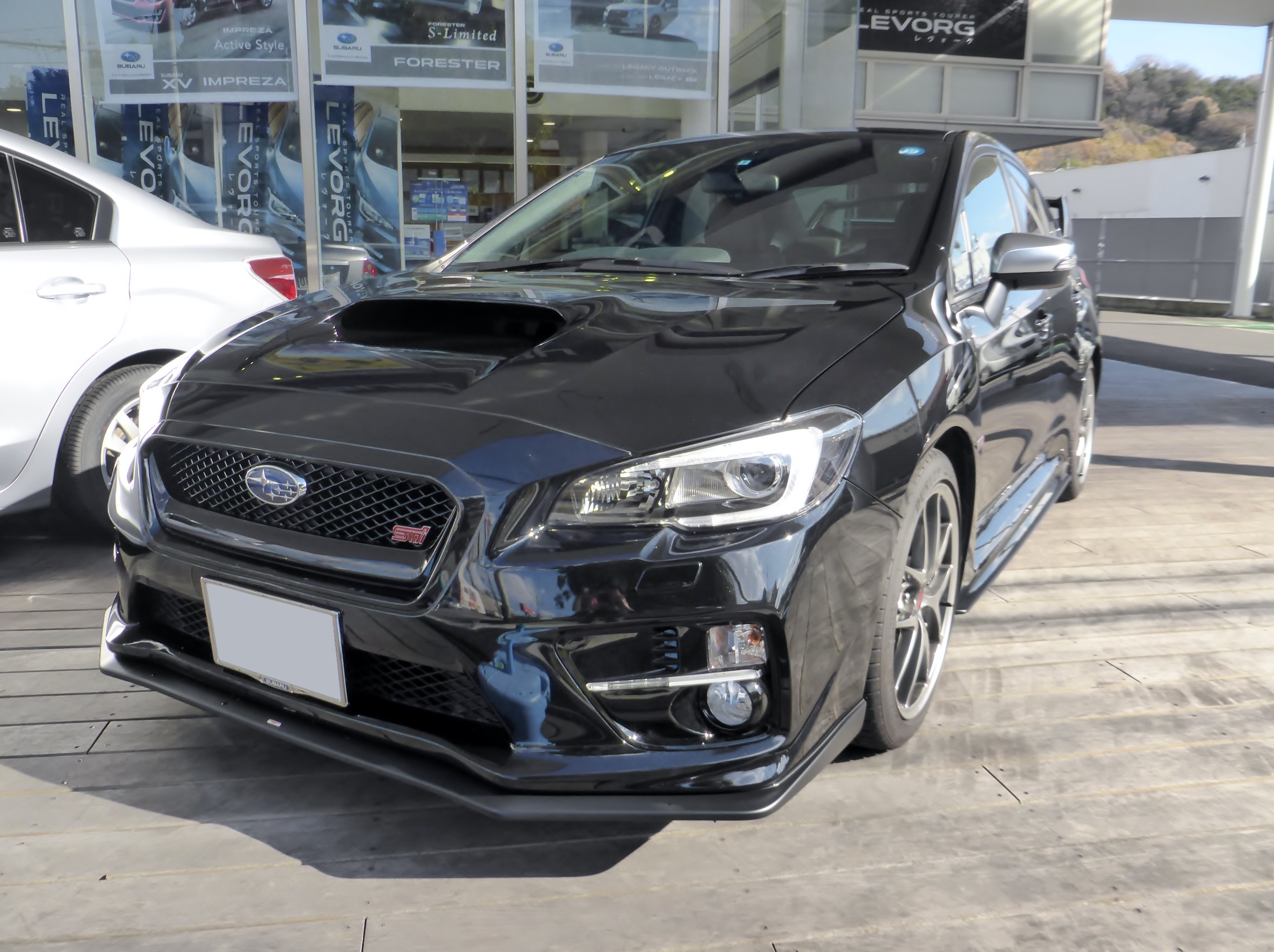
Subaru WRX STI Type S (VA) front · Tokumeigakarinoaoshima · CC0 1.0
Research pending
A matching completed auction sale has not been verified for this exact year, body, trim, engine, transmission and market.
Joyride shows this gap instead of substituting an asking price, unsold bid or mismatched special vehicle.
More than a set of wheels.
Subaru launched the all-new WRX STI in Japan on August 25, 2014 under the idea 'Pure Power in Your Control.' The company strengthened the body and suspension, added active torque vectoring, and kept the rally-influenced six-speed manual and DCCD hardware. This profile is the Japanese CBA-VAB Type S, not the base STI, the automatic WRX S4 or an export-market 2.5-litre STI.
Look a little closer.
Enthusiasts often call this the VA generation, but Subaru's exact Japanese model code for this STI Type S is VAB.
Photos show an example of the model or generation. The pictured vehicle’s year, equipment, or modifications can differ from the specification described here.
Control, not just power
The 308 PS output was only one part of the redesign. Subaru stiffened the body and steering, revised suspension geometry, added active torque vectoring and retained multi-mode DCCD so the driver could tune center-differential behavior for the road surface.
Source: Subaru · all-new WRX STI launched in Japan ↗A faster sedan that still works as a sedan
The wheelbase grew by 25 mm and Subaru used that increase for rear legroom. Larger door openings, a 60:40 folding rear seat and a larger trunk made the STI more practical without changing its 1,795 mm width.
Source: Subaru · all-new WRX STI launched in Japan ↗Where these facts come from
Selected facts checked for this edition. Some source pages link to broader model families. Last reviewed 2026-10-05.