
Rimac Concept_One
Rimac's production Concept_One used one electric motor for each wheel and software that adjusted every wheel's torque 100 times per second. It was a tiny Croatian company's proof that an electric car could be a hand-built hypercar, not just an efficient commuter.
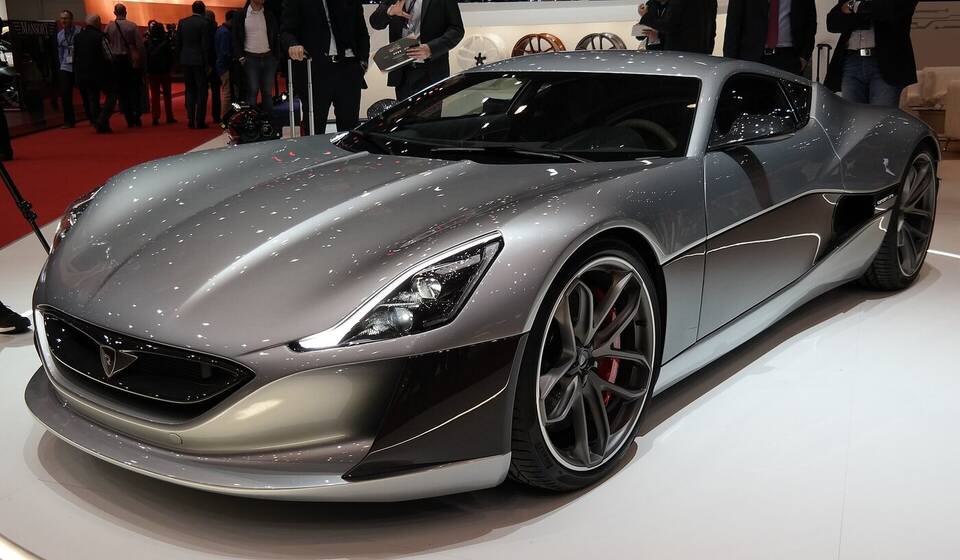
2016 Rimac Concept_One · Norbert Aepli, Switzerland (User:Noebu) · CC BY 4.0
Research pending
A matching completed auction sale has not been verified for this exact year, body, trim, engine, transmission and market.
Joyride shows this gap instead of substituting an asking price, unsold bid or mismatched special vehicle.
More than a set of wheels.
Mate Rimac began with a garage project and built a company around high-performance electric technology. After several development versions, Rimac unveiled the production Concept_One at the 2016 Geneva Motor Show. Only eight were planned. Its 82 kWh battery, four motors and in-house control software made the car both a finished road machine and a rolling display of technology Rimac could supply to other automakers.
Look a little closer.
The car gathered information from more than 500 sensors and could display or store telemetry, a bit like carrying a racing engineer inside the dashboard.
Photos show an example of the model or generation. The pictured vehicle’s year, equipment, or modifications can differ from the specification described here.
Production car, not the earlier concept
Rimac's 2016 production specification is 800 kW, 1,600 N·m, an 82 kWh battery, 1,850 kg and 355 km/h. Earlier 2011 publicity described a 92 kWh concept and different range/top-speed claims, while a 2017 update rose to 900 kW and 90 kWh. Joyride keeps those three stages separate.
Source: Rimac Newsroom — Concept_One production version ↗Four motors as a stability system
R-AWTV calculated wheel torque 100 times each second using chassis and suspension sensors. It could act as traction control, stability control and an electric form of ABS, while also allowing comfort, control, track and drift settings. The driver was not simply commanding one motor; software was coordinating four machines at once.
Source: Rimac Newsroom — All Wheel Torque Vectoring ↗Battery built for bursts of enormous power
The 82 kWh pack used 8,450 individually monitored cells and was designed to deliver up to 1,000 kW during acceleration and absorb up to 400 kW under regenerative braking. Liquid thermal management helped control heat. Those are Rimac engineering figures, not independent track measurements.
Source: Rimac Newsroom — Concept_One production version ↗Where these facts come from
- Rimac Newsroom — Concept_One production version
- Rimac Newsroom — All Wheel Torque Vectoring
- Rimac Newsroom — 2017 Geneva specification comparison
Selected facts checked for this edition. Some source pages link to broader model families. Last reviewed September 30, 2026.