
Wuling Hong Guang MINI EV
A tiny four-seat electric car built for crowded Chinese cities, the 2020 Hong Guang MINI EV paired a 120 km NEDC rating with home-style AC charging and a price that brought new-car electric driving within reach of many families.
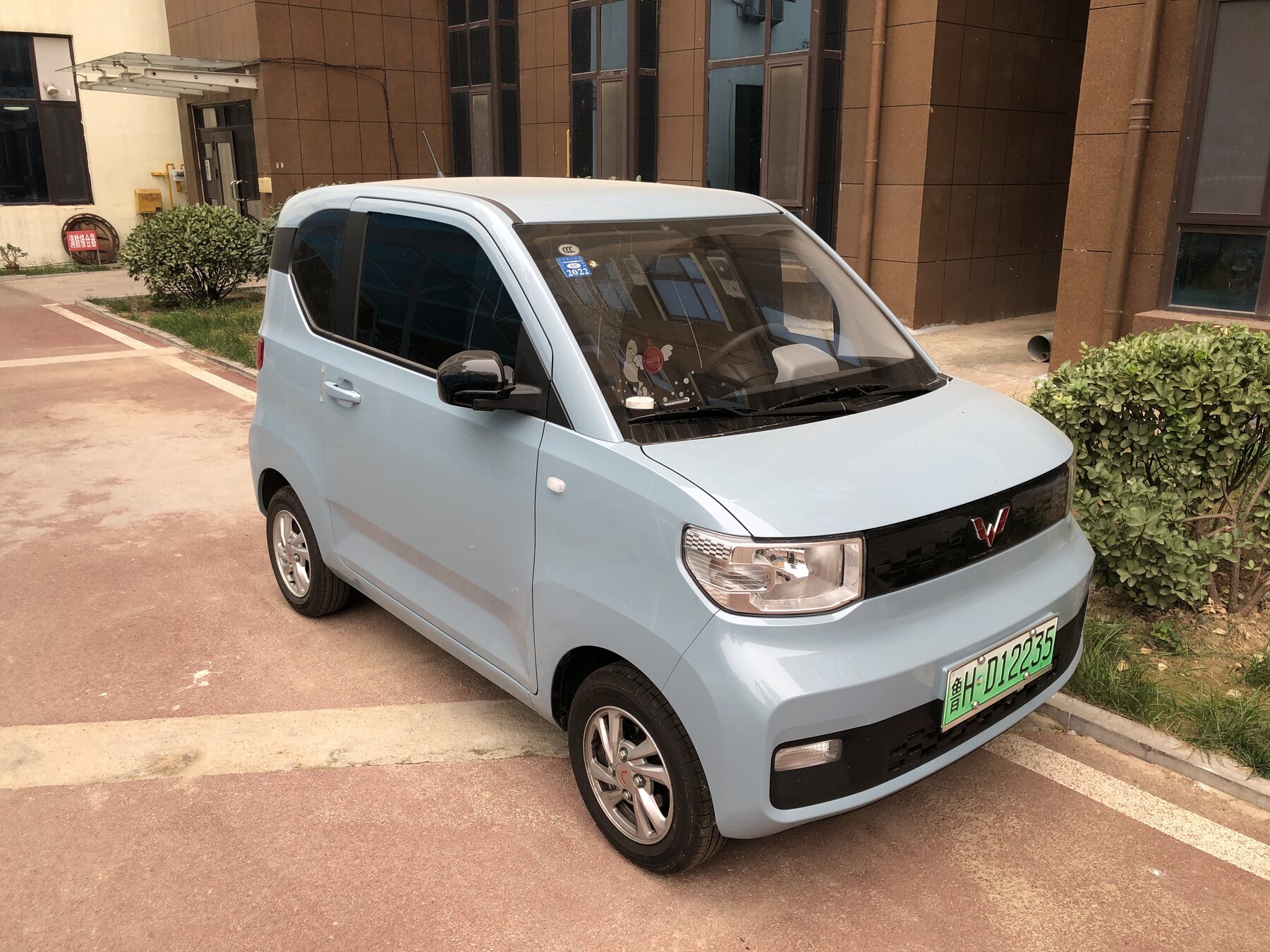
2020 Wuling Hong Guang MINI EV launch-body representative · David290 · CC BY-SA 4.0
Research pending
A matching completed auction sale has not been verified for this exact year, body, trim, engine, transmission and market.
Joyride shows this gap instead of substituting an asking price, unsold bid or mismatched special vehicle.
More than a set of wheels.
Wuling launched the Hong Guang MINI EV in China in July 2020 as its first battery-electric model. The little two-door car was only 2,917 mm long, yet its tall, boxy cabin made room for four seats. This profile covers the launch-series 120 km version, not the larger-battery 170 km car or later Macaron and long-range updates. A 20 kW electric motor was modest on paper, but an EV motor can begin pulling as soon as it turns, which suited short trips and gaps in city traffic. The small battery could recharge from an AC supply in about 6.5 hours, while the car's 100 km/h rated maximum speed kept its mission focused on urban and nearby travel. The 120 km number came from China's NEDC laboratory cycle, so it belongs with its test label rather than being treated as a promise for every road, temperature and driving style.
Look a little closer.
At only 2,917 mm long, the launch MINI EV still made room for four seats by using a tall, boxy body rather than a long bonnet.
Photos show an example of the model or generation. The pictured vehicle’s year, equipment, or modifications can differ from the specification described here.
What the 120 km label really means
Range ratings are comparison tools, not magic promises. Wuling's 120 km figure came from the NEDC laboratory cycle used in China at the time. A laboratory follows a fixed pattern so two vehicles can be compared, but a real trip can use more energy because of cold weather, steep roads, high speed, cabin heating or repeated hard acceleration. The small battery was roughly 9.2–9.3 kWh depending on the source's nominal-capacity convention. That is why a 6.5-hour AC recharge could be reasonable even without rapid charging: there was far less energy to refill than in a large long-range EV. For Joyride, every appearance of 120 km should retain the NEDC label, and the page should avoid converting it into an unqualified everyday-driving promise.
Source: Wuling Hongguang Mini EV Review ↗A city car shaped like useful space
At 2,917 mm long, the launch MINI EV was shorter than many cars' wheelbases plus overhangs, but its roof stood 1,621 mm high. The boxy outline used that height for people instead of stretching a long nose or tail. Four seats did not turn it into a large family car—rear access still required folding a front seat—but they made it more flexible than a one- or two-seat microcar. The 20 kW motor and 100 km/h maximum speed also reveal the engineering priority: simple urban movement rather than motorway performance. Its significance came from combining this compact package with launch prices beginning below RMB 30,000, not from pretending it could do every job a larger EV could.
Source: Wuling Hong Guang MINI EV officially launches in three versions ↗Where these facts come from
- GM Delivers 2.9 Million Vehicles in China in 2020
- Wuling Hong Guang MINI EV officially launches in three versions
- Recommended New-Energy Vehicle Catalogue entry for Wuling LZW7004EVPKAK
- Wuling Hongguang Mini EV Review
- Hong Guang MINI EV 170/120 km information
- Hong Guang MINI EV Classic specifications
- File: 五菱宏光mini EV 9732 1.jpg
Selected facts checked for this edition. Some source pages link to broader model families. Last reviewed October 3, 2026.