
Audi quattro
Audi fitted a light, compact permanent four-wheel-drive system into a fast road coupé—and showed that four driven wheels could help a car on pavement as well as mud or snow.
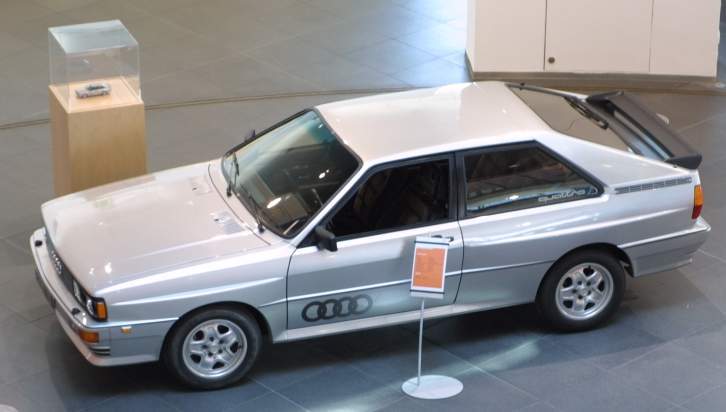
1980 Audi quattro · Thorsten Weber (Wikimedia user Heierlon) · Public domain
Research pending
A matching completed auction sale has not been verified for this exact year, body, trim, engine, transmission and market.
Joyride shows this gap instead of substituting an asking price, unsold bid or mismatched special vehicle.
More than a set of wheels.
Audi unveiled the quattro at the Geneva Motor Show in March 1980. Four-wheel drive was already familiar in off-road vehicles, but Audi's compact system made it practical in a production performance coupé. The launch car combined a turbocharged, intercooled five-cylinder engine with a five-speed manual gearbox and manually lockable center and rear differentials. It produced 147 kW / 200 PS, could reach 222 km/h, and stayed in production through 1991. This page deliberately covers the original 1980 European specification; later Torsen-equipped and larger-engine quattros are different versions.
Look a little closer.
The launch quattro was only 4,404 mm long—shorter than many modern family sedans—yet it carried a 200 PS turbo engine, permanent all-wheel drive and four usable seats. Its idea later spread across Audi's model range instead of remaining a one-off rally trick.
Photos show an example of the model or generation. The pictured vehicle’s year, equipment, or modifications can differ from the specification described here.
The clever hollow shaft
Engineer Franz Tengler's hollow-shaft layout routed power to the center differential and back to the front axle through the same compact space. That avoided the heavy separate transfer box common in four-wheel-drive trucks.
Source: Audi MediaCenter · 40 years of quattro ↗Road car first, rally legend next
The production coupé appeared at Geneva in 1980; Audi entered the World Rally Championship with quattro the following year. Competition proved the traction advantage and helped make permanent all-wheel drive central to Audi's identity.
Source: Audi · history of the Four Rings ↗Traction became an everyday safety tool
The quattro did more than launch quickly. Sending power to four tires gave the car more opportunities to find grip on wet or slippery roads. Audi says the system's success helped all-wheel drive move from one special coupé into many of its other model lines.
Source: Audi · ascent to the premium segment ↗A compact system made the idea practical
Audi's hollow-shaft layout let one gearbox distribute power in both directions without adding a truck-style transfer case beside it. That kept the driveline compact enough for a low road car and helped avoid unnecessary weight and complexity.
Source: Audi USA · the history of Audi quattro ↗Why the exact year matters
Early cars used manual switches for the center and rear differential locks. Later quattros gained different control hardware and eventually larger engines, so those later specifications should not be mixed into this 1980 launch-car page.
Source: Audi Switzerland · 40 years of quattro ↗The turbo five arrived one year before quattro
Audi introduced its first turbocharged five-cylinder gasoline engine in the Audi 200 5T in 1979, where it produced 125 kW and 265 N·m. For the original 1980 quattro, Audi combined turbocharging with an intercooler and permanent all-wheel drive; output rose to 147 kW. That sequence shows how the launch car joined an evolved production engine to the new compact driveline rather than beginning as an isolated racing special.
Source: Audi · 50 years of the Audi five-cylinder ↗The body began with the Audi Coupé B2
Audi says the launch quattro body was based on the Audi Coupé B2, which itself was based on the Audi 80. The quattro was visually separated by flared fenders, bulkier bumpers and sills, and a larger rear spoiler. That makes Audi's Geneva photograph useful evidence for the exact launch appearance, while the source does not establish the market specification or originality of later surviving cars.
Source: Audi · quattro B2, model year 1980 at Geneva ↗The rally results followed the road-car debut
Audi took quattro into the World Rally Championship in 1981. Hannu Mikkola delivered its first WRC victory at the Swedish Rally, and Michèle Mouton won Sanremo that year. Audi then won the 1982 manufacturers' title and Mikkola the 1983 drivers' title. Those results explain the road car's reputation, but they do not transfer rally-car power, weight, bodywork or sound to the 1980 production specification.
Source: Audi · company history ↗A five-cylinder rhythm all its own
Audi gives the inline-five's firing order as 1-2-4-5-3 and says that unusual sequence creates its characteristic sound. The numbers are the order in which the five cylinders take their power strokes. The original quattro did not invent Audi's five-cylinder: the family began in the Audi 100 in 1976, gained a gasoline turbo in the Audi 200 5T in 1979, and then combined turbocharging, intercooling and permanent all-wheel drive in the 1980 quattro. That makes the launch car an important meeting point for two already developing Audi ideas, not a one-off racing engine dropped into an unrelated body.
Source: Audi · 50 years of the Audi five-cylinder ↗Eleven years, but only 11,452 cars
Audi Japan records production from March 1980 through May 1991 and a total of 11,452 cars. That long calendar span can be misleading: the quattro remained a comparatively rare specialist coupé while Audi kept improving it. Across the full run, displacement and output eventually grew, so a surviving car from the late 1980s can look familiar while carrying different engine, differential, dashboard and trim details. Joyride therefore keeps the launch specification separate: the exact production total belongs to the whole original generation, but the later 2,226 cc and 220 PS figures do not belong in the 1980 technical table.
Source: Audi Japan Press Center · Audi quattro, 1980 ↗What the driver-controlled locks were for
A differential normally lets connected wheels or axles rotate at different speeds, which a car needs when it turns. On very slippery ground, though, that freedom can let power follow the easiest path toward a spinning wheel. The early quattro gave the driver manual locks for the center and rear differentials, helping those connected parts turn together when extra traction was needed. Audi's period history specifically links the two manually lockable differentials with strong performance on slippery surfaces. This should not be confused with the self-acting Torsen center differential that arrived on later quattros.
Source: Audi Japan Press Center · Audi quattro, 1980 ↗Why Audi chose five cylinders
Audi wanted more performance for the second-generation Audi 100 than its existing four-cylinder engines could provide, but the company says an inline-six was rejected because it needed too much installation space and would have harmed weight distribution. Engineers instead extended the EA 827 four-cylinder concept into an inline-five. The resulting 2,144 cc family first reached customers in the Audi 100 5E, then gained turbocharging in the Audi 200 5T before the 1980 quattro added an intercooler and permanent all-wheel drive. For a young reader, the important lesson is that the quattro's engine was not chosen merely for an unusual sound: five cylinders helped Audi fit stronger performance into a compact front-engine package. The source describes the engine-family development; it does not mean every component in the quattro was identical to the earlier Audi 100 engine.
Source: Audi · 50 years of the Audi five-cylinder ↗A near-launch cabin survives in Japan
A 2024 photograph shows the cockpit of a 1981 Series 1 Audi Quattro preserved at the Toyota Automobile Museum. Seen through the side glass, it gives Joyride an early-generation cabin reference to place beside the existing 1990 20V cockpit image. The view is especially useful because it shows how different an early analog dashboard and steering-wheel area look from the later digital-display car already in the gallery. The file page identifies the museum car as a 1981 two-door fastback and Series 1, but does not state its chassis number, original sales market, engine code, trim provenance or restoration history. Joyride should therefore label it as a surviving early-version reference, not proof that every visible cabin detail was fitted to every 1980 launch car.
Source: Wikimedia Commons · 1981 Series 1 Audi Quattro cabin at Toyota Automobile Museum ↗Preserved as a new kind of car
Toyota Automobile Museum groups its 1981 Audi Quattro in Zone 12, called “Birth of New Vehicle Types.” That curatorial choice helps explain the car's significance: it was not simply another fast coupé, but an example of a category-changing idea that used permanent all-wheel drive in a road-performance shape. A second CC0 photograph shows this museum car from the rear-left, adding a clear surviving early-version exterior view without pretending it is the exact 1980 Geneva display car. Toyota's exhibit listing confirms the model and year, while the Commons page identifies this photographed specimen as a Series 1 two-door fastback. Neither source authenticates every visible trim, wheel or restoration detail, so those remain visual context rather than launch-specification evidence.
Source: Toyota Automobile Museum · Zone 12, Birth of New Vehicle Types ↗The snowy comparison that changed the brief
The quattro idea began before the famous white coupé existed. Audi's official Finnish history places the spark in Muonio, Finnish Lapland, during the winter of 1976–1977. Engineers were testing in deep snow with a Volkswagen Type 183 Iltis as the comparison vehicle. The Iltis had much less road-car glamour, but its four driven wheels and high ground clearance let it outperform more powerful front-wheel-drive prototypes in those conditions. The lesson was not simply to copy an off-roader. Audi says the new passenger-car system had to be light, compact and efficient, without the heavy transfer case or second propeller shaft then associated with four-wheel-drive trucks. That engineering brief explains why the 1980 quattro mattered: the breakthrough was packaging useful all-wheel drive inside a fast, low coupé that people could use on ordinary roads.
Source: Audi Finland · quattro history ↗A small team turned the idea into a production project
An Audi archive photograph identifies project leader Walter Treser and says twelve engineers supported him from February 1977 in developing Audi's first car with permanent quattro drive. That number does not mean only twelve people ever touched the finished car; it documents the focused early project team. For young readers, it is a useful reminder that a landmark vehicle begins as a chain of practical problems: how to route the power, keep the system compact, test it in difficult weather and make it reliable enough for series production. Less than three years after that team formed, Audi showed the production quattro at Geneva in March 1980.
Source: Audi · 12-engineer quattro project team, February 1977 ↗The car was nearly called Carat
Walter Treser also had to give the project a name. Audi Finland says one proposal was Carat, an abbreviation for Coupé All-Wheel-Drive Turbo. A perfume already used that name, which did not fit the image Audi wanted for the car, so Treser developed the name Audi quattro instead. The Italian word means “four,” and Audi deliberately writes the model and drive name with a lower-case q. The naming story is fun, but it also shows how completely the technology and the car became linked: the first production coupé made quattro a word people could recognize long after the original model left production.
Source: Audi Finland · quattro history ↗Where these facts come from
- Audi · ascent to the premium segment
- Audi · quattro B2 1980
- Audi MediaCenter · 40 years of quattro
- Audi · history of the Four Rings
- Audi USA · the history of Audi quattro
- Audi Switzerland · 40 years of quattro
- Audi · 50 years of the Audi five-cylinder
- Audi · company history
- Audi Japan Press Center · Audi quattro, 1980
- Toyota Automobile Museum · Zone 12, Birth of New Vehicle Types
- Audi Finland · quattro history
- Audi · 12-engineer quattro project team, February 1977
Selected facts checked for this edition. Some source pages link to broader model families. Last reviewed September 30, 2026.