
BMW M1 (E26) road car
BMW Motorsport's first clean-sheet road car put a racing-bred straight-six behind the seats and wrapped it in a low Giugiaro shape.
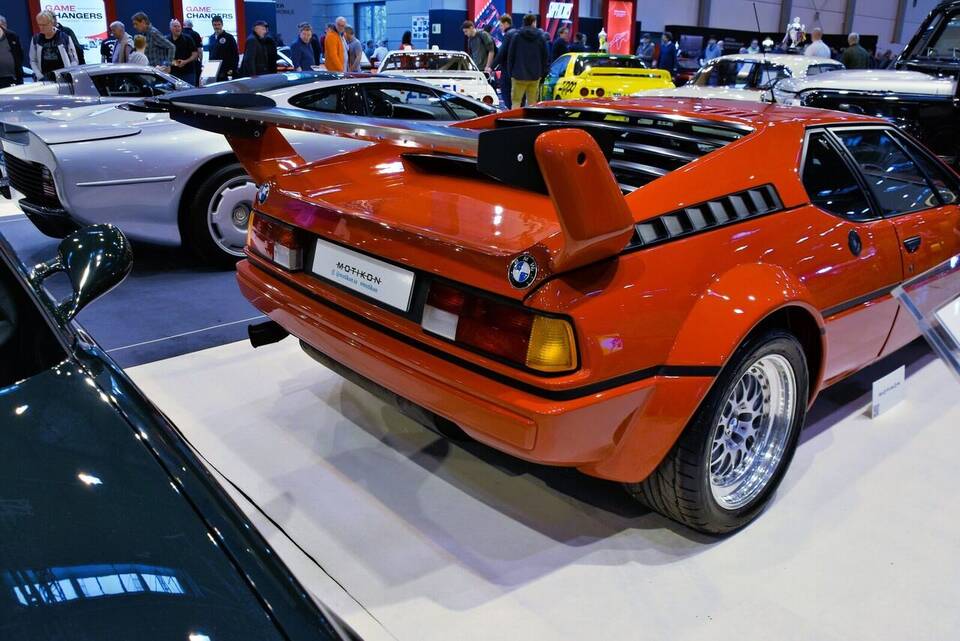
BMW_M1_(E26,_1980)_(52858728204).jpg · Charles from Port Chester, New York · CC BY 2.0
Research pending
A matching completed auction sale has not been verified for this exact year, body, trim, engine, transmission and market.
Joyride shows this gap instead of substituting an asking price, unsold bid or mismatched special vehicle.
More than a set of wheels.
BMW Motorsport planned the M1 as a Group 4 racing car that also had to exist as a street-legal series of at least 400 cars. Giorgetto Giugiaro shaped the low coupé from ideas previewed by BMW's 1972 Turbo concept. Production became a cross-border relay—spaceframe and body work in Italy, final mechanical assembly by Baur in Stuttgart—after Lamborghini could not complete the job. The road M1 nevertheless arrived at the 1978 Paris Motor Show with 277 bhp, a usable cabin and performance that made it Germany's fastest road-going sports car of its moment.
Look a little closer.
Its two fuel tanks each held 58 litres and sat on opposite sides ahead of the rear axle.
Photos show an example of the model or generation. The pictured vehicle’s year, equipment, or modifications can differ from the specification described here.
Homologation created a road supercar
Group 4 rules required at least 400 related cars within 24 months. That turned a racing programme into a two-seat road model, forcing BMW Motorsport to prove crash safety and make the M1 usable away from a circuit as well as fast on one.
Source: BMW Group PressClub · Thirty years of the BMW M1 ↗A European production relay
The steel spaceframe came from Marchesi, the glass-fibre-reinforced body from T.I.R., and ItalDesign joined those parts and fitted the interior. Baur in Stuttgart then installed the mechanical systems. The complicated route explains why the M1 story is as much about manufacturing rescue as raw performance.
Source: BMW Group Classic · M1 model-series history ↗Where these facts come from
- BMW Group Classic · BMW M1 road car
- BMW Group Classic · M1 model-series history
- BMW Group PressClub · Thirty years of the BMW M1
- RM Sotheby's · 1981 BMW M1 road-car production context
Selected facts checked for this edition. Some source pages link to broader model families. Last reviewed 2026-10-01.