
Bugatti Type 35
The first Type 35 treated light weight, balance and beautiful shapes as parts of the same engineering problem—and changed racing-car design.
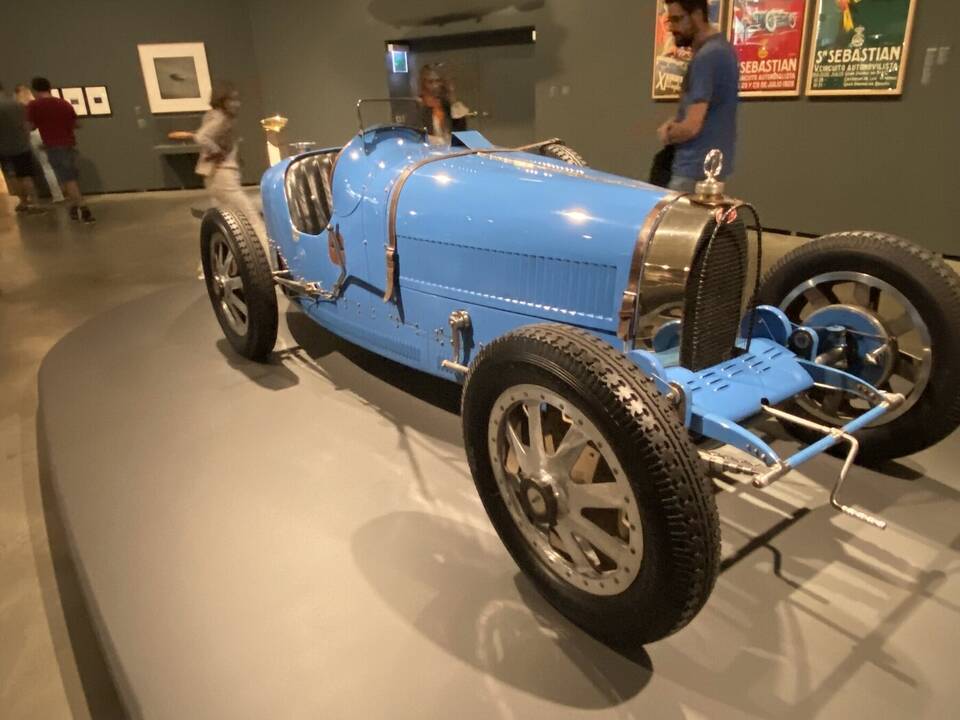
Bugatti Type 35 chassis 4325 · Kuroczynski · CC BY-SA 4.0
Research pending
A matching completed auction sale has not been verified for this exact year, body, trim, engine, transmission and market.
Joyride shows this gap instead of substituting an asking price, unsold bid or mismatched special vehicle.
More than a set of wheels.
Bugatti entered five new Type 35s in the French Grand Prix at Lyon on August 3, 1924. This page follows that original 1,991 cc naturally aspirated car, not the later simpler 35A, enlarged 35T, supercharged 35C or 2.3-litre 35B.
Look a little closer.
Its cast-aluminium wheels also contained the brake drums, combining jobs and reducing weight where spinning wheels make every gram matter.
Photos show an example of the model or generation. The pictured vehicle’s year, equipment, or modifications can differ from the specification described here.
A difficult debut did not end the idea
Tyre failures hurt the Type 35 team at Lyon, but the new aluminium wheels survived running on damaged tyres. Bugatti studied the failure, changed tyre specification and kept developing the car instead of abandoning it.
Source: Bugatti · the making of a champion ↗Lightness in every direction
The hollow front axle, dipped rear axle, aluminium-panelled body and engine used as a stressed chassis member helped keep the car to about 750 kg. Low mass made the Type 35 agile without chasing power only through a giant engine.
Source: Bugatti · a century of Type 35 engineering ↗Where these facts come from
- Bugatti · the making of a champion
- Bugatti · a century of Type 35 engineering
- The Bugatti Trust · Type 35 / 35B / 35C / 35T data
Selected facts checked for this edition. Some source pages link to broader model families. Last reviewed September 30, 2026.