
Ducati 916
Twin headlights, exhausts tucked under the tail and an exposed rear wheel gave Massimo Tamburini’s 916 a shape that followed its engineering.
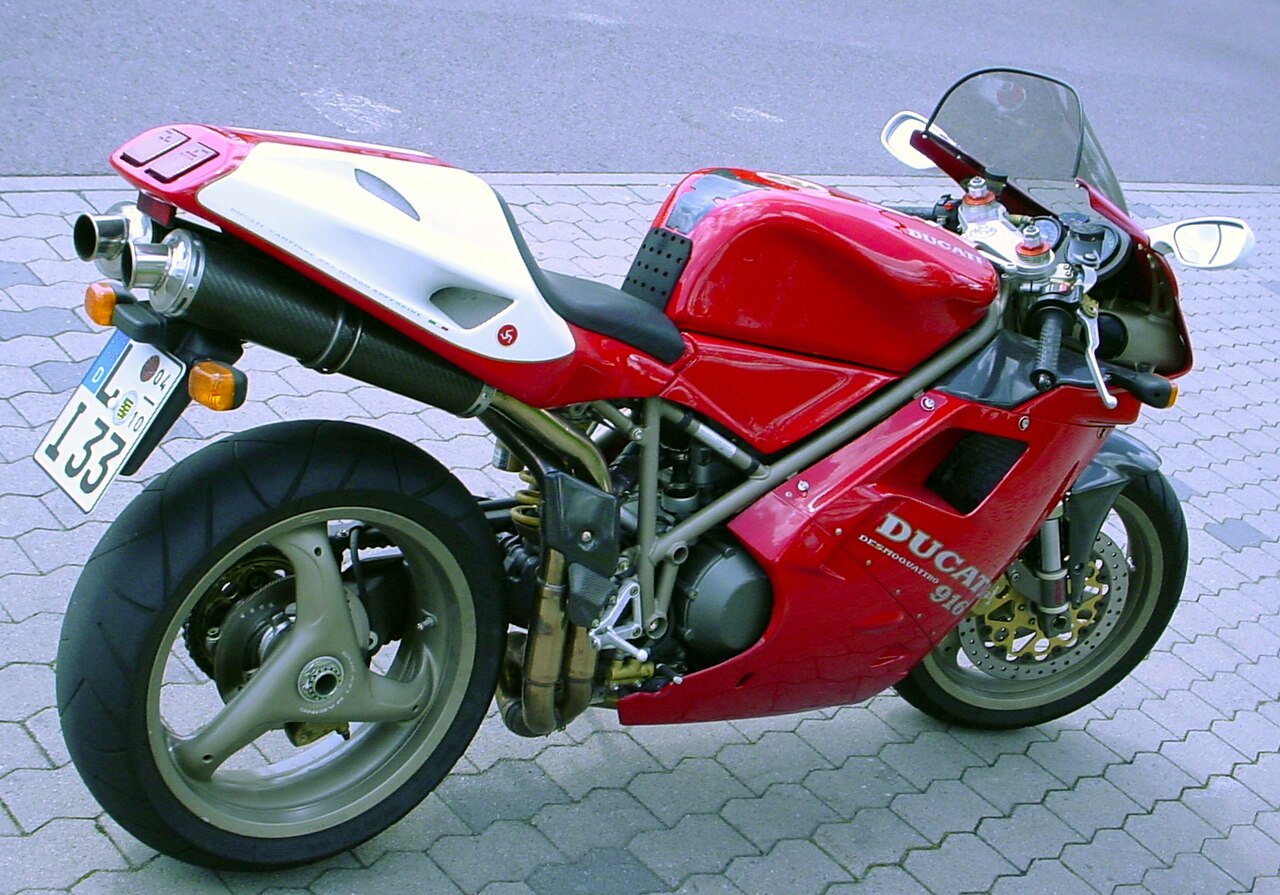
Ducati916.jpg · Deko4you · CC BY-SA 3.0
Research pending
A matching completed auction sale has not been verified for this exact year, body, trim, engine, transmission and market.
Joyride shows this gap instead of substituting an asking price, unsold bid or mismatched special vehicle.
More than a set of wheels.
Ducati introduced the 916 for 1994 after the 851 and 888 had established its modern superbike formula. Tamburini developed a compact new motorcycle around an evolved twin-cylinder engine. Its styling became famous, but the chassis, airbox and service access also changed substantially. This profile follows the standard road motorcycle rather than one of the more powerful competition or special variants.
Look a little closer.
Ducati recounts that Tamburini studied rainwater tracks on prototype bodywork to learn how air moved around the motorcycle.
Photos show an example of the model or generation. The pictured vehicle’s year, equipment, or modifications can differ from the specification described here.
The airbox uses the fuel tank as a wall
The 916 did not simply hide a separate airbox beneath its tank. The contemporary test describes a molded lower tray with the tank’s underside completing the enclosure. Two front scoops supplied air through individual filters. Several neighboring parts therefore cooperated to make one working space, an example of how tightly the new motorcycle was packaged.
Source: Cycle World · Ducati 916 road and track test, July 1994 ↗Rain leaves clues on the bodywork
Ducati describes Tamburini riding evolving prototypes in rain and studying the water trails left across their surfaces. Those streaks gave visible clues to the way air traveled around the bodywork. The account makes the 916’s shape easier to understand: its designer repeatedly examined a working motorcycle, adjusting the surfaces as the prototype developed instead of treating the fairing as a finished drawing.
Source: Ducati Heritage · 916 ↗Where these facts come from
Selected facts checked for this edition. Some source pages link to broader model families. Last reviewed 2026-10-02.