
Ford Bronco Wagon
A short, square all-purpose vehicle with coil-spring front suspension and four driven wheels.
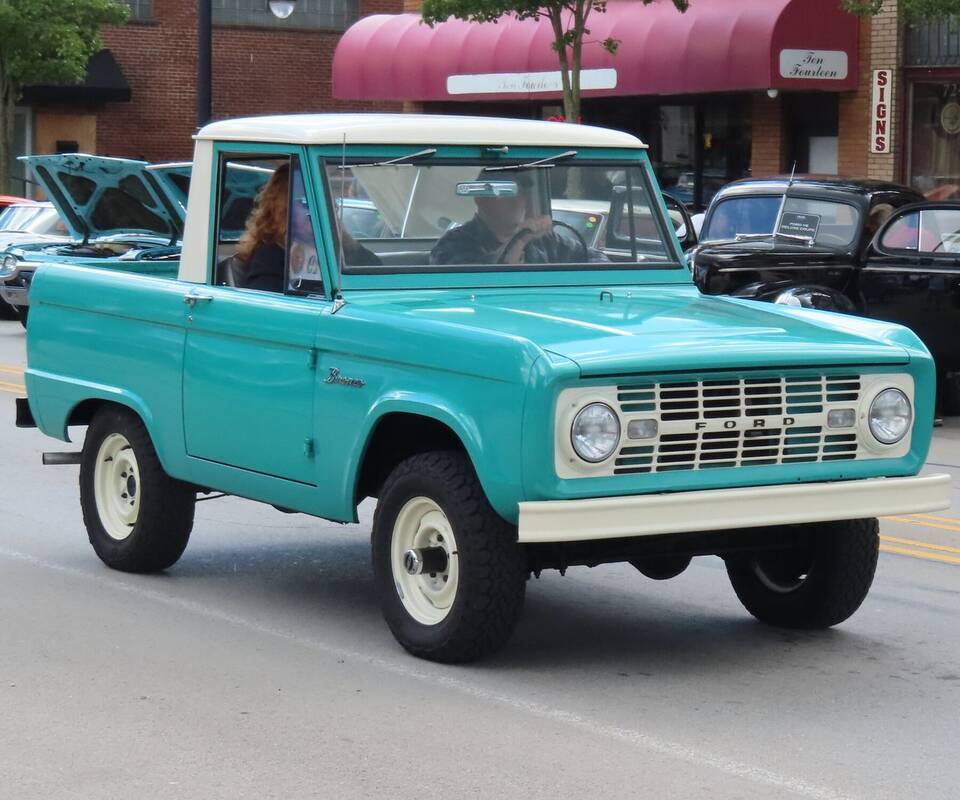
1966 Ford Bronco Sports Utility half-cab photographed in Pennsylvania. · MercurySable99 · CC BY-SA 4.0 International
Research pending
A matching completed auction sale has not been verified for this exact year, body, trim, engine, transmission and market.
Joyride shows this gap instead of substituting an asking price, unsold bid or mismatched special vehicle.
More than a set of wheels.
Ford introduced the Bronco in August 1965 for the 1966 model year. Roadster, Sport Utility pickup and enclosed Wagon bodies shared the same compact chassis. This page follows the Wagon with the standard six-cylinder engine, not a later V8 swap or a modern Bronco.
Look a little closer.
The Wagon's full-length roof and upper sides were bolted on, so owners could remove them with tools.
Photos show an example of the model or generation. The pictured vehicle’s year, equipment, or modifications can differ from the specification described here.
Three bodies, one new idea
Ford called Bronco an all-purpose vehicle. The open Roadster, short-roof Sport Utility and enclosed Wagon let buyers choose farm work, outdoor recreation or weather protection without changing the basic 92-inch-wheelbase chassis.
Source: Ford Motor Company · The Ford Bronco ↗Why the front used coils
Many rugged vehicles used leaf springs at both ends. Bronco's radius-arm, coil-spring front suspension was designed to combine axle strength with useful wheel movement and a smoother ride. Its short wheelbase also helped the vehicle turn in tight spaces.
Source: Ford · First-generation Bronco history ↗Where these facts come from
- Ford Motor Company · The Ford Bronco
- Ford · First-generation Bronco history
- Ford · 1966 Bronco announcement
- Ford · 1966 Bronco brochure
Selected facts checked for this edition. Some source pages link to broader model families. Last reviewed September 29, 2026.